
Revision summary
Religious communities produce diversity through worship, kinship, law, education and neighbourhoods. Hindu sects, Muslims, Christians, Sikhs, Jains, Buddhists, Parsis and tribal religions each add institutions. Articles 25–30 protect this as a constitutional plurality. Caste-like ranking and communal conflict mean diversity is stratified. Personal law is both a cultural contribution and a gender problem.
Model answer
Copper italics in this answer — like this — are the key facts. Each one is unpacked in the Facts & figures rail.
Introduction
India’s cultural diversity is not a food festival. It is a living arrangement of languages, kinship rules, worship, law and neighbourhoods that religious communities have historically produced. M. N. Srinivas’s local and all-India Hinduism, T. N. Madan on religious identity, and Imtiaz Ahmad on Muslim caste-like stratification show communities as social structures, not only as belief. They contribute diversity by keeping different public worlds in one political territory.
Body
What communities contribute
- Hindu society itself is internally diverse: Shaiva, Vaishnava, Shakta, Bhakti regional cultures, and jati custom. That internal plurality is a community contribution, not a homogeneous bloc. Muslim communities added Persian-Arabic literacy, Sufi shrines that overlap Hindu pilgrimage geographies, distinct kinship (including cousin marriage in many groups), and a personal-law tradition. Christians—Syrian, Latin, tribal and Dalit Christians—added schools, hospitals and new associational forms, especially in the South and Northeast. Sikhs institutionalised sangat, langar and a distinct script and law. Jains and Buddhists (including Ambedkarite Navayana) shaped ethics of ahimsa, urban mercantile trust, and a modern anti-caste religion. Parsis left a dense urban civic footprint in Bombay. Tribal sarna, donyi-polo and related practices keep non-Sanskritic sacred geographies that the Forest Rights struggle also defends.
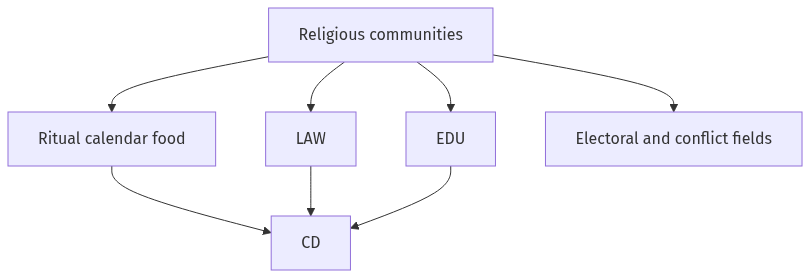
Diversity appears in calendar and cuisine, in architecture, in music, and in family law. The Constitution’s Articles 25–30 protect profession, practice, institutions and minority education. That legal pluralism is itself a contribution: communities run schools, waqf, gurdwaras and maths as public-cultural infrastructure.
Contribution is not only harmony
Communities also contribute hierarchy and conflict. Caste among Hindus, and caste-like ranking among Muslims and Christians, structure diversity as inequality. Communal riots, temple-mosque disputes, and anti-conversion politics show diversity as a field of power. Ashis Nandy and others distinguished religion as faith from religion as ideology; sociology must keep both. Personal laws can protect cultural difference and freeze gender inequality. Uniform civil code debates are therefore debates about how much diversity the family may carry.
Religious communities also translate into electoral blocks, which is diversity entering democracy (Kothari’s Congress system and its later fragmentation). The contribution to culture is then inseparable from the contribution to politics.
- Everyday diversity is also neighbourhood-level: a dargah sharing a qasba with a temple, a Kerala church calendar beside Onam, a Punjab gurdwara langar that feeds across faith while caste can still appear in who cooks. S. C. Dube’s village studies and later urban ethnography show syncretism and boundary-making as twins. Festivals become public culture on television; that is contribution as well as commodification. Diaspora temples and mosques then export Indian diversity and sometimes a harder identity than the mixed street at home.
- A fair account says: without these communities there is no Indian cultural diversity as we know it; with them, diversity is stratified and sometimes violent. The sociological task is to describe both.
Flow diagram
Conclusion
Religious communities contribute India’s cultural diversity by institutionalising different languages of worship, kinship, education and law inside one state. They also organise inequality and conflict. Diversity here is a structured plurality, not a slogan of automatic tolerance.
Quick related
Students also ask
-
How do you account for the increasing significance of religion in public and personal spheres in the context of secularization thesis in India?
Next question on this syllabus topic (2023 · Q6(a)). View answer →
-
Is Indian diversity only religious?
No. Language, region and jati cut across religion. Religion is one major producer of public cultural worlds.
-
Do communities only preserve the past?
They also invent: reform sects, new temples, televised ritual, and Ambedkarite Buddhism are modern contributions.
Same topic · past papers
UPSC has asked this before
These previous-year questions sit on the same topic. Open one to practise the earlier ask.
-
2021 · Q1(e) · Sociology GS 2 · 10 marks
Caste-like formations are present in Non-Hindu religious communities as well. Discuss with examples -
2023 · Q5(b) · Sociology GS 2 · 10 marks
Examine the concept of 'Cultural Pluralism' in the context of India's Unity in Diversity
More from this topic
Q1(e) · UPSC Mains 2026 · Sociology GS 2 · 10 marks · Solution
How does the concept 'secular' go beyond any religion in plural society like India? Analyse.
Religion and Society
This model answer examines how Indian secularism, distinct from Western models of strict church-state separation, embraces 'Sarva Dharma Sambhava' and principled distance. It highlights how the Indian state maintains neutrality while actively reforming social evils across religious lines. The answer incorporates sociological perspectives on pluralism, constitutional provisions, and judicial precedents to show how secularism safeguards minority rights while fostering national integration.
Q1(d) · UPSC Mains 2026 · Sociology GS 2 · 10 marks · Solution
Discuss the debates on the concepts 'duty' and 'worship' while understanding religion in India.
Religion and Society
This 10-marker for UPSC Mains GS I / Sociology Paper II unpacks the sociological and philosophical debates surrounding 'duty' (Dharma/Karma) and 'worship' (Bhakti/Rituals) in Indian religion. It highlights how duty translates into ethical action and social order, while worship spans emotional devotion and ritualistic orthodoxy. The answer balances classical textual traditions with subaltern and reformist critiques, supported by a clear Mermaid flowchart and essential sociological perspectives.
Q6(a) · UPSC Mains 2023 · Sociology GS 2 · 20 marks · Solution
How do you account for the increasing significance of religion in public and personal spheres in the context of secularization thesis in India?
Religion and Society
Hard secularization expected religion to shrink with modernisation. India combined a secular constitutional state with louder public and personal faith. The Rudolphs and Yogendra Singh explain religious groups as modern organisations and recast traditions. Democracy, personal law and media keep religion public; kinship keeps it personal. The useful model is recasting and principled distance, not disappearance.