
Revision summary
Hard secularization expected religion to shrink with modernisation. India combined a secular constitutional state with louder public and personal faith. The Rudolphs and Yogendra Singh explain religious groups as modern organisations and recast traditions. Democracy, personal law and media keep religion public; kinship keeps it personal. The useful model is recasting and principled distance, not disappearance.
Model answer
Copper italics in this answer — like this — are the key facts. Each one is unpacked in the Facts & figures rail.
Introduction
The secularization thesis, in its hard European form, expected modernisation to shrink religion into a private hobby. India modernised its state, markets, and elections while religion grew louder in both public and personal life. The account is not that Indians failed to become modern. It is that Indian modernity uses religion as organisation and meaning.
Body
The thesis and the Indian mismatch
- Classical secularization linked industry, science, and the nation-state to a decline of church power and of everyday ritual.
- India built a secular Constitution in the sense of no established church and equal citizenship, not in the sense of a religion-free public.
- T. N. Madan and Ashis Nandy, in different tones, argued that forcing a Western private-religion model misunderstands South Asian faith as total social life.
Why religion is more public
- The Rudolphs showed traditional religious groups becoming interest groups: trusts, parties, and pilgrimage economies are modern associations.
- Yogendra Singh’s heterogenetic and orthogenetic change recasts faith through print, television, and now social media rather than deleting it.
- Electoral democracy rewards religious blocs; the sacred calendar is also a campaign calendar.
- Courts, personal law, and temple-mosque disputes keep theology in the state’s living room.
- Urban anonymity did not end caste-linked ritual; it often produced louder public festivals and televised gurus.
Why religion is more personal as well
- Marriage, food, and mourning remain faith-marked; market bio-data still lists community.
- New middle-class piety, pilgrimage packages, and household gods on phones intensify personal practice even among the credentialed, which Beteille’s split middle class helps locate.
- Dumont’s hierarchy is weaker in a factory, yet purity and festivity return in the home and the wedding.
A better Indian formulation
- Rajeev Bhargava’s principled distance is closer to Indian constitutional practice than a vanishing of the sacred.
- A. R. Desai would still ask when public religion is ideology covering class and majoritarian power.
- Increasing significance is therefore compatible with hospitals and software parks: those are not evidence that the thesis was fulfilled.
Limits of the ‘increase’ story
- Some spaces did secularise: campuses, offices, and mixed cities for daily work.
- The increase is uneven by region, class, and faith, and it includes reformist as well as majoritarian forms.
Flow diagram
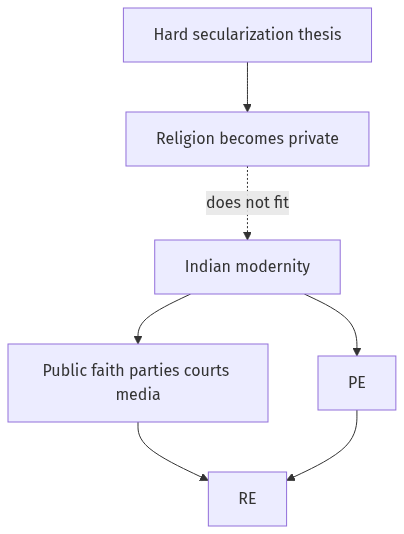
Conclusion
Religion in India did not follow the hard secularization thesis. Public life uses faith as mobilisation and law; personal life uses it as kinship and meaning. Indian modernity recasts the sacred instead of retiring it.
Quick related
Students also ask
-
Discuss the problem of religious minorities in India and suggest measures to solve them.
Next question on this syllabus topic (2022 · Q2(c)). View answer →
-
Does a secular Constitution require silent religion?
No. It requires equal citizenship and no theocratic monopoly. Public faith can still be loud.
-
Is rising public religion only revival of the old village?
No. It uses television, apps, courts and parties. That is modern organisation of the sacred.
Same topic · past papers
UPSC has asked this before
These previous-year questions sit on the same topic. Open one to practise the earlier ask.
-
2022 · Q5(b) · Sociology GS 2 · 10 marks
Examine different understandings of secularization in india?
More from this topic
Q1(e) · UPSC Mains 2026 · Sociology GS 2 · 10 marks · Solution
How does the concept 'secular' go beyond any religion in plural society like India? Analyse.
Religion and Society
This model answer examines how Indian secularism, distinct from Western models of strict church-state separation, embraces 'Sarva Dharma Sambhava' and principled distance. It highlights how the Indian state maintains neutrality while actively reforming social evils across religious lines. The answer incorporates sociological perspectives on pluralism, constitutional provisions, and judicial precedents to show how secularism safeguards minority rights while fostering national integration.
Q1(d) · UPSC Mains 2026 · Sociology GS 2 · 10 marks · Solution
Discuss the debates on the concepts 'duty' and 'worship' while understanding religion in India.
Religion and Society
This 10-marker for UPSC Mains GS I / Sociology Paper II unpacks the sociological and philosophical debates surrounding 'duty' (Dharma/Karma) and 'worship' (Bhakti/Rituals) in Indian religion. It highlights how duty translates into ethical action and social order, while worship spans emotional devotion and ritualistic orthodoxy. The answer balances classical textual traditions with subaltern and reformist critiques, supported by a clear Mermaid flowchart and essential sociological perspectives.
Q4(a) · UPSC Mains 2024 · Sociology GS 2 · 20 marks · Solution
How do religious communities contribute to the cultural diversity of India?
Religion and Society
Religious communities produce diversity through worship, kinship, law, education and neighbourhoods. Hindu sects, Muslims, Christians, Sikhs, Jains, Buddhists, Parsis and tribal religions each add institutions. Articles 25–30 protect this as a constitutional plurality. Caste-like ranking and communal conflict mean diversity is stratified. Personal law is both a cultural contribution and a gender problem.