
Revision summary
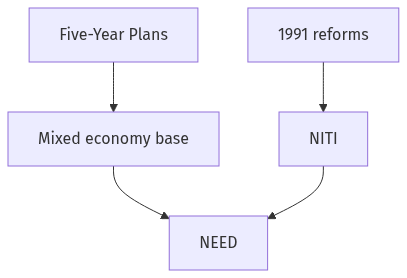
Planning meant Five-Year Plans, public investment and a mixed economy. It built industry and science and left caste-agrarian power under-attacked. Desai read it as bourgeois-state planning. NITI Aayog replaced the Commission but missions and state plans continue. Climate, health and equity still require democratic planning, not only markets.
Model answer
Copper italics in this answer — like this — are the key facts. Each one is unpacked in the Facts & figures rail.
Introduction
Development planning in India was the Nehruvian bet that a mixed economy, Five-Year Plans, and public investment in steel, dams and IITs could build a national productive base and reduce poverty. NITI Aayog replaced the Planning Commission in 2015. The question is not nostalgia. It is whether a society this unequal still needs a public map of investment, or only markets and schemes.
Body
What planning did and did not do
Planning created a heavy-industry and scientific infrastructure, a language of balanced regional growth, and anti-poverty programmes. A. R. Desai criticised it as planning for a bourgeois state that left agrarian class power intact. Licence-permit raj and public-sector inefficiency were real. Green Revolution planning raised grain and stratified the village. Caste and gender were thin in early plan documents.
After 1991, indicative planning shrank. Growth accelerated in services and some industry; inequality and informality remained. NITI Aayog is a think-tank and competitive-federalism body, not a Commission that allocates Plan funds. States still plan; the Union still runs missions. So planning did not die. It changed form.
Relevance now
Climate, urban infrastructure, health, and a just energy transition cannot be left only to firms. COVID showed the need for public capacity. Caste-class targeting of health and education still needs a map, which is planning by another name. The risk of NITI-style planning is rankings without redistribution. The risk of old planning is rigidity. Relevance lies in democratic, ecological, federal planning—closer to FRA consent and panchayat lists than to a closed Yojana Bhavan.
Planning also names who is the public. Five-Year Plans spoke of the poor as targets; NITI dashboards speak of states as competitors. Both can hide caste and gender unless the plan is forced to list them. S. C. Dube and village studies showed why a national plan fails when it ignores local structure. Relevance today is therefore not a return to licence raj. It is a public investment map for health, skills (NEP), energy and urban services that is open to Gram Sabha and legislative audit.
Critically, planning remains relevant as coordination and equity. It is obsolete as a fantasy of total state control of prices and licences.
Flow diagram
Conclusion
Indian development planning built a public productive base and failed to undo agrarian and caste inequality. After 1991 and NITI Aayog it is no longer a Soviet-style command system. It remains relevant for climate, infrastructure and redistribution if it is federal and rights-based.
Quick related
Students also ask
-
Analyze the idea of developmental planning in India
Next question on this syllabus topic (2021 · Q5(a)). View answer →
-
Did liberalisation end planning?
It ended licence-heavy allocation. The state still plans infrastructure, welfare missions and fiscal rules.
-
Is NITI a Planning Commission?
No. It advises and ranks; it does not command Plan funds as the old Commission did.
Same topic · past papers
UPSC has asked this before
These previous-year questions sit on the same topic. Open one to practise the earlier ask.
-
2023 · Q6(b) · Sociology GS 2 · 20 marks
In the face of rising global climatic concerns, how do you contextualize the relevance of Chipko Movement and its Gandhian tone? Answer analytically
More from this topic
Q4(a) · UPSC Mains 2026 · Sociology GS 2 · 20 marks · Solution
How does the Constitution of India promote education? Do you think that education can be a major instrument of social change? Clarify
Visions of Social Change in India
• Article 21A (added by the 86th Amendment, 2002) makes elementary education a fundamental right for children aged 6 to 14. • Originally, free and compulsory education for children was placed under DPSP Article 45. • Articles 15(5) and 46 provide protective discrimination and special educational provisions for SCs, STs, and backward classes. • Education acts as an instrument of social change by enabling upward mobility and breaking caste-based occupational rigidities. • Schooling empowers women, challenges patriarchal norms, and boosts female workforce participation. • Critical pedagogy fosters democratic participation, civic awareness, and constitutional morality. • Commercialization and unequal standards create a dual education system that reinforces class divides. • Marginalized groups still face systemic dropouts due to poverty, poor infrastructure, and institutional discrimination.
Q5(c) · UPSC Mains 2025 · Sociology GS 2 · 10 marks · Solution
Discuss the social bases of political mobilization in Independent India. Has some change occurred in these during the last 60-70 years?
Visions of Social Change in India
Early mobilisation ran through the Congress coalition, language states and dominant-caste farmers. Mandal made OBC politics central; Dalit parties institutionalised Ambedkarite identity. Mandir and regional parties reordered religion and federal identity. Media, the new middle class and DBT welfare added new glues. Caste, class and region did not vanish; their hierarchy of importance shifted.
Q3(c) · UPSC Mains 2024 · Sociology GS 2 · 10 marks · Solution
Education is a key to social development. Elucidate
Visions of Social Change in India
Social development is more than GDP; education is a main public lever for capabilities. Ambedkar treated schooling as anti-caste equipment. NEP 2020 recasts foundational learning and language policy as development tools. Bourdieu’s cultural capital and India’s dual school system show reproduction of inequality. Education works as a key when joined to work, health and anti-discrimination.