
Revision summary
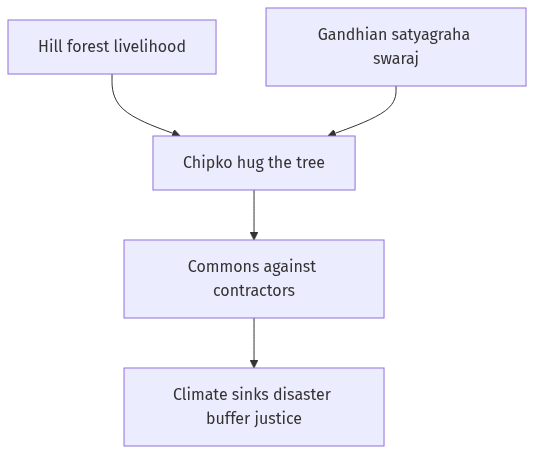
Chipko was 1970s Himalayan resistance to commercial felling, led in key actions by village women. Its Gandhian tone was non-violence, moral pressure and local control of livelihood resources. Climate politics now rereads forests as sinks, sponges and gendered commons. The movement names contractors and the state, which is climate justice in local form. It is a teaching case, not a complete national climate plan.
Model answer
Copper italics in this answer — like this — are the key facts. Each one is unpacked in the Facts & figures rail.
Introduction
Chipko began in the 1970s Uttarakhand hills as villagers, many of them women, hugged trees to stop commercial felling. Its Gandhian tone was non-violence, local swaraj over livelihood, and moral claim on the state. Global climate concern now rereads that local forest defence as an early climate politics of care, carbon, and commons.
Body
What Chipko was
- The movement grew from hill economy: forests as fodder, fuel, water sponge, and landslide shield, not as timber volume for contractors.
- Gaura Devi’s Reni action, and the organising work of Chandi Prasad Bhatt and Sunderlal Bahuguna, made a village method nationally visible.
- It was not a city NGO first. It was agrarian and gendered resistance, which Desai’s class lens can still hold: who owns the forest surplus.
The Gandhian tone
- Satyagraha without arms, constructive local organisation, and an appeal to the conscience of rulers echo Gandhi’s repertoire.
- Bahuguna’s fasts and marches used the body as argument, as Gandhi had done.
- The tone is also village swaraj: those who live with the forest should decide its use, against a distant developmental state.
- It is not a full copy of Gandhi: Chipko spoke ecology more clearly than Hind Swaraj spoke carbon.
Climate relevance today
- Forests as carbon sinks, monsoon regulators, and disaster buffers are now global climate language; Chipko already defended those functions as livelihood.
- Climate justice asks who pays for emissions and who loses the commons; Chipko named contractors and the state, not a nameless Anthropocene.
- Women’s leadership in Chipko prefigures the fact that climate harm is gendered in water, fuel, and care work.
- Narmada later showed the same conflict at dam scale: development versus river people. Chipko remains the forest-scale classic.
Analytical limits
- Chipko cannot be romanticised as a complete climate policy; India still needs energy, jobs, and urban mitigation.
- A Gandhian tone can be ignored by a growth coalition unless law, as in later forest rights debates, records community power.
- Yogendra Singh would see Chipko as orthogenetic ethics meeting a heterogenetic commercial forest regime.
Why the case still teaches
- Climate policy that only trades carbon in cities repeats the contractor logic Chipko fought.
- Non-violent local veto plus scientific hydrology is a usable mix, not a museum of the 1970s.
Flow diagram
Conclusion
Chipko is relevant to climate concern because it defended forests as living commons through Gandhian non-violence and local claim. The climate age needs that sociology of who owns the sink, not only a global temperature number.
Quick related
Students also ask
-
Discuss the phenomenon of rural-urban continuum with suitable examples
Next question on this syllabus topic (2023 · Q7(c)). View answer →
-
Was Chipko only about hugging trees?
The hug was a tactic. The demand was control over forest use against commercial extraction.
-
Can Chipko guide climate policy in cities?
Its principle travels: those who live with the risk should have a veto. The tactics will differ in a city.
Same topic · past papers
UPSC has asked this before
These previous-year questions sit on the same topic. Open one to practise the earlier ask.
-
2023 · Q3(a) · Sociology GS 2 · 20 marks
Contextualize Louis Dumont's concept of 'binary opposition' with reference to caste system in India
More from this topic
Q5(e) · UPSC Mains 2026 · Sociology GS 2 · 10 marks · Solution
Bring out the debates of 'insiders' and 'outsiders' approaches in understanding Indian society.
Perspectives on the study of Indian society
• The insider (emic) approach studies Indian society using native categories, sacred texts, and cultural immersion, championed by G.S. Ghurye and D.P. Mukerji. • Critics argue the insider view suffers from upper-caste bias and ignores ground realities in favor of normative texts. • The outsider (etic) approach applies universal models and comparative frameworks, famously used by Western scholars like Louis Dumont. • Critics dismiss the outsider view as orientalist reductionism that imposes Western concepts and misinterprets local idioms. • Modern Indian sociology bridges this binary through a reflexive methodology combining cultural familiarity with analytical rigor. • Ultimately, combining native insights with objective scrutiny is essential to capture India's complex social dynamics.
Q5(a) · UPSC Mains 2026 · Sociology GS 2 · 10 marks · Solution
Discuss the challenges faced by the aged people in receiving 'elder care'.
Perspectives on the study of Indian society
• India's aging population faces severe elder care challenges due to the breakdown of traditional joint families and youth out-migration. • Over 80% of seniors lack formal pensions because they worked in the informal sector, worsening financial vulnerability. • High out-of-pocket medical costs for chronic illnesses quickly drain meager personal savings. • Public hospitals suffer from an acute shortage of geriatric specialists, dedicated wards, and rehabilitation facilities. • Implementation of the Maintenance and Welfare of Parents and Senior Citizens Act, 2007 remains weak, leaving legal tribunals overburdened. • Solutions require shifting from a welfare approach to a rights-based framework, combining community care networks with strict legal enforcement under Article 41.
Q4(c) · UPSC Mains 2026 · Sociology GS 2 · 10 marks · Solution
Compare G. S. Ghurye's and A. R. Desai's approaches used in understanding Indian society
Perspectives on the study of Indian society
• **Ghurye’s Indological Approach:** Relied on sacred texts and classical literature to study Indian society through civilizational continuity. • **Core Themes in Ghurye:** Focused on caste, kin, and how Hinduism historically integrated diverse tribal and regional groups. • **Desai’s Materialist Approach:** Rejected textual idealism in favor of Marxist political economy to study social structures. • **Economic Formations:** Analyzed Indian society through successive modes of production—ancient, feudal, and colonial capitalist. • **Caste vs. Class:** Viewed caste and religion as superstructural elements that mask underlying economic exploitation. • **Critique of State and Nationalism:** Argued that the nationalist movement was bourgeois, leaving agrarian inequalities intact post-independence. • **Key Contrast:** Ghurye highlights cultural tradition and integration, while Desai emphasizes economic power and class conflict.