
Revision summary
Social development is more than GDP; education is a main public lever for capabilities. Ambedkar treated schooling as anti-caste equipment. NEP 2020 recasts foundational learning and language policy as development tools. Bourdieu’s cultural capital and India’s dual school system show reproduction of inequality. Education works as a key when joined to work, health and anti-discrimination.
Model answer
Copper italics in this answer — like this — are the key facts. Each one is unpacked in the Facts & figures rail.
Introduction
- Social development means a wider set of capabilities than income growth: health, literacy, dignity, and the ability to take part in public life. Education is a key because it is the main public institution that can reallocate those capabilities across generation. In India that claim is tested every day in government schools, coaching factories and the National Education Policy, 2020.
Body
How education develops society
Literacy and numeracy lower child mortality when they reach mothers; they raise the chance of using law, banks and panchayats. Schooling delayed marriage in many groups and is a pathway out of some hereditary occupations. Ambedkar treated education as a weapon against caste, not as polish. Public employment and the professions still filter by credentials. NEP 2020’s stress on foundational literacy, mother tongue, and multiple exit points is an attempt to treat school as development infrastructure rather than only as an exam funnel.
Education also builds a common civic language—unevenly, in a multilingual society. That is development in Srinivas’s westernization sense and in Yogendra Singh’s modernisation of tradition: new roles without a total cultural wipe.
The key can jam
Pierre Bourdieu’s cultural capital is visible in English-medium private schools versus understaffed rural schools. Caste and class buy coaching. NEP can still leave a dual system. Gendered drop-out, disability exclusion, and Adivasi language mismatch show that school can reproduce the structure it is asked to dissolve. A. R. Desai would remind us that education without land and work is a limited solvent of class.
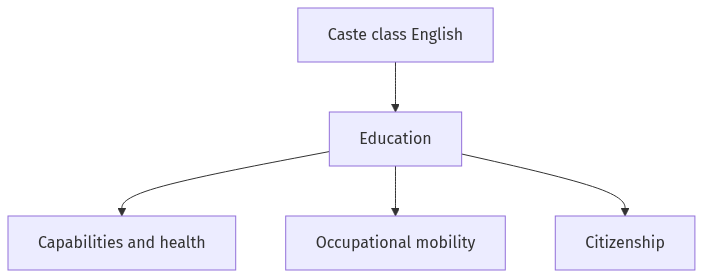
So education is a key, not a master key. It works when tied to health, work and anti-discrimination; it fails as a slogan that blames the poor for not ‘valuing school’.
Flow diagram
Conclusion
Education is a key to social development because it spreads capabilities, delays some patriarchal clocks, and opens civic and occupational doors. In India it is also a market of inequality. NEP 2020 is a reform of the key; caste, class and language still decide whose lock it opens.
Quick related
Students also ask
-
Critically examine the relevance of development planning in India
Next question on this syllabus topic (2024 · Q6(c)). View answer →
-
Does more schooling automatically mean development?
Not if quality is stratified and jobs do not follow. Credentials can inflate without capabilities.
-
Is NEP only a skills policy?
It includes skills and also language, equity and higher-education architecture. Outcomes will depend on state capacity.
More from this topic
Q4(a) · UPSC Mains 2026 · Sociology GS 2 · 20 marks · Solution
How does the Constitution of India promote education? Do you think that education can be a major instrument of social change? Clarify
Visions of Social Change in India
• Article 21A (added by the 86th Amendment, 2002) makes elementary education a fundamental right for children aged 6 to 14. • Originally, free and compulsory education for children was placed under DPSP Article 45. • Articles 15(5) and 46 provide protective discrimination and special educational provisions for SCs, STs, and backward classes. • Education acts as an instrument of social change by enabling upward mobility and breaking caste-based occupational rigidities. • Schooling empowers women, challenges patriarchal norms, and boosts female workforce participation. • Critical pedagogy fosters democratic participation, civic awareness, and constitutional morality. • Commercialization and unequal standards create a dual education system that reinforces class divides. • Marginalized groups still face systemic dropouts due to poverty, poor infrastructure, and institutional discrimination.
Q5(c) · UPSC Mains 2025 · Sociology GS 2 · 10 marks · Solution
Discuss the social bases of political mobilization in Independent India. Has some change occurred in these during the last 60-70 years?
Visions of Social Change in India
Early mobilisation ran through the Congress coalition, language states and dominant-caste farmers. Mandal made OBC politics central; Dalit parties institutionalised Ambedkarite identity. Mandir and regional parties reordered religion and federal identity. Media, the new middle class and DBT welfare added new glues. Caste, class and region did not vanish; their hierarchy of importance shifted.
Q6(c) · UPSC Mains 2024 · Sociology GS 2 · 10 marks · Solution
Critically examine the relevance of development planning in India
Visions of Social Change in India
Planning meant Five-Year Plans, public investment and a mixed economy. It built industry and science and left caste-agrarian power under-attacked. Desai read it as bourgeois-state planning. NITI Aayog replaced the Commission but missions and state plans continue. Climate, health and equity still require democratic planning, not only markets.