
Revision summary
Urban growth is more than four old metros: NCR, Bengaluru and Hyderabad show sprawl and private urbanism. Census towns mark in-situ urbanisation without municipal status. Corridors, smart-city projects and gated enclaves fragment the city. Secondary cities absorb education and services. Class, caste and informality shape who gets infrastructure.
Model answer
Copper italics in this answer — like this — are the key facts. Each one is unpacked in the Facts & figures rail.
Introduction
Urban growth in India is not only the swelling of Delhi, Mumbai, Kolkata and Chennai. Recent decades show sprawl, census towns, corridor cities and gated fragments. The Census idea of an urban place—size, density, non-farm work—now covers settlements that still look like large villages. That mismatch is itself a trend.
Body
Metropolitan concentration and sprawl
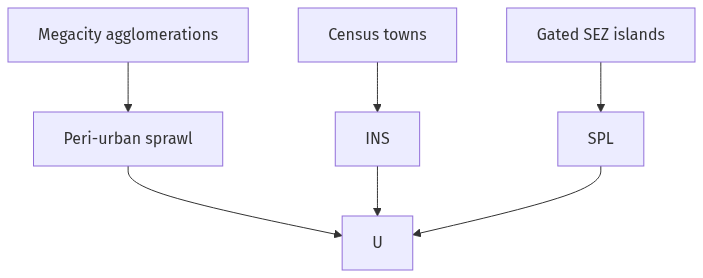
Million-plus agglomerations keep drawing migrants and capital. Mumbai–Pune, Delhi–NCR, Bengaluru, Hyderabad and Ahmedabad–Gandhinagar illustrate peri-urban growth: farms become plots, then gated colonies and logistics parks. Gurgaon/Gurugram is a textbook of private urbanism beside villages that supply labour and land. Floods in Chennai and Bengaluru show that growth has outrun drainage as a public good.
Census towns, secondary cities and corridors
- A large share of recent urbanisation is census towns: statutory rural, functionally urban. This is in-situ urbanisation, often along highways, not a move into the old municipal core. Tier-2 cities—Indore, Coimbatore, Lucknow, Bhubaneswar—grow as service and education hubs. Industrial corridors and ‘smart city’ projects try to plan growth; much actual settlement remains unplanned slum and peri-plot.
Gated housing, malls and SEZs produce splintered urbanism (a useful description even without the jargon as a brand): elite islands, informal work around them. Caste and religion still sort neighbourhoods. The trend is therefore dual: more urban people, and more unequal urban form.
Smaller towns along national highways in Uttar Pradesh, Rajasthan and Tamil Nadu show ribbon development: workshops, marriage halls, coaching centres and rental rooms without a municipal plan. Hill towns and pilgrimage cities add a seasonal urbanism that the census captures poorly. Coastal peri-urban Goa and Kerala mix tourism capital with local land sale, which is another named trend: urbanisation through real estate rather than through a mill.
- Recent growth is also digital and logistical: warehouses, delivery hubs, and student PG belts around coaching and IT. That is urban settlement without a mill chimney, which matters for how we read industrialisation later in this paper.
Flow diagram
Conclusion
Recent urban growth in India combines megacity sprawl, census-town in-situ urbanisation, corridor and gated fragments, and strained infrastructure. Examples from NCR, Bengaluru, Hyderabad and census towns show a society becoming urban without becoming equal or fully municipal.
Quick related
Students also ask
-
Are slums the manifestations of industrialisation and urbanisation in India? Explain.
Next question on this syllabus topic (2024 · Q5(c)). View answer →
-
Is urban growth the same as industrialisation?
Not in India. Services, construction and census towns grow without a matching factory core.
-
Are census towns really urban?
Functionally often yes; politically they lack municipal services, which is the sociological point.
Same topic · past papers
UPSC has asked this before
These previous-year questions sit on the same topic. Open one to practise the earlier ask.
-
2021 · Q8(b) · Sociology GS 2 · 20 marks
Urban settlements in India tend to replicate its rural caste-kinship imprints. Discuss the main reasons -
2020 · Q7(a) · Sociology GS 2 · 20 marks
Elaborate the causes, consequences and other concerns of growth of urban settlements in India. -
2025 · Q2(a) · Sociology GS 2 · 20 marks
Do you think that in a society like India orthogenetic changes take place through differentiation? Do you observe continuities in the orthogenetic process ? Elaborate your answer with suitable examples -
2025 · Q3(b) · Sociology GS 2 · 20 marks
Do you think that new economic reforms of British rule have disrupted the old economic system of India? Substantiate your answer with suitable examples -
2023 · Q7(c) · Sociology GS 2 · 10 marks
Discuss the phenomenon of rural-urban continuum with suitable examples
More from this topic
Q7(c) · UPSC Mains 2026 · Sociology GS 2 · 10 marks · Solution
Examine the process of formalisation of informal sector to safeguard the interests of marginalised sections of the society
Industrialization and Urbanisation in India
• **Core Objective:** Formalising India's vast informal workforce integrates vulnerable groups into legal and institutional frameworks to secure their rights. • **Digital Tracking:** The e-Shram portal creates national databases and assigns Unique Account Numbers (UAN) to make unorganized workers visible for welfare delivery. • **Welfare Delivery:** Registration streamlines access to accident insurance, PM-SYM pensions, and direct benefit transfers. • **Wage Reforms:** Consolidating labour laws introduces universal statutory minimum wages and mandates formal appointment letters. • **Safety Standards:** New codes aim to improve occupational health and reduce the workplace exploitation of marginalised communities. • **Implementation Hurdles:** High compliance costs push micro-enterprises to stay informal, limiting the reach of safety nets. • **Social Realities:** Deep-rooted caste and class vulnerabilities among SC, ST, and OBC workers require more than just administrative registration to resolve.
Q6(b) · UPSC Mains 2025 · Sociology GS 2 · 20 marks · Solution
Discuss the trend of urbanization in India. Do you think that Industrialization is the only precondition of urbanization? Give you arguments
Industrialization and Urbanisation in India
India’s urbanisation is rising but remains metro-concentrated and full of census towns and slums. Kundu’s exclusionary urbanisation captures labour demand without inclusive housing. Tertiary growth, administrative history, transport and agrarian distress urbanise besides factories. Industrial belts exist and matter; they do not exhaust the trend. Policy that waits only for industry misses actually existing urban India.
Q5(e) · UPSC Mains 2025 · Sociology GS 2 · 10 marks · Solution
Do you think that law has been able to abolish child labour in India? Comment.
Industrialization and Urbanisation in India
The 1986 Act as amended in 2016 bans most child work under 14 but allows family-enterprise help. RTE adds a schooling right that is unevenly realised. Child labour persists in agriculture, kilns, domestic and home-based informal work. Poverty, caste occupations and weak inspection explain the gap between statute and practice. Law delegitimised the practice more than it abolished it.