
Revision summary
Marriage regulates sexuality, filiation, property and group closure, which is why sociology treats it as central. Ambedkar and ethnographers of Indian kinship made endogamy and alliance core tools. Age at marriage, arranged love, migration and law are changing the field unevenly. Caste endogamy remains strong; inter-marriage is politically explosive. Implications run through gender bargaining, fertility and household authority.
Model answer
Copper italics in this answer — like this — are the key facts. Each one is unpacked in the Facts & figures rail.
Introduction
Marriage is not only a wedding. In sociology it is the institution that regulates sexuality, filiation, property and group boundaries. Levi-Strauss treated alliance as the exchange that makes society. Ambedkar treated endogamous marriage as the lock of caste. Indian ethnography—Karve, Dumont, Uberoi—made marriage the door to kinship regions. If marriage changes, caste, household and inequality change with it. That is why the study is important, and why new patterns have large implications.
Body
Why sociology studies marriage
Marriage links the domestic group to the political economy. It organises legitimacy of children, claims on land and surname, care of the aged, and the unpaid labour of women. It is a market of honour: hypergamy, dowry and kanyadan idioms rank families. It is a demographic engine: age at marriage shapes fertility. It is a legal status: personal laws, the Special Marriage Act, and criminal law on bigamy and cruelty sit here. Without marriage, accounts of caste, class and religion miss their reproduction.
Functionalists saw it as meeting needs of personality and socialisation (Murdock’s nuclear unit). Conflict and feminist theories see it as a site of patriarchy and property. Both are usable in India if neither is treated as the whole story.
Changing patterns
Age at marriage has risen with schooling, especially for girls in many states, though child marriage persists in belts of Rajasthan, Bihar and elsewhere. Companionacy and ‘arranged love’ mixes have grown in urban middle classes; caste endogamy remains high. Inter-caste and inter-religious marriages exist and attract violence and social boycott. Dowry has not died with education; it has inflated in some status groups. Divorce and separation are more thinkable, still stigmatised. Migration produces delayed co-residence and translocal conjugality. Live-in relations and the Navtej Johar (2018) reading of Section 377 changed the public status of same-sex intimacy, while marriage equality remains legally unsettled after later litigation. NRI and app-mediated matches extend the field without dropping filters of caste and language.
Hindu Succession reform, the Domestic Violence Act, and optional civil marriage slightly shift bargaining inside the couple. Personal law plurality means Muslim, Christian and customary marriages change on different clocks.
Implications
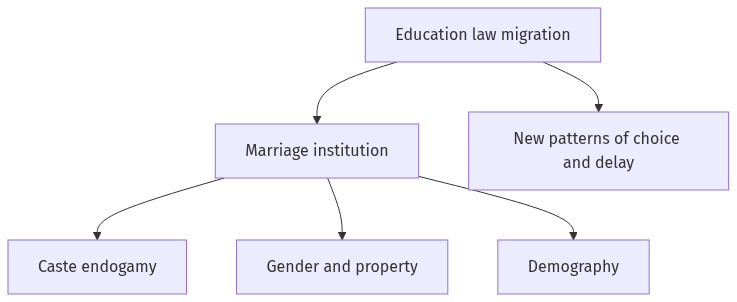
For caste, stable endogamy means caste continues even when occupation opens. For gender, later marriage and schooling can raise women’s voice; dowry, honour and unpaid care can still intensify. For demography, later and fewer marriages interact with falling fertility and with a marriage squeeze in some sex-ratio-distorted regions. For the household, conjugality gains against the joint karta in some classes, while wedding expenditure and kin ritual expand as status theatre. For politics, love jihad discourses, anti-conversion marriage laws in some states, and khap intervention show the state and community fighting over the same institution.
Kinship studies also show that marriage is the hinge of alliance versus descent debates. If North Indian village exogamy and gotra rules loosen only at the edges, the North remains an alliance-avoiding, descent-heavy field. If Dravidian cross-cousin practice declines with schooling, South Indian kinship is changing its reproduction rule, not only its wedding film style. Uberoi and family sociologists would add that the state now marries people through registration, NRI law, and welfare lists, so marriage is also a citizenship event.
Changing patterns therefore do not mean the death of arranged caste marriage. They mean a differentiated field: a metropolitan edge of choice and delay, and a large core of endogamous arrangement, with conflict at the boundary.
Flow diagram
Conclusion
Marriage is sociologically important because it reproduces groups, property and gender. Indian patterns are shifting in age, media and law, but endogamy and honour still organise most matches. The implication is a split modernity: more individual bargaining inside a caste marriage market, not a general free market of individuals.
Quick related
Students also ask
-
Do you think that the constitutional provisions for women have led to their uplift? Give reasons for your answer
Next question on this syllabus topic (2024 · Q3(b)). View answer →
-
Are arranged marriages disappearing?
They are being recast as family-mediated matches with some youth veto, especially in cities. They remain the majority pattern.
-
Does later marriage end caste?
No. Later marriage can coexist with caste-filtered apps and samaj ceremonies.
Same topic · past papers
UPSC has asked this before
These previous-year questions sit on the same topic. Open one to practise the earlier ask.
-
2024 · Q1(d) · Sociology GS 2 · 10 marks
Do you think that family bondings are being affected by the changing kinship patterns in India? Comment. -
2017 · Q6(b) · Sociology GS 2 · 20 marks
Examine the impact of heritage tourism on urban socio-spatial patterns in India
More from this topic
Q5(e) · UPSC Mains 2026 · Sociology GS 2 · 10 marks · Solution
Bring out the debates of 'insiders' and 'outsiders' approaches in understanding Indian society.
Perspectives on the study of Indian society
• The insider (emic) approach studies Indian society using native categories, sacred texts, and cultural immersion, championed by G.S. Ghurye and D.P. Mukerji. • Critics argue the insider view suffers from upper-caste bias and ignores ground realities in favor of normative texts. • The outsider (etic) approach applies universal models and comparative frameworks, famously used by Western scholars like Louis Dumont. • Critics dismiss the outsider view as orientalist reductionism that imposes Western concepts and misinterprets local idioms. • Modern Indian sociology bridges this binary through a reflexive methodology combining cultural familiarity with analytical rigor. • Ultimately, combining native insights with objective scrutiny is essential to capture India's complex social dynamics.
Q5(a) · UPSC Mains 2026 · Sociology GS 2 · 10 marks · Solution
Discuss the challenges faced by the aged people in receiving 'elder care'.
Perspectives on the study of Indian society
• India's aging population faces severe elder care challenges due to the breakdown of traditional joint families and youth out-migration. • Over 80% of seniors lack formal pensions because they worked in the informal sector, worsening financial vulnerability. • High out-of-pocket medical costs for chronic illnesses quickly drain meager personal savings. • Public hospitals suffer from an acute shortage of geriatric specialists, dedicated wards, and rehabilitation facilities. • Implementation of the Maintenance and Welfare of Parents and Senior Citizens Act, 2007 remains weak, leaving legal tribunals overburdened. • Solutions require shifting from a welfare approach to a rights-based framework, combining community care networks with strict legal enforcement under Article 41.
Q4(c) · UPSC Mains 2026 · Sociology GS 2 · 10 marks · Solution
Compare G. S. Ghurye's and A. R. Desai's approaches used in understanding Indian society
Perspectives on the study of Indian society
• **Ghurye’s Indological Approach:** Relied on sacred texts and classical literature to study Indian society through civilizational continuity. • **Core Themes in Ghurye:** Focused on caste, kin, and how Hinduism historically integrated diverse tribal and regional groups. • **Desai’s Materialist Approach:** Rejected textual idealism in favor of Marxist political economy to study social structures. • **Economic Formations:** Analyzed Indian society through successive modes of production—ancient, feudal, and colonial capitalist. • **Caste vs. Class:** Viewed caste and religion as superstructural elements that mask underlying economic exploitation. • **Critique of State and Nationalism:** Argued that the nationalist movement was bourgeois, leaving agrarian inequalities intact post-independence. • **Key Contrast:** Ghurye highlights cultural tradition and integration, while Desai emphasizes economic power and class conflict.