
Revision summary
Villages display caste, kinship and agrarian rank with great force. Srinivas, Marriott and Dumont can be read through village interaction. Beteille denies that the village stands for the whole civilisation. Cities, texts, markets and citizenship are also Indian values in practice. Desai adds that the village is a historical class formation, not a timeless essence.
Model answer
Copper italics in this answer — like this — are the key facts. Each one is unpacked in the Facts & figures rail.
Introduction
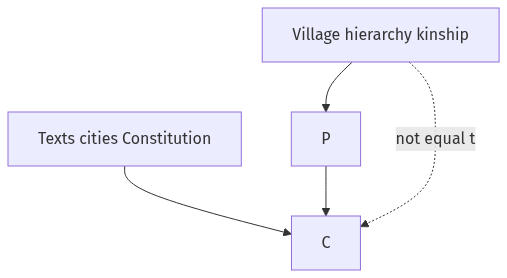
Andre Beteille questioned the habit of treating the village as a miniature of Indian civilisation. Villages display hierarchy, kinship, and agrarian rank with great clarity. They do not exhaust the values stored in texts, cities, courts, and the modern state.
Body
What the village does represent
- Srinivas’s field view showed that lived India is jati, dominant caste, faction, and Sanskritization, which no shastra alone can invent.
- Marriott’s interactional caste and Dumont’s purity–impurity binary are visible in village food, wells, and temples.
- Kinship, gotra, and marriage circles still use the village as a unit of exogamy in the north and as a field of alliance in the south.
- For millions, civilisational practice still means harvest rites, caste panchayats, and local honour, so the village is not a sideshow.
Why Beteille’s caution is right
- Indian civilisation also lives in cities, maths, courts, factories, and the Constitution. Beteille argued that equality, individualism, and office are now civilisational facts, not only village hierarchy.
- Dumont’s Homo Hierarchicus drew on texts as much as on villages; reducing civilisation to Rampura or Kishan Garhi would betray Dumont as well as Beteille.
- A. R. Desai’s dialectic shows the village as a class structure produced by colonial settlement and post-independence reform, not as a timeless value capsule.
- The 1950s golden period of village studies created a professional bias: what was methodologically convenient became theoretically total.
A usable overview
- Agree that basic ranked values of purity, kinship, and patronage are densely instantiated in villages.
- Disagree that the village is representative of the whole civilisational set, which now includes citizenship, markets, and urban anonymity.
- Yogendra Singh’s modernization of tradition and the Rudolphs’ modernity of tradition both need town, party, and law as well as the hamlet.
Way forward for the argument
- Use the village as a crucial site, not as a proxy for India.
- Read civilisational values as a layered archive: text, village, city, and state.
Flow diagram
Conclusion
Beteille is right to refuse the village as a full representative of Indian civilisational values. The village is a major theatre of hierarchy and kinship. Civilisation also speaks in cities, scriptures, and the Republic.
Quick related
Students also ask
-
Contextualize Louis Dumont's concept of 'binary opposition' with reference to caste system in India
Next question on this syllabus topic (2023 · Q3(a)). View answer →
-
Did Beteille say villages do not matter?
No. He studied Tanjore villages closely. He denied that they represent the entire civilisational set.
-
Can one still start a paper on India with the village?
Yes, as a site of hierarchy and agrarian class. Then add city, law, and text so the claim is not total.
Same topic · past papers
UPSC has asked this before
These previous-year questions sit on the same topic. Open one to practise the earlier ask.
-
2021 · Q1(d) · Sociology GS 2 · 10 marks
Critically examine briefly the phrase "Little 'Republics" as used to denote India's villages -
2019 · Q2(a) · Sociology GS 2 · 20 marks
Critically examine Dube's contributions to the study of Indian villages
More from this topic
Q5(d) · UPSC Mains 2026 · Sociology GS 2 · 10 marks · Solution
How do Louis Dumont and André Beteille differ in their approaches in understanding caste system in India? Explain.
Caste System
Louis Dumont and André Beteille offer contrasting paradigms for studying the Indian caste system. Dumont applies a structuralist-ideological approach, viewing caste as a hierarchical system governed by the religious principle of purity and pollution, derived from classical texts. Conversely, Beteille adopts an empirical-sociological approach, focusing on village-level realities in Tamil Nadu to demonstrate how caste, class, and power often diverge, reflecting secular social stratification. While Dumont sees caste as an integrated whole of structural values, Beteille emphasizes structural pluralism and social mobility. Understanding both theorists is essential for analyzing the continuity and transformation of social inequality in contemporary India.
Q4(c) · UPSC Mains 2024 · Sociology GS 2 · 10 marks · Solution
What are the different forms of untouchability still practised in India? Discuss with suitable illustrations
Caste System
Untouchability is practised exclusion on grounds of hereditary pollution, abolished in Article 17 but not in social geography. Forms include water, food, temple, housing, school and marriage bans. Manual scavenging continues despite the 2013 Act. Urban cups, sewers and housing filters are contemporary illustrations. Guru’s humiliation and Ambedkar’s annihilation agenda still describe the structure.
Q2(c) · UPSC Mains 2024 · Sociology GS 2 · 10 marks · Solution
What, according to Andre Beteille, are the bases of agrarian class structure in India? Analyse
Caste System
Béteille based agrarian class on land property and labour, not on caste rank. Owners, tenants and agricultural labourers are the main classes in his Tanjore study. Caste, class and power are three interacting dimensions. Ownership, control and labour remain the operational bases. Corporate farming, reverse tenancy and public works modify the actors without cancelling the scheme.