
Revision summary
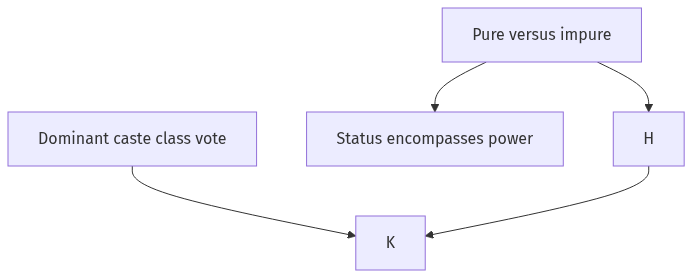
Dumont’s master binary is pure versus impure, with status encompassing power. Caste is treated as a hierarchical whole, not a failed class system. Marriott tests the binary in food and service interaction. Srinivas, Beteille and Desai show land, office and class leaking through the model. The binary remains useful for ritual rank, not as a total theory.
Model answer
Copper italics in this answer — like this — are the key facts. Each one is unpacked in the Facts & figures rail.
Introduction
Louis Dumont used binary opposition to argue that caste is a whole organised by the contrast of pure and impure. Status, not power, is the encompassing pole. The Indian debate is whether that binary explains lived caste or only a Brahmanical idea of caste.
Body
The binary in Dumont
- Pure and impure is the master opposition: occupations, foods, bodies, and castes are ranked by pollution and its removal.
- Priest and king, status and power, hierarchy and equality, homo hierarchicus and homo aequalis are paired so that Indian caste is not a failed class system but a different ideology.
- The Brahmana encompasses the Kshatriya because ritual status encompasses political power in the ideology, even when kings rule in fact.
- Untouchability is not a side cruelty; it is the logical extreme of the same binary.
Village and interactional context
- McKim Marriott’s transactions of food and service give the binary an interactional test: who accepts whose cooked food.
- 1950s village studies supplied Dumont with a field for hierarchy, yet Marriott also showed that rank is negotiated, not only deduced from texts.
- Srinivas’s dominant caste places land and numbers against priestly purity, so the status–power binary leaks in the village.
Critiques that re-context the binary
- Andre Beteille argued that land, office, and caste do not coincide as Dumont’s whole would like, and that equality is now an Indian value, not only a Western import.
- A. R. Desai treats purity talk as ideology over class; the binary may hide rent and labour.
- Dalit movements and Ambedkarite politics refuse the binary as fate and turn it into a public wrong.
- Yogendra Singh and the Rudolphs show caste operating as association and vote bank, which is not Dumont’s encompassing ritual whole.
What still holds
- Everyday refusals of touch, marriage, and temple entry still follow a purity grammar in many regions.
- The binary is a powerful model of ideology. It is not a complete sociology of power, gender, or the state.
Flow diagram
Conclusion
Dumont’s binary opposition contextualises caste as a ranked ideology of pure and impure, status over power. Indian sociology keeps the insight for ritual rank and rejects it as a total explanation of village class, dominant caste, and democratic politics.
Quick related
Students also ask
-
In the context of changing Indian society, how do you view Andre Beteille's conceptions of harmonic and disharmonic social structures ?
Next question on this syllabus topic (2022 · Q1(d)). View answer →
-
Did Dumont say kings have no power?
No. He said that in the caste ideology, status encompasses power. Actual kingdoms still used force.
-
Is the binary only Hindu?
Dumont built it from Hindu materials. Ranking practices among other Indian communities need separate tests.
Same topic · past papers
UPSC has asked this before
These previous-year questions sit on the same topic. Open one to practise the earlier ask.
-
2023 · Q6(b) · Sociology GS 2 · 20 marks
In the face of rising global climatic concerns, how do you contextualize the relevance of Chipko Movement and its Gandhian tone? Answer analytically -
2022 · Q1(e) · Sociology GS 2 · 10 marks
Explain Leela Dube's concept of "Seed and Earth"
More from this topic
Q5(d) · UPSC Mains 2026 · Sociology GS 2 · 10 marks · Solution
How do Louis Dumont and André Beteille differ in their approaches in understanding caste system in India? Explain.
Caste System
Louis Dumont and André Beteille offer contrasting paradigms for studying the Indian caste system. Dumont applies a structuralist-ideological approach, viewing caste as a hierarchical system governed by the religious principle of purity and pollution, derived from classical texts. Conversely, Beteille adopts an empirical-sociological approach, focusing on village-level realities in Tamil Nadu to demonstrate how caste, class, and power often diverge, reflecting secular social stratification. While Dumont sees caste as an integrated whole of structural values, Beteille emphasizes structural pluralism and social mobility. Understanding both theorists is essential for analyzing the continuity and transformation of social inequality in contemporary India.
Q4(c) · UPSC Mains 2024 · Sociology GS 2 · 10 marks · Solution
What are the different forms of untouchability still practised in India? Discuss with suitable illustrations
Caste System
Untouchability is practised exclusion on grounds of hereditary pollution, abolished in Article 17 but not in social geography. Forms include water, food, temple, housing, school and marriage bans. Manual scavenging continues despite the 2013 Act. Urban cups, sewers and housing filters are contemporary illustrations. Guru’s humiliation and Ambedkar’s annihilation agenda still describe the structure.
Q2(c) · UPSC Mains 2024 · Sociology GS 2 · 10 marks · Solution
What, according to Andre Beteille, are the bases of agrarian class structure in India? Analyse
Caste System
Béteille based agrarian class on land property and labour, not on caste rank. Owners, tenants and agricultural labourers are the main classes in his Tanjore study. Caste, class and power are three interacting dimensions. Ownership, control and labour remain the operational bases. Corporate farming, reverse tenancy and public works modify the actors without cancelling the scheme.