
Revision summary
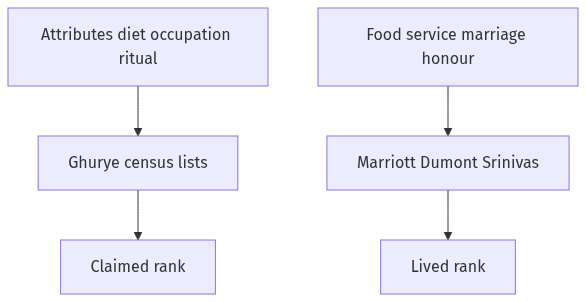
Attributional caste scores groups by listed traits such as diet, occupation and ritual. Ghurye and colonial lists exemplify that approach. Interactional caste ranks groups by who gives and receives food, service and honour. Marriott, Dumont and Srinivas made interaction the test of hierarchy. Lived rank can diverge from textbook attributes.
Model answer
Copper italics in this answer — like this — are the key facts. Each one is unpacked in the Facts & figures rail.
Introduction
Attributional studies rank a caste by the traits it is said to possess. Interactional studies rank it by who gives and who receives food, service, women, and honour in daily life. Both describe caste; they do not photograph the same thing.
Body
Attributional approach
- G. S. Ghurye listed features such as segmental division, hierarchy, restrictions on feeding and marriage, civil and religious disabilities, and lack of free occupational choice.
- Census ethnography and many textbooks still score a jati by occupation, diet, dress, and ritual status as if those attributes were a fixed essence.
- The approach is strong for comparison across regions and for legal schedules. It is weak when attributes change while rank stays, or when rank changes while old labels remain.
Interactional approach
- McKim Marriott argued that caste position is produced in transactions: cooked food, raw food, garbage, and ritual service.
- Louis Dumont placed interaction under a binary of pure and impure: who can touch whom is an enactment of ideology, not a list of hobbies.
- M. N. Srinivas’s dominant caste shows that land, numbers, and office can reorder local interaction even when textual attributes stay ‘low’ or ‘high’.
Why the difference matters
- Attribution can freeze a group as vegetarian or priestly while the village already takes its water from another jati’s well on new terms.
- Interaction captures Sanskritization as a change of practice before a change of name, and it captures boycott as a political weapon.
- A full answer uses attributes as claims people make, and interaction as the test of those claims.
Flow diagram
Conclusion
Attributional caste is a catalogue of traits. Interactional caste is a map of exchanges. Indian sociology needs both, but rank is decided in interaction.
Quick related
Students also ask
-
Do you agree with the view of Andre Beteille that India's villages are representative of Indian society's basic civilizational values ? Present a sociological overview
Next question on this syllabus topic (2023 · Q2(a)). View answer →
-
Is Dumont only attributional because he uses texts?
He starts from ideology, but purity is proven in interaction, not only in a list of traits.
-
Which approach helps a fieldworker more?
Interaction: watch who eats together and who refuses. Attributes still help to hear how people describe themselves.
Same topic · past papers
UPSC has asked this before
These previous-year questions sit on the same topic. Open one to practise the earlier ask.
-
2019 · Q3(c) · Sociology GS 2 · 10 marks
Give an account of Ranajit Guha's approach in studying 'subaltern class'
More from this topic
Q5(d) · UPSC Mains 2026 · Sociology GS 2 · 10 marks · Solution
How do Louis Dumont and André Beteille differ in their approaches in understanding caste system in India? Explain.
Caste System
Louis Dumont and André Beteille offer contrasting paradigms for studying the Indian caste system. Dumont applies a structuralist-ideological approach, viewing caste as a hierarchical system governed by the religious principle of purity and pollution, derived from classical texts. Conversely, Beteille adopts an empirical-sociological approach, focusing on village-level realities in Tamil Nadu to demonstrate how caste, class, and power often diverge, reflecting secular social stratification. While Dumont sees caste as an integrated whole of structural values, Beteille emphasizes structural pluralism and social mobility. Understanding both theorists is essential for analyzing the continuity and transformation of social inequality in contemporary India.
Q4(c) · UPSC Mains 2024 · Sociology GS 2 · 10 marks · Solution
What are the different forms of untouchability still practised in India? Discuss with suitable illustrations
Caste System
Untouchability is practised exclusion on grounds of hereditary pollution, abolished in Article 17 but not in social geography. Forms include water, food, temple, housing, school and marriage bans. Manual scavenging continues despite the 2013 Act. Urban cups, sewers and housing filters are contemporary illustrations. Guru’s humiliation and Ambedkar’s annihilation agenda still describe the structure.
Q2(c) · UPSC Mains 2024 · Sociology GS 2 · 10 marks · Solution
What, according to Andre Beteille, are the bases of agrarian class structure in India? Analyse
Caste System
Béteille based agrarian class on land property and labour, not on caste rank. Owners, tenants and agricultural labourers are the main classes in his Tanjore study. Caste, class and power are three interacting dimensions. Ownership, control and labour remain the operational bases. Corporate farming, reverse tenancy and public works modify the actors without cancelling the scheme.