
Revision summary
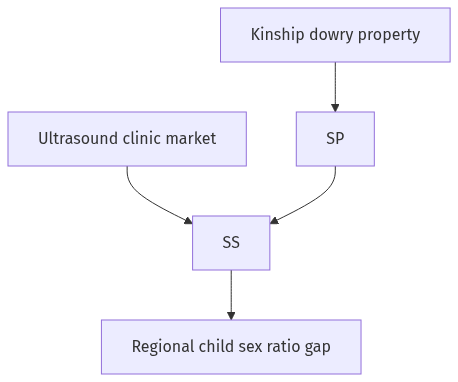
Sex ratio varies sharply by region in India, especially the child sex ratio. North-western agnatic, dowry-heavy systems show more masculine ratios. Kerala and parts of the north-east have been closer to balance. Ultrasound converted preference into selection where law was weak. Development without gender justice can worsen the ratio.
Model answer
Copper italics in this answer — like this — are the key facts. Each one is unpacked in the Facts & figures rail.
Introduction
Sex ratio in India is not one national figure with a single cause. Regions differ because kinship, property, and medical markets differ. The child sex ratio exposes prenatal selection more sharply than the overall ratio, which also reflects age structure and adult mortality.
Body
The pattern
- North-western states such as Haryana, Punjab, and parts of Rajasthan and western Uttar Pradesh have shown persistently masculine child sex ratios in census decades after 1991.
- Kerala and several north-eastern states have been closer to balance, with Kerala’s overall ratio historically less masculine.
- Urban prosperous belts can be worse than some poor regions, which kills the simple story that development automatically values daughters.
Reasons
- North Indian agnatic descent, dowry, and village exogamy, as Karve mapped, make sons the old-age and property default; daughters marry out.
- South Indian alliance systems and women’s fuller public presence in some regions reduce, but do not erase, son preference.
- Ultrasound and the failing enforcement of the Pre-Conception and Pre-Natal Diagnostic Techniques Act turned preference into sex-selective abortion where clinics and cash met honour.
- Srinivas’s Sanskritizing mobility can worsen seclusion and dowry as groups climb, which is a cruel twist of ‘development’.
- Female infanticide and neglect of girl children remain in some pockets; adult sex ratio also follows maternal death and migration of working-age men.
Why region is the right unit
- Dumont’s hypergamy and ranked alliance help explain northern honour around daughters.
- Policy that copies one state onto another without kinship will miss the mechanism.
Flow diagram
Conclusion
Regional sex ratios in India follow kinship and medical markets, not only income. The north-west’s masculine child ratios and the relatively better southern and some north-eastern figures are sociological maps, not accidents.
Quick related
Students also ask
-
In the face of rising global climatic concerns, how do you contextualize the relevance of Chipko Movement and its Gandhian tone? Answer analytically
Next question on this syllabus topic (2023 · Q6(b)). View answer →
-
Does a better overall sex ratio mean girls are safe?
Not always. Migration of men and longer female survival at older ages can mask a bad child sex ratio.
-
Is son preference only rural?
No. Urban clinic access has produced strongly masculine ratios in some prosperous towns.
More from this topic
Q5(e) · UPSC Mains 2026 · Sociology GS 2 · 10 marks · Solution
Bring out the debates of 'insiders' and 'outsiders' approaches in understanding Indian society.
Perspectives on the study of Indian society
• The insider (emic) approach studies Indian society using native categories, sacred texts, and cultural immersion, championed by G.S. Ghurye and D.P. Mukerji. • Critics argue the insider view suffers from upper-caste bias and ignores ground realities in favor of normative texts. • The outsider (etic) approach applies universal models and comparative frameworks, famously used by Western scholars like Louis Dumont. • Critics dismiss the outsider view as orientalist reductionism that imposes Western concepts and misinterprets local idioms. • Modern Indian sociology bridges this binary through a reflexive methodology combining cultural familiarity with analytical rigor. • Ultimately, combining native insights with objective scrutiny is essential to capture India's complex social dynamics.
Q5(a) · UPSC Mains 2026 · Sociology GS 2 · 10 marks · Solution
Discuss the challenges faced by the aged people in receiving 'elder care'.
Perspectives on the study of Indian society
• India's aging population faces severe elder care challenges due to the breakdown of traditional joint families and youth out-migration. • Over 80% of seniors lack formal pensions because they worked in the informal sector, worsening financial vulnerability. • High out-of-pocket medical costs for chronic illnesses quickly drain meager personal savings. • Public hospitals suffer from an acute shortage of geriatric specialists, dedicated wards, and rehabilitation facilities. • Implementation of the Maintenance and Welfare of Parents and Senior Citizens Act, 2007 remains weak, leaving legal tribunals overburdened. • Solutions require shifting from a welfare approach to a rights-based framework, combining community care networks with strict legal enforcement under Article 41.
Q4(c) · UPSC Mains 2026 · Sociology GS 2 · 10 marks · Solution
Compare G. S. Ghurye's and A. R. Desai's approaches used in understanding Indian society
Perspectives on the study of Indian society
• **Ghurye’s Indological Approach:** Relied on sacred texts and classical literature to study Indian society through civilizational continuity. • **Core Themes in Ghurye:** Focused on caste, kin, and how Hinduism historically integrated diverse tribal and regional groups. • **Desai’s Materialist Approach:** Rejected textual idealism in favor of Marxist political economy to study social structures. • **Economic Formations:** Analyzed Indian society through successive modes of production—ancient, feudal, and colonial capitalist. • **Caste vs. Class:** Viewed caste and religion as superstructural elements that mask underlying economic exploitation. • **Critique of State and Nationalism:** Argued that the nationalist movement was bourgeois, leaving agrarian inequalities intact post-independence. • **Key Contrast:** Ghurye highlights cultural tradition and integration, while Desai emphasizes economic power and class conflict.