
Revision summary
Development-induced displacement is forced loss of land and livelihood for projects labelled national growth. Narmada, older dams and mining belts are Indian case studies. Those without clear title, often Adivasi, Dalit and women users, lose first. Compensation rarely restores common resources. The process is class and ethnicity structured, not a neutral side-effect.
Model answer
Copper italics in this answer — like this — are the key facts. Each one is unpacked in the Facts & figures rail.
Introduction
Development-induced displacement is the forced removal of people from land and livelihood in the name of dams, mines, industry, expressways, and city renewal. The project is counted as growth. The displaced are often counted as a cost to be managed, not as rights-holders.
Body
Concept
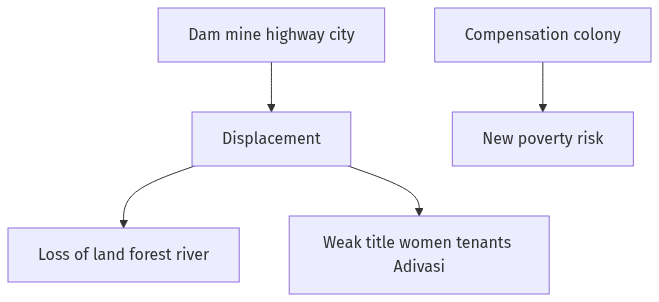
- Displacement is not only a house lost. It is the break of common forest, river, shrine, and work that A. R. Desai would treat as a class dispossession.
- Compensation, when it comes, usually prices private title and ignores women, tenants, and forest users without papers.
- Resettlement colonies can produce a new poor rather than restore a community.
Case studies
- The Narmada projects, especially Sardar Sarovar, displaced Adivasi and peasant villages across state borders; the Narmada Bachao Andolan made the sociology public: who gains irrigation and power, who loses the riverbank.
- Hirakud and later large dams showed an older pattern: downstream cities and canals, upstream submergence of the already weak.
- Mining and industrial corridors in Odisha, Jharkhand, and Chhattisgarh have moved Adivasi households for ore and plants, which is integration-as-dispossession rather than Nehruvian partnership.
- Urban projects and protected forests also displace slum and pastoral users, so the concept is not only rural.
Sociological expansion
- Caste and tribe sort who is ‘sacrificed’ for the national surplus.
- Yogendra Singh’s modernizing state uses law and science as heterogenetic force; the village tradition of riverine life is not asked for consent in fact.
Flow diagram
Conclusion
Development-induced displacement is organised eviction for a public project. Narmada and mining belts show that growth can deepen agrarian and tribal inequality unless land and voice come first.
Quick related
Students also ask
-
"Instead of promoting equality in society , the present system of education itself has contributed to increased socio economic disparities" Comment .
Next question on this syllabus topic (2022 · Q7(a)). View answer →
-
Is all displacement development-induced?
No. War, disaster and communal violence also displace. This concept names project-led eviction.
-
Does a rehabilitation package cancel displacement?
A fair package can reduce harm. It does not automatically restore community, forest or river rights.
Same topic · past papers
UPSC has asked this before
These previous-year questions sit on the same topic. Open one to practise the earlier ask.
-
2023 · Q8(a) · Sociology GS 2 · 20 marks
Explain the thematic linkages between 'Patriarchy' and 'Honour killing' in India, citing some recent cases
More from this topic
Q7(b) · UPSC Mains 2026 · Sociology GS 2 · 20 marks · Solution
Give a sociological explanation of violence against women in India. What suggestions would you give to mitigate these violences?
Challenges of Social Transformation
• Rooted in structural patriarchy, unequal socialization, and institutionalized gender roles within public and private spheres. • Sustained by family, marriage, and religion, which normalize male dominance and control over women's autonomy. • Intersecting factors like class, caste, and religion expose marginalized women to multiple layers of structural violence. • Requires rigorous legal enforcement and gender-sensitizing law enforcement to improve justice delivery. • Demands stronger institutional support, including one-stop crisis centers, helplines, and accessible legal aid. • Calls for educational reforms and community engagement to dismantle toxic masculinity and promote gender equality. • Grounded in Articles 14 and 21, demanding a shift toward transformative social engineering and substantive equality.
Q8(b) · UPSC Mains 2025 · Sociology GS 2 · 20 marks · Solution
Do you think that forced displacement of labourers has caused their deprivation and resultant inequalities during the recent past years? Elaborate
Challenges of Social Transformation
Forced displacement strips land, commons and urban foothold, then cheapens labour. Cernea’s impoverishment risks and Fernandes’s undercounting still describe Indian projects. Recent drivers include mining, highways, city beautification, conflict, climate and COVID reverse migration. Women, ST, SC and migrants lose most; land-value winners gain. R&R law exists; deprivation remains the modal outcome when consent and livelihoods are thin.
Q8(a) · UPSC Mains 2025 · Sociology GS 2 · 20 marks · Solution
Is it possible to have sustainable development in India? Cite major environmental issues and suggest a few measures to achieve the sustainability
Challenges of Social Transformation
Sustainable development is possible in India only if growth is decoupled from dumping costs on the poor. Main issues are climate risk, air and water stress, forest loss, land conversion and inequality. Guha–Gadgil’s sociology of ecosystem people versus omnivores still explains who suffers. Measures include just energy transition, FRA, crop and city reform, and SDG-consistent budgets. Possibility is a political path, not a technical guarantee.