
Revision summary
Pressure groups influence policy without ordinarily taking office. Pluralists treat them as necessary vehicles of interest articulation. Critics note unequal organising power, capture and majoritarian or caste intimidation. Olson explains why concentrated interests beat diffuse majorities. Indian farmers’ protests, chambers of commerce and caste associations show both voices and capture. The answer is conditional: necessary, and dangerous without equality and transparency.
Model answer
Copper italics in this answer — like this — are the key facts. Each one is unpacked in the Facts & figures rail.
Introduction
Pressure groups, or interest groups, are organised associations that seek to influence public policy without themselves usually forming the government. Business chambers, farmers’ unions, professional bodies, caste associations, student unions and environmental campaigns all belong here. Arthur Bentley and David Truman made them central to the empirical study of democracy. The sociological question is not whether they exist, but whether they deepen popular rule or quietly replace it.
Body
Necessary element
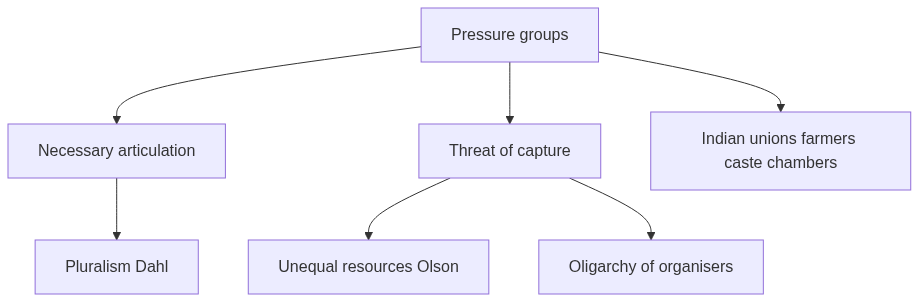
In a complex society the citizen cannot speak on every technical file. Almond and Powell called interest articulation a function of the political system. Pressure groups supply information, mobilise members, and check a remote bureaucracy. Robert Dahl’s pluralism pictured power as dispersed among competing groups, so that no single class monopolises the state. In India, the farmers’ movements that culminated in the 2020–21 protests, trade unions in industrial belts, the Narmada Bachao Andolan, and disability-rights groups have put issues on the agenda that parties had delayed. Caste associations have also been vehicles of political education and reservation claims. Without such groups, democracy shrinks to a periodic vote.
Threat
Elite and Marxist critics reply that groups are not equal. E. E. Schattschneider wrote that the pluralist heaven sings with an upper-class accent. Mancur Olson showed that small concentrated interests organise more easily than large diffuse ones: a tariff for a few firms beats a quiet loss for millions of consumers. Regulatory capture, “iron triangles” and black money turn pressure into privatisation of the state. Caste and communal organisations can polarise, intimidate, and hollow out citizenship. Business houses fund think tanks and media while informal workers remain weakly unionised. Feminist and environmental groups may win law on paper and lose implementation. Mosca and Michels, though writing of elites and parties, warn that organisation itself tends toward oligarchy: the office-bearers of a union or an NGO may cease to represent the base.
The balanced sociological judgement is therefore conditional. Pressure groups are necessary for a living democracy and dangerous when resources, media and coercive honour are unequal. Law on lobbying, transparency of political funding, and the capacity of poor people’s organisations decide which face appears. Illustrations should always pair a democratic gain with a capture risk, not preach a single slogan.
Flow diagram
Conclusion
Pressure groups are a necessary element of democratic interest articulation and a possible threat when organisation follows wealth, caste and oligarchy. The examiner wants both faces, with theory and Indian examples. Democracy needs associations; it also needs them to be contestable and relatively equal.
Quick related
Students also ask
-
What would you identify as the similarities and differences in the elite theories of Mosca, Michels and Pareto? Discuss their main/crucial issues
Next question on this syllabus topic (2025 · Q4(b)). View answer →
-
Are political parties pressure groups?
No. Parties seek office and aggregate many interests. Pressure groups usually remain outside government while trying to steer it.
-
Are caste associations only a threat?
They have been both a ladder of political inclusion and a vehicle of exclusion. A one-sided answer misses the sociology.
Same topic · past papers
UPSC has asked this before
These previous-year questions sit on the same topic. Open one to practise the earlier ask.
-
2022 · Q7(c) · Sociology GS 1 · 15 marks
Illustrate with examples the role of pressure groups in the formulation of social policies. -
2021 · Q6(b) · Sociology GS 1 · 20 marks
Explain how political parties and pressure groups are dialectically related to each other in terms of achieving their goals -
2021 · Q2(b) · Sociology GS 1 · 20 marks
How far are sociologists justified in using positivist approach to understand social reality ? Explain with suitable illustrations -
2021 · Q4(a) · Sociology GS 1 · 20 marks
Explain the concept of social mobility. Describe with suitable illustrations how education and social mobility are related to each other
More from this topic
Q8(a) · UPSC Mains 2026 · Sociology GS 1 · 20 marks · Solution
How are the concepts of nation, state and citizenship interrelated in a democracy? Elaborate
Politics and Society
• The state is the sovereign institutional apparatus that maintains law and order within a defined territory. • The nation is an imagined community bound by shared culture, history, language, or political values. • Citizenship acts as the legal bridge connecting individuals to the collective through rights and duties. • Modern democracies must constantly balance universal citizenship rights with particular national cultural loyalties. • State authority derives its democratic legitimacy directly from the active participation of its citizens. • Globalisation, migration, and multiculturalism increasingly challenge the traditional boundaries of nation-states. • Maintaining a healthy democracy requires inclusive citizenship that prevents majoritarian identities from marginalising minorities.
Q4(a) · UPSC Mains 2026 · Sociology GS 1 · 20 marks · Solution
Elaborate major sociological theories of power. How does power shape political process in modern societies?
Politics and Society
• Marx views power as structurally tied to economic ownership and class dominance. • Weber defines power as
Q1(e) · UPSC Mains 2026 · Sociology GS 1 · 10 marks · Solution
Explain in brief the relationship between social movement, collective action and revolution in bringing about social and political changes.
Politics and Society
This 10-marker for Sociology Paper I examines the continuum between everyday collective action, structured social movements, and radical revolutions in driving systemic social and political change. Collective action provides the foundational mobilization, social movements sustain ideological and institutional pressure, and revolution marks a structural rupture leading to regime change. The answer utilizes classical sociological frameworks from Tilly, Marx, and Smelser to explain this continuum. It includes a concise Mermaid flowchart illustrating the progressive escalation from mobilization to structural transformation. The response concludes by linking grassroots agency to democratic consolidation and policy reform.