
Revision summary
Comte expected science to replace theology; Weber expected disenchantment of technique. Secularisation is regional, not a universal emptying of faith. Relations include conflict, institutional separation and practical coexistence. Berger’s later desecularisation thesis matches much of the contemporary world. India shows high-tech science beside public ritual and sacred politics. The modern pattern is differentiation plus plurality, not a simple war.
Model answer
Copper italics in this answer — like this — are the key facts. Each one is unpacked in the Facts & figures rail.
Introduction
Modern society is often described as scientific, and science is often described as the opposite of religion. The sociological relationship is more mixed. Auguste Comte expected a scientific stage to replace theological thought. Max Weber spoke of disenchantment: calculation drives out magic. Later research found secularisation in some regions and religious revival in others. Science and religion now compete, ignore, and sometimes bless each other in the same public sphere.
Body
Conflict, separation and coexistence
Conflict appears in creation controversies, in battles over reproductive technology, and when clerical authority denies epidemiological advice. The independence model, close to Stephen Jay Gould’s “non-overlapping magisteria,” treats science as how the heavens go and religion as how to go to heaven. Dialogue appears in religious environmentalism and in scientists who remain practising believers. Peter Berger first expected secularisation, then stressed desecularisation: the world is furiously religious, with pockets of European-style unbelief.
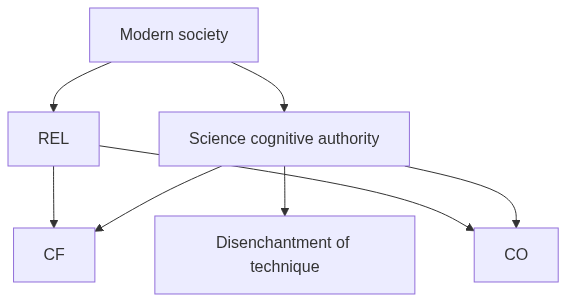
Weber’s disenchantment never meant that temples empty overnight. It meant that technical rationality becomes the default for administration, medicine and production, while meaning and theodicy may still be sought in faith. Thomas Luckmann described invisible religion; Durkheim already allowed civic sacredness. In India, space missions and large science laboratories coexist with ritual at launch, pilgrimage economies, and political uses of sacred geography. Ayurveda and evidence-based medicine negotiate prestige. Anti-superstition movements and new gurudoms grow together.
The nature of the relationship in modern society is therefore structurally differentiated and empirically plural. Science claims cognitive authority over empirical nature; religion claims authority over ultimate meaning, identity and often morality. The state, the market and the media decide which claim wins in a given dispute. A single formula of inevitable conflict is as unhelpful as a pious harmony.
Flow diagram
Conclusion
Science and religion in modern society are differentiated institutions that sometimes clash, sometimes ignore each other, and sometimes intertwine in ritual and politics. Disenchantment names a tendency of technique, not the death of the sacred. Examples should show that plurality, not a winner-takes-all story.
Quick related
Students also ask
-
How does a multicultural society accommodate diversities of all kinds-ethnic, linguistic, and religious? Discuss its major challenges
Next question on this syllabus topic (2024 · Q6(b)). View answer →
-
Does a scientist performing a puja disprove disenchantment?
No. It shows differentiation: technical work can follow science while meaning and luck are still ritualised.
-
Is conflict the true modern relation?
It is one relation, visible in bioethics and schooling debates, not the only one.
Same topic · past papers
UPSC has asked this before
These previous-year questions sit on the same topic. Open one to practise the earlier ask.
-
2016 · Q7(a) · Sociology GS 1 · 20 marks
"Religious pluralism is the order of present-day societies." Explain by giving suitable examples. -
2021 · Q4(c) · Sociology GS 1 · 10 marks
With suitable examples, explain how conformity and deviance coexist in a society as propounded by R.K. Merton -
2019 · Q5(a) · Sociology GS 1 · 10 marks
Differentiate between 'Life-chances' and 'Life-style' with suitable examples -
2018 · Q5(d) · Sociology GS 1 · 10 marks
Distinguish between qualitative techniques of data collection with suitable examples from Indian society. -
2016 · Q6(a) · Sociology GS 1 · 20 marks
"Globalization has pushed the labour into informal organization of work." Substantiate your answer with suitable examples.
More from this topic
Q6(c) · UPSC Mains 2026 · Sociology GS 1 · 10 marks · Solution
How does the rise of new 'cults' and 'sects' influence intercaste relations?
Religion and Society
• Neo-religious sects and cults act as catalysts, altering traditional ritual hierarchies and intercaste dynamics. • Groups like Radhasoami and Brahma Kumaris create egalitarian spaces where caste markers are secondary. • They continue Bhakti traditions, offering lower castes dignity and spiritual authority denied by orthodox structures. • Sectarian affiliation aids upward mobility, helping groups shed stigmatized identities through behavioral purification. • Independent economic and educational resources reduce lower-caste dependence on dominant agrarian castes. • While sometimes reproducing internal stratification, these sects largely promote societal democratization and equality.
Q3(a) · UPSC Mains 2026 · Sociology GS 1 · 20 marks · Solution
Discuss the relationship between religion and science in modern society. Do they necessarily remain in conflict?
Religion and Society
• Modernity features the dual rise of scientific rationality and institutionalised secularisation.
Q7(b) · UPSC Mains 2024 · Sociology GS 1 · 20 marks · Solution
How do you understand the phenomena of the mushrooming of sects and cults in contemporary society? Discuss the factors responsible for the trend
Religion and Society
Church–sect theory treats sects as demanding protest groups beside an accommodated church. Cult, in careful use, names looser or new mystical memberships, not a tabloid insult. New religious movements are the contemporary research label for much of this field. Factors include urban migration, a market in belief, charismatic founders and media. Crises of meaning and weak monopoly of old churches open space for new groups. India’s guru organisations and global NRMs illustrate the same structural trend.