
Revision summary
Sampling selects units so researchers can speak carefully about a population. Probability samples give known chances of selection and estimable error. Stratified designs aid comparison; cluster designs save cost and inflate error. Non-probability samples help exploratory and hidden-population work. Convenience and quota designs are often misused as if they were random. Match the sampling form to the claim: national rates versus theoretical cases.
Model answer
Copper italics in this answer — like this — are the key facts. Each one is unpacked in the Facts & figures rail.
Introduction
Sampling in social research is the selection of a subset of persons, households, organisations or events from a defined population so that we can say something disciplined about the whole. A census is rarely possible. The quality of a survey on caste, voting or nutrition stands or falls with how the sample was drawn. Different forms of sampling trade representativeness against cost, access and the need for depth.
Body
Probability sampling
In probability designs every unit has a known, non-zero chance of selection, which allows sampling error to be estimated.
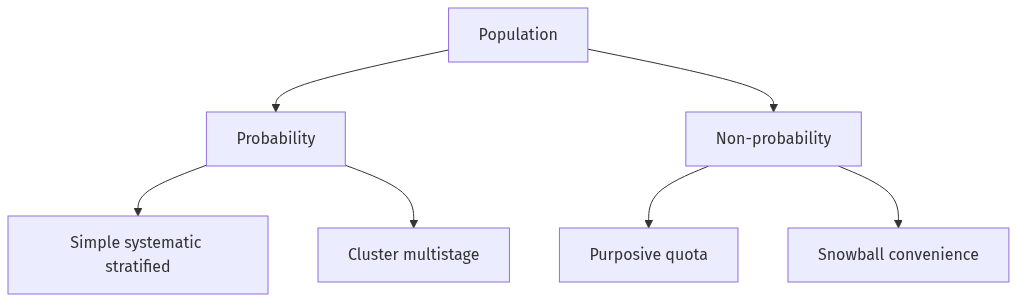
Simple random sampling gives each unit equal chance. It is unbiased in theory and clumsy in practice when no complete list exists, as in an unlisted slum. Systematic sampling takes every kth unit from a list; it is convenient but dangerous if the list has a hidden period. Stratified sampling divides the population into strata—region, caste group, rural/urban—and samples within each. It improves precision for comparisons and needs good stratum information. Cluster and multistage sampling, used by NSSO and NFHS, select villages or blocks first, then households. They cut travel costs and raise design effects: people in a cluster are alike, so effective sample size shrinks. Advantages of probability samples are generalisability and honest margins of error. Disadvantages are cost, non-response, outdated frames, and ethical or political difficulty of listing stigmatised populations.
Non-probability sampling
Convenience samples of students or online volunteers are cheap and weak for inference. Purposive samples choose theoretically important cases, essential in ethnography and case comparison. Quota samples mimic margins of sex or age without random selection; they look representative and hide interviewer bias. Snowball samples follow networks and are often the only way to reach hidden populations—drug users, undocumented migrants, queer networks—but they over-represent the well connected.
No single form is best. A national poverty estimate needs a probability design. A study of a new sect may need snowballing. Mixed designs are common. The sociologist’s duty is to match form to claim: do not generalise a campus convenience sample to “Indian youth.”
Flow diagram
Conclusion
Sampling is the bridge from studied cases to a population. Probability forms support statistical inference at a price; non-probability forms support access and theory at the price of unknown bias. Advantages and disadvantages are not abstract: they decide whether a sociological statement is a finding or an anecdote.
Quick related
Students also ask
-
What are variables? How do they facilitate research?
Next question on this syllabus topic (2023 · Q2(c)). View answer →
-
Is a large convenience sample as good as a small random sample?
No. Size does not cancel selection bias. A large online poll can be precisely wrong.
-
Why do NFHS-type surveys use multistage clusters?
Because listing and visiting every household nationally is too costly; clusters trade some precision for feasibility.
Same topic · past papers
UPSC has asked this before
These previous-year questions sit on the same topic. Open one to practise the earlier ask.
-
2023 · Q4(a) · Sociology GS 1 · 20 marks
Do you think that common sense is the starting point of social research? What are its advantages and limitations? Explain -
2025 · Q3(c) · Sociology GS 1 · 10 marks
What is hypothesis? Critically evaluate the significance of hypothesis in social research -
2020 · Q5(b) · Sociology GS 1 · 10 marks
Discuss the importance and sources of hypothesis in social research. -
2017 · Q3(c) · Sociology GS 1 · 10 marks
Examine epistemological foundation of qualitative methods of social research -
2016 · Q1(c) · Sociology GS 1 · 10 marks
Analyze the importance of qualitative methods in social research
More from this topic
Q3(c) · UPSC Mains 2025 · Sociology GS 1 · 10 marks · Solution
What is hypothesis? Critically evaluate the significance of hypothesis in social research
Research Methods and Analysis
A hypothesis is a testable claim about relations among variables. It guides measurement, sampling, statistical tests and evaluation studies. Mertonian middle-range theory prefers such claims to total systems. Grounded theory and exploratory ethnography warn against premature locking. Bad hypotheses reify official categories and cannot be falsified. Significance is high when the statement can be shown to be wrong.
Q2(c) · UPSC Mains 2023 · Sociology GS 1 · 10 marks · Solution
What are variables? How do they facilitate research?
Research Methods and Analysis
A variable is a property with more than one value across cases. Independent, dependent, and control variables structure causal claims. They enable hypothesis, measurement, and comparison, as in Durkheim’s suicide rates and survey tables. Operationalisation turns concepts into observable values. A variable remains an index. It is not the whole social relation.
Q2(b) · UPSC Mains 2022 · Sociology GS 1 · 15 marks · Solution
Explain the different types of non- probability sampling techniques .Bring out the conditions of their usage with appropriate examples.
Research Methods and Analysis
Non-probability sampling gives no known chance of selection. Convenience, purposive, quota, snowball, and theoretical sampling fit pilots, types, hidden groups, and saturation. Gig networks, SHGs, and caste associations are typical Indian uses. Census and NFHS remain the designs for rates. Name the bias; do not sell a quota as a random national fact.