
Revision summary
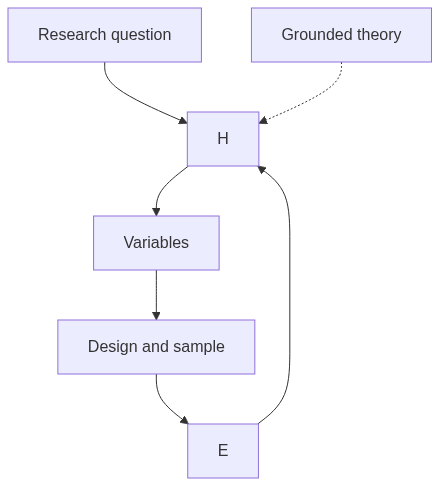
A hypothesis is a testable claim about relations among variables. It guides measurement, sampling, statistical tests and evaluation studies. Mertonian middle-range theory prefers such claims to total systems. Grounded theory and exploratory ethnography warn against premature locking. Bad hypotheses reify official categories and cannot be falsified. Significance is high when the statement can be shown to be wrong.
Model answer
Copper italics in this answer — like this — are the key facts. Each one is unpacked in the Facts & figures rail.
Introduction
A hypothesis is a provisional, testable statement about the relation between two or more variables. It is not a guess thrown into the air, and it is not yet a finding. William Goode and Paul Hatt treated it as the working tool that turns a vague interest into a researchable question. Robert Merton’s middle-range theory lives on hypotheses that can meet evidence, rather than on total systems that explain everything in advance.
Body
Significance in social research
A clear hypothesis names independent and dependent variables, and often the direction of the link: “higher years of women’s schooling are associated with lower completed fertility, controlling for household wealth.” That sentence decides what to measure, whom to sample, and which table or model is relevant. It allows a null hypothesis to be stated and, in quantitative work, statistically assessed. It also disciplines the literature review: one reads to derive and refine the claim, as in Durkheim’s derivations about integration and suicide. In applied work, a hypothesis makes evaluation possible: did a sanitation campaign change reported open defecation, or only slogans?
Critical limits
Not all good sociology begins with a hypothesis. Barney Glaser and Anselm Strauss’s grounded theory builds concepts from data precisely because premature hypotheses can force the field into official boxes. Exploratory ethnography of a new platform labour market may need sensitising concepts, not a locked prediction. A badly theorised hypothesis reifies census categories—“modernisation reduces caste”—and then “confirms” them. Qualitative case studies test hypotheses differently, through pattern matching and deviant cases, not only p-values. Hypotheses can also smuggle values: what counts as “development” is already political.
The critical evaluation is therefore that the hypothesis is indispensable for explanatory and survey research, and dangerous when it becomes a cage. Significance is highest when variables are sociologically real and the statement can be wrong. A hypothesis that cannot fail is not a hypothesis.
Flow diagram
Conclusion
A hypothesis states a testable relation and organises measurement, sampling and inference. Its significance is real for scientific sociology. Its limits appear in exploratory and interpretive work, and whenever categories are taken uncritically from the state or from common sense.
Quick related
Students also ask
-
What is sampling in the context of social research? Discuss different forms of sampling with their relative advantages and disadvantages
Next question on this syllabus topic (2025 · Q7(a)). View answer →
-
Must every answer in sociology start with a hypothesis?
No. Descriptive and interpretive studies may not. Explanatory survey work almost always should.
-
Give a simple example.
“Urban residence is positively associated with later age at marriage among women, controlling for education.”
Same topic · past papers
UPSC has asked this before
These previous-year questions sit on the same topic. Open one to practise the earlier ask.
-
2020 · Q5(b) · Sociology GS 1 · 10 marks
Discuss the importance and sources of hypothesis in social research. -
2016 · Q3(c) · Sociology GS 1 · 15 marks
"Hypothesis is a statement of the relationship between two or more variables."Elucidate by giving example of poverty and illiteracy. -
2025 · Q7(a) · Sociology GS 1 · 20 marks
What is sampling in the context of social research? Discuss different forms of sampling with their relative advantages and disadvantages -
2017 · Q3(c) · Sociology GS 1 · 10 marks
Examine epistemological foundation of qualitative methods of social research -
2016 · Q1(c) · Sociology GS 1 · 10 marks
Analyze the importance of qualitative methods in social research
More from this topic
Q7(a) · UPSC Mains 2025 · Sociology GS 1 · 20 marks · Solution
What is sampling in the context of social research? Discuss different forms of sampling with their relative advantages and disadvantages
Research Methods and Analysis
Sampling selects units so researchers can speak carefully about a population. Probability samples give known chances of selection and estimable error. Stratified designs aid comparison; cluster designs save cost and inflate error. Non-probability samples help exploratory and hidden-population work. Convenience and quota designs are often misused as if they were random. Match the sampling form to the claim: national rates versus theoretical cases.
Q2(c) · UPSC Mains 2023 · Sociology GS 1 · 10 marks · Solution
What are variables? How do they facilitate research?
Research Methods and Analysis
A variable is a property with more than one value across cases. Independent, dependent, and control variables structure causal claims. They enable hypothesis, measurement, and comparison, as in Durkheim’s suicide rates and survey tables. Operationalisation turns concepts into observable values. A variable remains an index. It is not the whole social relation.
Q2(b) · UPSC Mains 2022 · Sociology GS 1 · 15 marks · Solution
Explain the different types of non- probability sampling techniques .Bring out the conditions of their usage with appropriate examples.
Research Methods and Analysis
Non-probability sampling gives no known chance of selection. Convenience, purposive, quota, snowball, and theoretical sampling fit pilots, types, hidden groups, and saturation. Gig networks, SHGs, and caste associations are typical Indian uses. Census and NFHS remain the designs for rates. Name the bias; do not sell a quota as a random national fact.