
Revision summary
A variable is a property with more than one value across cases. Independent, dependent, and control variables structure causal claims. They enable hypothesis, measurement, and comparison, as in Durkheim’s suicide rates and survey tables. Operationalisation turns concepts into observable values. A variable remains an index. It is not the whole social relation.
Model answer
Copper italics in this answer — like this — are the key facts. Each one is unpacked in the Facts & figures rail.
Introduction
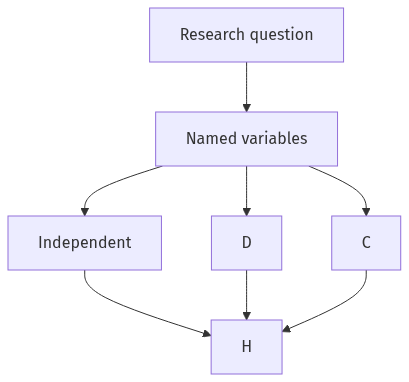
A variable is a property that takes more than one value across cases. Research proceeds by naming variables, stating how they relate, and measuring those values. Without variables, a study remains a stack of stories that cannot be compared.
Body
Types that matter
- An independent variable is the condition the researcher treats as a presumed cause or grouping factor.
- A dependent variable is the outcome to be explained.
- Control variables are held constant so that a false association is less likely.
- Discrete variables take categories, such as sex or caste group. Continuous variables take degrees, such as income or years of schooling.
- Durkheim treated suicide rates as a social fact that varied with integration and regulation, which is variable analysis at the level of rates.
How they facilitate research
- They turn a vague interest into a hypothesis: as education rises, age at marriage rises, other things equal.
- They allow operationalisation: poverty becomes a consumption line or a multidimensional index, not a mood.
- They make comparison possible across time, region, and group, which is why census and National Family Health Survey tables can be read sociologically.
- They discipline theory. If class is said to explain voting, class must be specified as occupation, income, or relation to surplus.
- Experiments, surveys, and even qualitative coding use variables when they sort cases by presence or absence of a trait.
Cautions
- Reification is the risk: a scale is not the whole of caste or piety.
- Spurious correlation appears when a third variable is ignored.
- Feminist method reminds us that the choice of variables already contains a standpoint.
Flow diagram
Conclusion
Variables are properties that vary. They facilitate research by making hypotheses, measurement, comparison, and control possible. Durkheim’s rates and contemporary surveys show the gain. The gain is lost if the variable is mistaken for the full social relation it only indexes.
Quick related
Students also ask
-
Explain the different types of non- probability sampling techniques .Bring out the conditions of their usage with appropriate examples.
Next question on this syllabus topic (2022 · Q2(b)). View answer →
-
Do qualitative studies avoid variables?
They often avoid numbers. They still sort cases by presence, absence, and degree of traits.
-
Is caste a variable?
Caste can be coded as a category in a table. The lived order is a relation, which the code only indexes.
Same topic · past papers
UPSC has asked this before
These previous-year questions sit on the same topic. Open one to practise the earlier ask.
-
2016 · Q3(c) · Sociology GS 1 · 15 marks
"Hypothesis is a statement of the relationship between two or more variables."Elucidate by giving example of poverty and illiteracy. -
2015 · Q1(c) · Sociology GS 1 · 10 marks
What are variables? Discuss their role in experimental research. -
2020 · Q1(e) · Sociology GS 1 · 10 marks
Analyse the relevance of 'Pattern variables' in the study of social change.
More from this topic
Q7(a) · UPSC Mains 2025 · Sociology GS 1 · 20 marks · Solution
What is sampling in the context of social research? Discuss different forms of sampling with their relative advantages and disadvantages
Research Methods and Analysis
Sampling selects units so researchers can speak carefully about a population. Probability samples give known chances of selection and estimable error. Stratified designs aid comparison; cluster designs save cost and inflate error. Non-probability samples help exploratory and hidden-population work. Convenience and quota designs are often misused as if they were random. Match the sampling form to the claim: national rates versus theoretical cases.
Q3(c) · UPSC Mains 2025 · Sociology GS 1 · 10 marks · Solution
What is hypothesis? Critically evaluate the significance of hypothesis in social research
Research Methods and Analysis
A hypothesis is a testable claim about relations among variables. It guides measurement, sampling, statistical tests and evaluation studies. Mertonian middle-range theory prefers such claims to total systems. Grounded theory and exploratory ethnography warn against premature locking. Bad hypotheses reify official categories and cannot be falsified. Significance is high when the statement can be shown to be wrong.
Q2(b) · UPSC Mains 2022 · Sociology GS 1 · 15 marks · Solution
Explain the different types of non- probability sampling techniques .Bring out the conditions of their usage with appropriate examples.
Research Methods and Analysis
Non-probability sampling gives no known chance of selection. Convenience, purposive, quota, snowball, and theoretical sampling fit pilots, types, hidden groups, and saturation. Gig networks, SHGs, and caste associations are typical Indian uses. Census and NFHS remain the designs for rates. Name the bias; do not sell a quota as a random national fact.