
Revision summary
Historical materialism explains social change from production, property and class struggle. Base and superstructure name the constraint of material life on law, politics and ideas. Capitalism is defined by wage labour, surplus value and contradiction. The theory remains relevant for global accumulation, gig work and India’s informal labour. Weberian status, feminist unpaid labour and culture mark its limits. Use it as a diagnostic of inequality, not as a total theory of society.
Model answer
Copper italics in this answer — like this — are the key facts. Each one is unpacked in the Facts & figures rail.
Introduction
Historical materialism is Karl Marx’s theory of how societies change. It holds that the way people produce their material life—forces of production and relations of production—sets the broad conditions for law, politics, religion and ideas, which he called the superstructure. History moves through contradiction and class struggle, not through the march of spirit that Hegel had imagined. The question is whether this map still helps us read contemporary societies, including India.
Body
Main features
The mode of production joins technology and labour (forces) to property and surplus extraction (relations). Ancient, feudal and capitalist modes are successive, though not a smooth ladder. In capitalism the bourgeoisie own the means of production and the proletariat sell labour power. Surplus value is pumped from the working day. Class struggle is the motor: classes in themselves may become classes for themselves. Ideology, including religion, often naturalises the existing relations; this is why Marx called religion the opium of the people in a precise, not merely abusive, sense. The legal and political superstructure is not a puppet in every hour, but in the last instance it is constrained by the economic base. Dialectics means change through contradiction: socialisation of production versus private appropriation, for example.
Friedrich Engels later emphasised that the superstructure can react on the base. Antonio Gramsci’s hegemony and later Marxist cultural theory stretched the original preface of 1859 without abandoning production.
Relevance now
Global capitalism still organises life around wage labour, commodity production and crises of over-accumulation. Platform firms extract value from gig workers who look like independent contractors, a form Marx would have recognised as real subsumption of labour. India’s vast informal sector, circular migration and agrarian distress are intelligible as combined and uneven development, not as a lag of “tradition”. Ecological crisis can be read as a rift in the metabolism between society and nature, a theme John Bellamy Foster recovered from Marx. Caste does not vanish, but class analysis still explains who owns land, factories and platforms.
Limits are equally part of a critical answer. Max Weber showed that status, party and religious ethics can steer economic action, as in the Protestant-ethic thesis. Gendered unpaid labour is not a footnote, as Marxist feminists argued. The twentieth-century socialist states complicated the prediction of proletarian emancipation. Culture, nationalism and digital identity are not mere reflections. Relevance, then, is diagnostic: historical materialism remains a powerful theory of accumulation and inequality, not a complete sociology of every institution.
Flow diagram
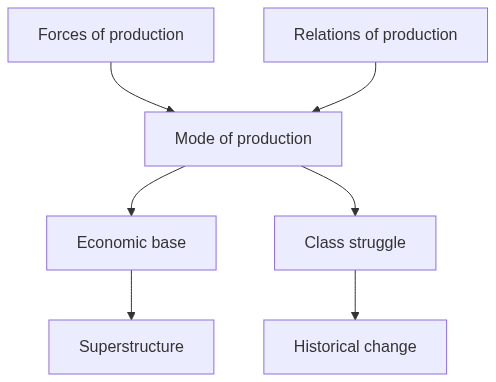
Conclusion
Marx’s features are mode of production, base and superstructure, class struggle and dialectical contradiction. The theory still illuminates global capitalism, informal labour and crisis. It is less sufficient alone for gender, caste honour and meaning, which is why contemporary sociology uses it with, not instead of, other tools.
Quick related
Students also ask
-
What do you understand by gender-based domestic division of labour? Is it undergoing a change in the wake of increasing participation of women in formal employment? Clarify your answer with illustrations
Next question on this syllabus topic (2025 · Q6(b)). View answer →
-
Does historical materialism deny ideas any power?
In the strong slogan, yes. Engels and later Marxists allowed reaction of the superstructure. A balanced answer avoids cartoon economism.
-
Is caste a disproof of Marx in India?
No, but caste cannot be reduced to class. The theory is relevant for property and labour, incomplete for endogamy and honour.
Same topic · past papers
UPSC has asked this before
These previous-year questions sit on the same topic. Open one to practise the earlier ask.
-
2023 · Q2(b) · Sociology GS 1 · 20 marks
What is historical materialism? Examine its relevance in understanding contemporary societies -
2017 · Q3(b) · Sociology GS 1 · 20 marks
Analyse Marxian conception of historical materialism as a critique of Hegelian dialectics -
2026 · Q8(b) · Sociology GS 1 · 20 marks
Critically evaluate the relevance of the cyclical theory of social change in understanding contemporary societies -
2016 · Q2(a) · Sociology GS 1 · 20 marks
Elucidate the basic premises of Davis' structural-functional theory of social stratification. How far is it relevant in understanding contemporary Indian society.
More from this topic
Q7(c) · UPSC Mains 2026 · Sociology GS 1 · 10 marks · Solution
Compare the social organisation of work in industrial capitalism and platform capitalism
Sociological Thinkers: Karl Marx
• **Setting:** Industrial capitalism centres work in physical factories; platform capitalism disperses it via digital apps. • **Control:** Factories use direct managerial supervision and time-discipline; platforms use invisible algorithms and automated ratings. • **Contracts:** Industrial work relies on standard, secure employment with welfare benefits; platform work relies on gig contracts and independent contractors. • **Risk:** Factories shoulder capital costs; platform capitalism shifts risks and equipment costs onto individual workers. • **Solidarity:** Shared factory spaces foster collective class consciousness; digital isolation creates an atomised "precariat." • **Surplus Value:** Both systems extract surplus value, but platforms obscure exploitation behind the illusion of entrepreneurial freedom.
Q5(d) · UPSC Mains 2026 · Sociology GS 1 · 10 marks · Solution
How does Max Weber's 'theory of authority' shape bureaucracy? Analyse.
Sociological Thinkers: Karl Marx
Max Weber's sociological framework links different forms of legitimate domination directly to the rise of modern rational-legal bureaucracy. Traditional and charismatic authority provide historical context, but rational-legal authority creates the impersonal rules, hierarchy, and technical expertise defining bureaucratic structures. While ensuring efficiency, this iron cage of rationalisation also poses risks of alienation and goal displacement, which later thinkers critiqued.
Q3(c) · UPSC Mains 2026 · Sociology GS 1 · 10 marks · Solution
How does Emile Durkheim conceptualize religion as a 'social fact'? Explain
Sociological Thinkers: Karl Marx
Emile Durkheim treats religion as a quintessential social fact in 'The Elementary Forms of the Religious Life' (1912). Moving away from supernatural or animistic definitions, he argues that religion is fundamentally a collective product. Society objectifies its own moral authority and solidarity through sacred symbols and rituals. By separating the sacred from the profane, religious practices reinforce social integration and collective consciousness. Thus, religion is society worshipping itself, operating as an external and coercive constraint upon individual thought and action.