
Revision summary
Formal organisations claim impersonal merit; gendered sociology shows otherwise. Acker’s gendered job, Kanter’s tokens and Hochschild’s second shift are core arguments. Pay gaps, glass ceilings and care penalties persist inside contracts and appraisals. POSH law in India is evidence that formal offices were not automatically safe. Formalisation can reduce some arbitrary power but also bureaucratises male defaults. The argued case is that formal workspaces are not free of gender bias.
Model answer
Copper italics in this answer — like this — are the key facts. Each one is unpacked in the Facts & figures rail.
Introduction
- Formal workplaces present themselves as rule-bound, meritocratic and impersonal: the office, the factory with contracts, the civil service, the corporate firm. Max Weber’s bureaucracy promised office without regard to person. The sociological record is that formality has not abolished gender bias. It has often reorganised it as recruitment filters, career clocks, occupational ghettos, pay gaps and cultures of the ideal male worker.
Body
Bias inside the rules
- Joan Acker argued that organisations are gendered: the abstract “job” assumes a body without care burdens and a life without pregnancy. Rosabeth Moss Kanter showed how tokens and skewed sex ratios produce stereotyped roles. Arlie Hochschild described the second shift at home and emotional labour at work, both of which fall more on women. The glass ceiling, glass cliff and sticky floor name patterns that formal appraisal systems still generate. Occupational segregation concentrates women in nursing, teaching, clerical and care-adjacent jobs even inside the formal sector, while boards and shop-floor technical grades remain male-heavy.
Harassment, pregnancy discrimination and the motherhood penalty show that a standing order is not a sex-neutral order. India’s Sexual Harassment of Women at Workplace Act, 2013 (POSH) exists because formal offices were not safe by virtue of being formal. Female labour-force participation has been stubbornly low, and even salaried women cluster in certain services. Dalit and Muslim women face a compounded filter at the gate. LGBTQ workers may be formally employed and informally closeted.
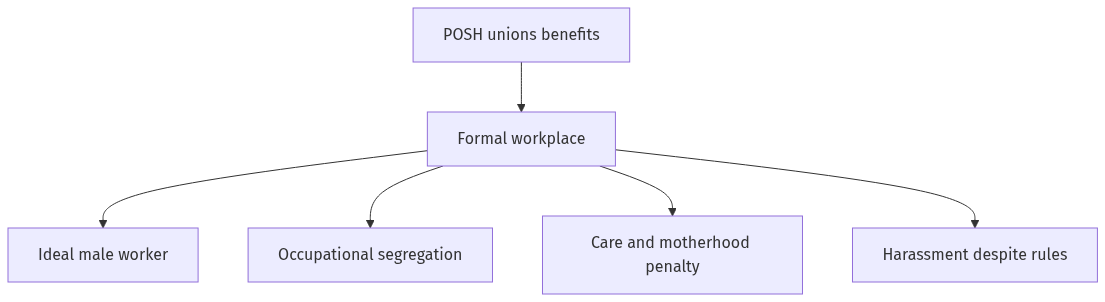
A contrary claim that markets and HR manuals dissolve patriarchy ignores unpaid care as a tax on women’s time, after the Time Use Survey, and ignores client-facing emotional rules that still code authority as male. Formalisation can help: written pay, unions, maternity benefits, internal complaints committees. It does not, by itself, equalise. The case to argue is therefore that formal workspaces are not free of gender bias; they are arenas where bias is bureaucratised and sometimes contested.
Flow diagram
Conclusion
Formal workplaces are organised by gender even when their handbooks deny it. Bias sits in the ideal worker, in care penalties, in segregation and in harassment. Law and unions can check it; formality alone does not erase it.
Quick related
Students also ask
-
What is science? Do you think that the methods used in natural sciences can be applied to sociology? Give reasons for your answer
Next question on this syllabus topic (2025 · Q6(a)). View answer →
-
Does a written equal-opportunity policy settle the question?
No. Policy can coexist with biased evaluation, unsafe cultures and care penalties.
-
Are factories different from offices?
The mix of bias differs—shop-floor masculinities versus corporate presenteeism—but neither is gender-free by being formal.
Same topic · past papers
UPSC has asked this before
These previous-year questions sit on the same topic. Open one to practise the earlier ask.
-
2023 · Q7(b) · Sociology GS 1 · 20 marks
Do you think that the social media has brought significant changes in the forms of protest? Argue your case -
2019 · Q7(b) · Sociology GS 1 · 20 marks
Feminist scholars argue that 'New media' is masculine and hence reinforces structural hierarchies rather than reconfiguring them. Comment -
2022 · Q8(a) · Sociology GS 1 · 20 marks
Sociologists argue for democratization of science and technology for inclusive development. Comment.
More from this topic
Q8(c) · UPSC Mains 2026 · Sociology GS 1 · 10 marks · Solution
Discuss the significance and limitations of 'intersectionality' in social research
Sociology
Intersectionality, coined by Kimberlé Crenshaw, examines how overlapping identities like race, class, and gender shape systemic oppression. Its significance in social research lies in capturing lived realities beyond single-axis frameworks and preventing reductive generalisations. However, limitations include methodological complexity, risks of infinite regress, and difficulties in operationalising fluid categories. Effective application requires balancing structural macro-analysis with micro-level lived experiences.
Q6(b) · UPSC Mains 2026 · Sociology GS 1 · 20 marks · Solution
Critically analyse the nature-nurture debate from different perspectives
Sociology
1. The nature-nurture debate explores whether biology or society primarily shapes human behavior
Q6(a) · UPSC Mains 2026 · Sociology GS 1 · 20 marks · Solution
Discuss the intellectual origins of sociology and its evolution as a distinct field of study
Sociology
Sociology arose in 19th-century Western Europe to make sense of massive upheavals caused by the Industrial and French Revolutions. Enlightenment thinkers laid the groundwork by championing reason, empirical observation, and human agency over traditional dogma. Auguste Comte gave the discipline its name, pushing for a positivist "physics of society" based on scientific laws. Émile Durkheim secured its academic legitimacy by defining "social facts" and using empirical methods to study human behavior. Max Weber introduced interpretive sociology, while Karl Marx focused on material conditions and class struggle. In the 20th century, Talcott Parsons advanced structural-functionalism to study systemic equilibrium. Later, conflict theories, the Frankfurt School, and postmodern critiques broadened the field to address power and marginalisation. Today, sociology continues to evolve by analyzing globalisation, digital shifts, and modern identity politics.