
Revision summary
Multiculturalism is public recognition of ethnic, linguistic and religious diversity. Accommodation uses constitutions, federalism, language policy and civil mixing. India is a principal case of pluralism inside a democratic republic. Challenges include majoritarianism, communal violence and segregated everyday life. Inequality that maps onto community turns culture into conflict. Group rights can clash with gender justice and with a common civic status.
Model answer
Copper italics in this answer — like this — are the key facts. Each one is unpacked in the Facts & figures rail.
Introduction
A multicultural society is one in which several ethnic, linguistic and religious communities live under one political order and claim public recognition, not only private worship. Accommodation means more than tolerance in the home. It means rules, resources and everyday habits that let diversity persist without civil war. The major challenges are those that turn diversity into hierarchy or into separate warring publics.
Body
How accommodation works
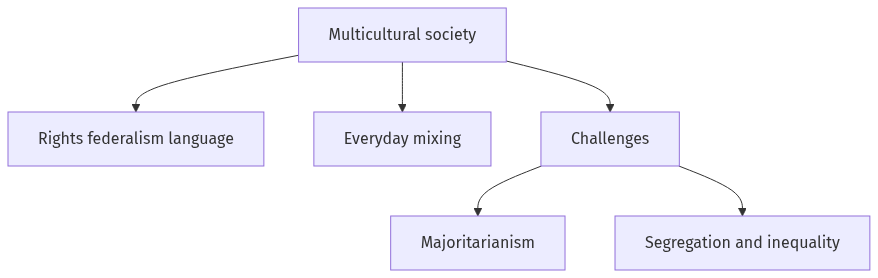
Bhikhu Parekh and Will Kymlicka have argued that liberal states can grant group-differentiated rights, such as language in schools or personal law in limited fields, while keeping a common citizenship. India is a major laboratory. The Constitution recognises linguistic states, minority educational rights, and freedom of religion. Federalism and the Official Languages framework try to accommodate language. Personal laws and, in a different way, the debate over a uniform civil code show the tension between community and equal citizenship. Everyday multiculturalism, as studied in cities, includes markets, schools and neighbourhoods where people deal across difference without becoming one culture.
Accommodation also needs a civil society that is not only communal. Inter-caste and inter-faith associations, a relatively independent press, and public universities have been sites of mixing. T. K. Oommen and others have written on pluralism in India as a historical pattern, not a recent import of a Canadian slogan. The nation-state still supplies a civic umbrella: vote, law and public employment.
Major challenges
Majoritarianism treats the largest religious or linguistic group as the owner of the nation and others as guests. That logic weakens accommodation. Segregation in housing, schools and marriage can produce what some writers call living separately under one flag. Economic inequality, when it maps onto ethnicity or religion, turns cultural difference into class conflict. Communal violence and riots destroy trust that law alone cannot quickly rebuild. A weak common civic culture leaves only community bosses as spokesmen. Feminists have criticised multicultural accommodation when it shelters patriarchal personal laws. Ambedkar’s warning about caste shows that diversity is not only a bouquet of equal cultures. Some differences are structures of oppression.
Global migration has made Western states face similar tests of language, religion and race. The Indian case adds caste and a civilisation of many traditions inside one republic. Successful accommodation is therefore a daily political and educational labour, not a once-and-for-all settlement.
Flow diagram
Conclusion
Multicultural societies accommodate ethnic, linguistic and religious diversity through law, federal arrangements, rights and everyday mixing. The major challenges are majoritarianism, segregation, mapped inequality and a thin civic bond. Diversity survives when equal citizenship is strong enough to hold difference without ranking it.
Quick related
Students also ask
-
How do you understand the phenomena of the mushrooming of sects and cults in contemporary society? Discuss the factors responsible for the trend
Next question on this syllabus topic (2024 · Q7(b)). View answer →
-
Is multiculturalism the same as communalism?
No. Communalism organises political power as religious blocs. Multicultural policy seeks equal belonging with difference.
-
Does a uniform civil code end multiculturalism?
It would change how religious family law is accommodated. Supporters stress equal citizenship; critics fear majority cultural dominance. The debate is part of the challenge.
Same topic · past papers
UPSC has asked this before
These previous-year questions sit on the same topic. Open one to practise the earlier ask.
-
2018 · Q4(c) · Sociology GS 1 · 15 marks
Discuss the challenges thrown by religious revivalism to a secular nation-state. -
2024 · Q6(a) · Sociology GS 1 · 20 marks
Underline the role of social media in contemporary social movements and describe its challenges -
2021 · Q1(c) · Sociology GS 1 · 10 marks
Discuss the challenges involved in collecting data through census method -
2021 · Q5(a) · Sociology GS 1 · 10 marks
Explain the emerging challenges in establishing gender equality in the informal sector -
2021 · Q6(a) · Sociology GS 1 · 20 marks
Elucidate the main problems and challenges faced by the migrant labourers in the recent 'Lockdown period'
More from this topic
Q6(c) · UPSC Mains 2026 · Sociology GS 1 · 10 marks · Solution
How does the rise of new 'cults' and 'sects' influence intercaste relations?
Religion and Society
• Neo-religious sects and cults act as catalysts, altering traditional ritual hierarchies and intercaste dynamics. • Groups like Radhasoami and Brahma Kumaris create egalitarian spaces where caste markers are secondary. • They continue Bhakti traditions, offering lower castes dignity and spiritual authority denied by orthodox structures. • Sectarian affiliation aids upward mobility, helping groups shed stigmatized identities through behavioral purification. • Independent economic and educational resources reduce lower-caste dependence on dominant agrarian castes. • While sometimes reproducing internal stratification, these sects largely promote societal democratization and equality.
Q3(a) · UPSC Mains 2026 · Sociology GS 1 · 20 marks · Solution
Discuss the relationship between religion and science in modern society. Do they necessarily remain in conflict?
Religion and Society
• Modernity features the dual rise of scientific rationality and institutionalised secularisation.
Q7(c) · UPSC Mains 2025 · Sociology GS 1 · 10 marks · Solution
What is the nature of relationship between science and religion in modern society? Analyze with suitable examples
Religion and Society
Comte expected science to replace theology; Weber expected disenchantment of technique. Secularisation is regional, not a universal emptying of faith. Relations include conflict, institutional separation and practical coexistence. Berger’s later desecularisation thesis matches much of the contemporary world. India shows high-tech science beside public ritual and sacred politics. The modern pattern is differentiation plus plurality, not a simple war.