
Revision summary
Church–sect theory treats sects as demanding protest groups beside an accommodated church. Cult, in careful use, names looser or new mystical memberships, not a tabloid insult. New religious movements are the contemporary research label for much of this field. Factors include urban migration, a market in belief, charismatic founders and media. Crises of meaning and weak monopoly of old churches open space for new groups. India’s guru organisations and global NRMs illustrate the same structural trend.
Model answer
Copper italics in this answer — like this — are the key facts. Each one is unpacked in the Facts & figures rail.
Introduction
Sects and cults are organised religious or quasi-religious groups that stand apart from the dominant church or from mainstream culture. Ernst Troeltsch and later Bryan Wilson developed a church–sect typology. In contemporary usage, new religious movements often occupy the same field. Their mushrooming means a visible increase in small, intense, often leader-centred groups. Sociology explains this trend by social conditions, not by mockery of believers.
Body
How to understand sects and cults
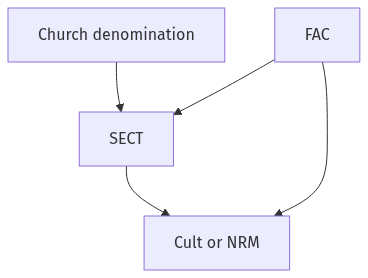
A church, in this tradition, is an inclusive, accommodated religious body aligned with the wider society. A sect is a voluntary, demanding group that protests compromise and claims a purer path. It often recruits from the dissatisfied. H. Richard Niebuhr noted that sects may become denominations over time. A cult, in older American sociology such as Howard Becker’s usage, was a looser, more individualistic, often mystical membership. Later media use of “cult” as a scare word is not a good scientific definition. Roy Wallis distinguished world-rejecting, world-accommodating and world-affirming movements. Eileen Barker’s work on new religious movements asked for empirical study of conversion and leaving, against moral panic.
In India, bhakti panths, reform sampradayas, guru-centred organisations, and urban wellness and meditation brands sit on a related spectrum. Some are old sects. Some are new markets of spirituality.
Factors behind the contemporary trend
Modernisation weakens the monopoly of a single parish church and creates a religious market, as rational-choice writers such as Rodney Stark argued in one influential line. Urban migration cuts people from village ritual and leaves a demand for belonging. Charismatic authority, in Weber’s sense, founds new groups around a gifted leader. Mass media and social media advertise gurus and apocalyptic messages cheaply. Rapid change produces a crisis of meaning and of trust in established clergy, parties and science. Relative deprivation, after Glock and others, can push people toward groups that promise status, healing or election. Globalisation imports movements and also exports Indian gurus. The same openness that supports secular choice supports sectarian choice. State regulation is often weak until a scandal.
The trend is therefore not proof that society is becoming more irrational. It is a sign that belief has been privatised, marketed and networked. Some groups become violent or exploitative, which is a matter for law. Most remain small attempts to rebuild community and certainty.
Why the mushrooming looks sudden
Census religion tables change slowly. The mushrooming is of organisations, brands and intense memberships, not always of a new majority faith. A city neighbourhood may host a meditation centre, a prosperity church, a caste guru’s weekly satsang and an online prophecy group in the same decade. That density is new even when the theological content is old. Factors pile up: spare income among the urban middle class, anxiety about jobs and marriage, distrust of established temples and churches, and a 24-hour screen. Sociology should count organisations and careers of members, and should not treat every new group as a civilisational collapse.
Flow diagram
Conclusion
Sects and cults are intense, often voluntary religious organisations outside the comfortable church. They multiply today because modern life breaks old monopolies and supplies markets, media, charisma and a hunger for meaning. Understanding the trend is a sociological task, not a panic.
Quick related
Students also ask
-
Give your comments on the growth of religious revivalism in the present day context
Next question on this syllabus topic (2021 · Q6(c)). View answer →
-
Do all cults become violent?
No. Violence is a rare outcome. Most groups remain small and many dissolve or become denominations.
-
Is a meditation company a sect?
Some world-affirming movements look like therapies or brands. The sociological test is organisation, belief and demand on members, not the marketing label.
Same topic · past papers
UPSC has asked this before
These previous-year questions sit on the same topic. Open one to practise the earlier ask.
-
2026 · Q4(c) · Sociology GS 1 · 10 marks
"The methods of natural sciences are inadequate in understanding the complex social phenomena." Discuss -
2020 · Q3(b) · Sociology GS 1 · 15 marks
Critically Analyse Durkheim's views on elementary forms of religious life and role of religion Also discuss the consequences of religious revivalism in contemporary society. -
2019 · Q3(a) · Sociology GS 1 · 20 marks
Discuss the importance of interpretative understanding of social phenomena and explain its limitations -
2022 · Q5(a) · Sociology GS 1 · 10 marks
Critically examine the relevance of Durkheim's views on religion in contemporary society. -
2022 · Q8(b) · Sociology GS 1 · 15 marks
Are traditional social institutions getting weakend as agents of social change in the contemporary society ? Substantiate.
More from this topic
Q6(c) · UPSC Mains 2026 · Sociology GS 1 · 10 marks · Solution
How does the rise of new 'cults' and 'sects' influence intercaste relations?
Religion and Society
• Neo-religious sects and cults act as catalysts, altering traditional ritual hierarchies and intercaste dynamics. • Groups like Radhasoami and Brahma Kumaris create egalitarian spaces where caste markers are secondary. • They continue Bhakti traditions, offering lower castes dignity and spiritual authority denied by orthodox structures. • Sectarian affiliation aids upward mobility, helping groups shed stigmatized identities through behavioral purification. • Independent economic and educational resources reduce lower-caste dependence on dominant agrarian castes. • While sometimes reproducing internal stratification, these sects largely promote societal democratization and equality.
Q3(a) · UPSC Mains 2026 · Sociology GS 1 · 20 marks · Solution
Discuss the relationship between religion and science in modern society. Do they necessarily remain in conflict?
Religion and Society
• Modernity features the dual rise of scientific rationality and institutionalised secularisation.
Q7(c) · UPSC Mains 2025 · Sociology GS 1 · 10 marks · Solution
What is the nature of relationship between science and religion in modern society? Analyze with suitable examples
Religion and Society
Comte expected science to replace theology; Weber expected disenchantment of technique. Secularisation is regional, not a universal emptying of faith. Relations include conflict, institutional separation and practical coexistence. Berger’s later desecularisation thesis matches much of the contemporary world. India shows high-tech science beside public ritual and sacred politics. The modern pattern is differentiation plus plurality, not a simple war.