
Revision summary
Social change is theorised as evolution, cycle, conflict, functional adaptation and global hierarchy. Unilinear evolution claims one sequence of stages for all societies. Comte, Morgan and some readings of Marx illustrate the ladder form. Limits include Eurocentrism, teleology and weak handling of collapse and mixture. Multilinear and dependency arguments were developed against that ladder. Differentiation can be kept as a theme without a compulsory staircase.
Model answer
Copper italics in this answer — like this — are the key facts. Each one is unpacked in the Facts & figures rail.
Introduction
Theories of social change try to say how and why societies become different over time. Some see a ladder of stages. Some see cycles. Some see struggle. Some see the working out of functions and adaptation. Unilinear evolutionary theory is the most famous ladder. Its limits are now part of the standard sociological critique, and they should be explained after the wider map of theories.
Body
Various theories of social change
Evolutionary theories, from Auguste Comte’s three stages and Herbert Spencer’s movement from simple to complex, to L. H. Morgan’s savagery–barbarism–civilisation, treat change as directional growth. Cyclical theories, in Vilfredo Pareto’s circulation of elites, Oswald Spengler, and to some extent Pitrim Sorokin’s cultural mentalities, treat rise and fall as recurrence. Conflict theories, especially Karl Marx’s historical materialism, treat contradiction and class struggle as the motor. Functionalist theories, in Durkheim’s differentiation and Parsons’s pattern variables and later AGIL adaptation, treat change as a response to strain while seeking a new equilibrium. Modernisation theory in the mid-twentieth century, associated with writers such as W. W. Rostow in economics and several American sociologists, expected poor countries to follow a Western industrial path. Dependency and world-systems theories, from Andre Gunder Frank and Immanuel Wallerstein, reversed that hope and located change in a global hierarchy. Max Weber offered no single law, but rationalisation and unintended consequences as historical processes.
Unilinear theory and its limitations
Unilinear evolution says that all societies pass through the same sequence of stages toward a single mature form, usually modelled on nineteenth-century Europe. Comte, Morgan and, in a cruder textbook form, some colonial anthropology used this shape. Marx’s preface can be read as a sequence of modes of production, though he also wrote about the Asiatic form and later correspondence that complicates a single ladder.
Limitations are several. The theory is Eurocentric. It takes one region’s history as the destiny of all. It is teleological. It reads the past as if it had to produce the present. It ignores multilinear paths, which Julian Steward and later anthropologists stressed: irrigation states, pastoralists and industrial societies do not sit on one rung-list. It handles reversal, collapse and mixture poorly. Empires fall. Hybrid institutions are normal. It can justify colonial rule as a push up the ladder. Yogendra Singh’s work on modernisation of Indian tradition, and critiques by dependency writers, show that contact with the West does not simply replay European stages. Gender and ecology are almost invisible on the old ladders.
- A better use of evolutionary ideas is limited: increasing differentiation is a useful theme, as in Durkheim, without a claim that every people must repeat the same rungs.
Flow diagram
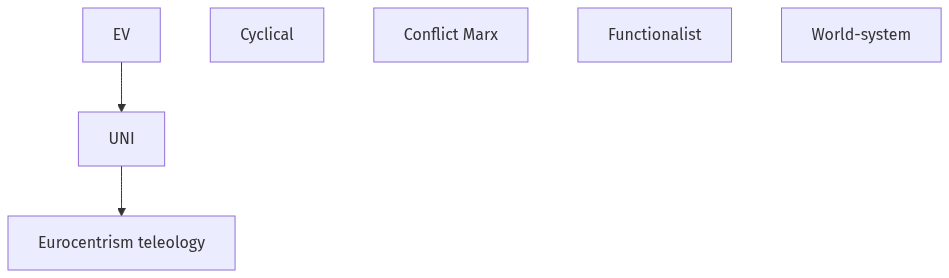
Conclusion
Theories of social change include evolution, cycle, conflict, function and global hierarchy. Unilinear evolution claims one ladder for all societies. Its limits are Eurocentrism, teleology, and blindness to diverse paths and reversals. Change is real. It is not one compulsory staircase.
Quick related
Students also ask
-
Critically examine the World-Systems theory of Immanuel Wallerstein in terms of development and dependency of various nations
Next question on this syllabus topic (2024 · Q8(c)). View answer →
-
Is Marx simply unilinear?
Popular versions look like a ladder of modes. His historical writings on specific societies are more complex, which a critical answer should note.
-
Do cyclical theories deny progress?
They deny a single upward law. They still describe patterned change, such as elite circulation.
Same topic · past papers
UPSC has asked this before
These previous-year questions sit on the same topic. Open one to practise the earlier ask.
-
2026 · Q1(c) · Sociology GS 1 · 10 marks
Discuss the role of geographical factors in social change and development. -
2026 · Q8(b) · Sociology GS 1 · 20 marks
Critically evaluate the relevance of the cyclical theory of social change in understanding contemporary societies -
2026 · Q8(c) · Sociology GS 1 · 10 marks
Discuss the significance and limitations of 'intersectionality' in social research -
2025 · Q5(e) · Sociology GS 1 · 10 marks
To what extent can education and skill development be an agent of social change? Critically analyze. -
2024 · Q4(a) · Sociology GS 1 · 20 marks
What do you understand by 'mixed method'? Discuss its strengths and limitations in social research
More from this topic
Q8(b) · UPSC Mains 2026 · Sociology GS 1 · 20 marks · Solution
Critically evaluate the relevance of the cyclical theory of social change in understanding contemporary societies
Social Change in Modern Society
This model answer evaluates the cyclical theory of social change for contemporary societies. It analyses how classical cyclical models help explain recurring crises, institutional decay, and cultural revivals. It then highlights the limitations of cyclical theories, such as ignoring linear technological progress, cumulative scientific knowledge, and modern globalisation. The response integrates classical sociological thinkers and concludes with a balanced perspective on contemporary social transformation.
Q1(c) · UPSC Mains 2026 · Sociology GS 1 · 10 marks · Solution
Discuss the role of geographical factors in social change and development.
Social Change in Modern Society
This model answer for UPSC Mains Sociology evaluates the role of geographical factors in social change and development. It moves beyond strict environmental determinism to examine how topography, climate, and natural resources shape settlement patterns, economic systems, and social stratification. Classical perspectives from Montesquieu to modern ecological approaches are integrated with examples like river valley civilizations and contemporary climate migration. The answer maintains a crisp, examiner-facing style with structural headings and a flowchart.
Q5(e) · UPSC Mains 2025 · Sociology GS 1 · 10 marks · Solution
To what extent can education and skill development be an agent of social change? Critically analyze.
Social Change in Modern Society
Durkheim and Parsons treat schooling as moral and role socialisation, a force of change. Human capital and capability approaches link skill to productivity and freedom. Bourdieu and correspondence theorists show reproduction of class through the school. Indian expansion of education has created new aspirations and some mobility. Coaching, English, caste and credential inflation limit the equalising effect. The extent is partial: necessary for change, insufficient as a sole agent.