
Revision summary
This model answer evaluates the cyclical theory of social change for contemporary societies. It analyses how classical cyclical models help explain recurring crises, institutional decay, and cultural revivals. It then highlights the limitations of cyclical theories, such as ignoring linear technological progress, cumulative scientific knowledge, and modern globalisation. The response integrates classical sociological thinkers and concludes with a balanced perspective on contemporary social transformation.
Model answer
Copper italics in this answer — like this — are the key facts. Each one is unpacked in the Facts & figures rail.
Introduction
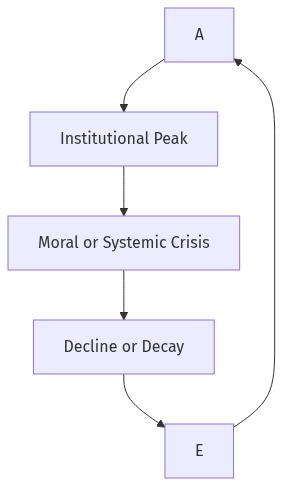
The cyclical theory of social change views societies as organic entities that undergo predictable patterns of growth, maturity, decline, and rebirth. While modern societies are predominantly characterised by linear progress and technological acceleration, cyclical frameworks remain vital for understanding recurrent systemic crises, institutional decay, and cultural revivals.
Body
Classical Roots and Core Tenets
Cyclical perspectives emphasise historical repetition and organic analogies rather than endless linear development.
- Spenglerian Decline: Oswald Spengler conceptualised cultures as organisms with a predetermined lifespan, culminating in civilisational petrification or 'fellahin' society.
- Toynbeean Challenge and Response: Arnold Toynbee argued that civilisations rise through successful creative responses to environmental and social challenges, and decline through moral and spiritual failure.
- Pareto's Circulation of Elites: Vilfredo Pareto demonstrated how governing elites inevitably degenerate in character, leading to their replacement by counter-elites in a continuous cycle.
Relevance to Contemporary Societies
Cyclical models offer deep insights into recurring socio-economic and political phenomena of the 21st century.
- Economic Crises: Recurrent capitalist boom-and-bust cycles, financial panics, and Kondratiev long waves validate the premise of systemic fluctuation.
- Political Polarisation: The rise of populist movements, democratic backsliding, and the cyclical alternation between open liberalism and closed nationalism reflect historical patterns of institutional decay.
- Cultural Nostalgia: Contemporary consumer culture frequently recycles retro aesthetics, traditionalism, and fundamentalist revivals as counter-reactions to hyper-modernity.
Limitations and Critical Evaluation
Despite descriptive utility, strict cyclical theories suffer from severe analytical shortcomings in modern contexts.
- Neglect of Cumulative Progress: Unlike ancient civilisations, modern scientific knowledge and technological innovations are cumulative and irreversible, invalidating pure recurrence.
- Teleological Determinism: Classical models often rely on unproven biological metaphors of birth and death, ignoring human agency and deliberate social engineering.
- Globalisation and Interconnectedness: Modern societies are part of a singular global capitalist world-system, making isolated civilisational life-cycles empirically obsolete.
Flow diagram
Conclusion
While strict adherence to civilisational life-cycles overlooks the cumulative nature of modern science and global integration, cyclical theories remain indispensable. They caution against naive optimism of linear progress, providing essential conceptual tools to diagnose institutional decay, systemic crises, and recurring cultural anxieties in contemporary life.
Quick related
Students also ask
-
To what extent can education and skill development be an agent of social change? Critically analyze.
Next question on this syllabus topic (2025 · Q5(e)). View answer →
-
What is the cyclical theory of social change in sociology?
It is a perspective that views societies and civilisations as passing through repeating stages of birth, growth, maturity, decline, and renewal, akin to biological organisms.
-
How is the cyclical theory relevant to modern societies?
It helps explain recurring economic depressions, systemic institutional crises, elite turnover, and cultural revivals like the rise of nationalism and historical nostalgia.
Same topic · past papers
UPSC has asked this before
These previous-year questions sit on the same topic. Open one to practise the earlier ask.
-
2026 · Q1(c) · Sociology GS 1 · 10 marks
Discuss the role of geographical factors in social change and development. -
2025 · Q5(e) · Sociology GS 1 · 10 marks
To what extent can education and skill development be an agent of social change? Critically analyze. -
2024 · Q5(e) · Sociology GS 1 · 10 marks
Critically examine the roles of science and technology in social change. What is your opinion on their increasing trend in 'online' education and teaching? -
2024 · Q8(b) · Sociology GS 1 · 20 marks
Discuss various theories of social change. Explain the limitations of unilinear theory of social change -
2022 · Q5(e) · Sociology GS 1 · 10 marks
Trace the trajectory of development perspectives on social change.
More from this topic
Q1(c) · UPSC Mains 2026 · Sociology GS 1 · 10 marks · Solution
Discuss the role of geographical factors in social change and development.
Social Change in Modern Society
This model answer for UPSC Mains Sociology evaluates the role of geographical factors in social change and development. It moves beyond strict environmental determinism to examine how topography, climate, and natural resources shape settlement patterns, economic systems, and social stratification. Classical perspectives from Montesquieu to modern ecological approaches are integrated with examples like river valley civilizations and contemporary climate migration. The answer maintains a crisp, examiner-facing style with structural headings and a flowchart.
Q5(e) · UPSC Mains 2025 · Sociology GS 1 · 10 marks · Solution
To what extent can education and skill development be an agent of social change? Critically analyze.
Social Change in Modern Society
Durkheim and Parsons treat schooling as moral and role socialisation, a force of change. Human capital and capability approaches link skill to productivity and freedom. Bourdieu and correspondence theorists show reproduction of class through the school. Indian expansion of education has created new aspirations and some mobility. Coaching, English, caste and credential inflation limit the equalising effect. The extent is partial: necessary for change, insufficient as a sole agent.
Q8(c) · UPSC Mains 2024 · Sociology GS 1 · 10 marks · Solution
Critically examine the World-Systems theory of Immanuel Wallerstein in terms of development and dependency of various nations
Social Change in Modern Society
Wallerstein takes the capitalist world-economy, not the nation, as the unit of analysis. Core, semi-periphery and periphery are linked positions in one division of labour. Development of the core has been historically tied to peripheral constraint. The theory criticises Rostow-style national stages and is cousin to Frank’s underdevelopment thesis. Criticisms include thin treatment of internal class, culture and new industrial cores. It remains a strong map of dependency, provided ranks are not treated as eternal.