
Revision summary
Sociology is the systematic study of social relationships, institutions and structures. Its nature is empirical, comparative and theoretical, after Comte, Durkheim, Marx and Weber. Social anthropology studies culture and community life, often through intensive fieldwork. The two subjects share the study of institutions and meaning. They differ in typical scale, method and historical setting. Indian village studies show how the border has been crossed in practice.
Model answer
Copper italics in this answer — like this — are the key facts. Each one is unpacked in the Facts & figures rail.
Introduction
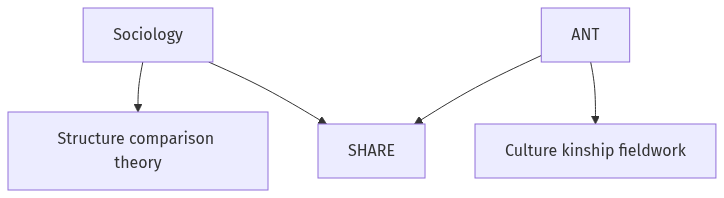
Sociology is the systematic study of how people live together in groups, institutions and structures. Auguste Comte gave the discipline a name and asked for a science of society. Emile Durkheim treated social facts as constraints that exist outside the individual. Max Weber studied meaningful social action. The nature of sociology follows from this project. It is empirical, comparative and theoretical. Social anthropology studies culture, kinship and everyday life in communities, often through long fieldwork. The two subjects share a border and also keep a division of labour.
Body
Nature of sociology
Sociology studies recurrent patterns such as class, caste, family, state, religion and work. It uses concepts, comparison and evidence. Durkheim insisted that social facts must be explained by other social facts. Karl Marx located institutions in modes of production and class struggle. Weber added interpretation of motives and the study of domination. Robert Merton later asked sociologists to look at both manifest and latent functions. The discipline is therefore neither a list of opinions nor a branch of psychology. It is generalising, but it does not claim the same laboratory control that physics enjoys. Anthony Giddens called this the study of a world that already interprets itself.
Sociology is also historical and critical. It asks how a present arrangement was made and whose interest it serves. C. Wright Mills linked private troubles to public issues. In India, G. S. Ghurye, M. N. Srinivas and A. R. Desai used this toolkit on caste, village and class. The nature of the subject is therefore scientific in method and social in object.
Relationship with social anthropology
Social anthropology, in the lineage of Bronislaw Malinowski, A. R. Radcliffe-Brown and later Clifford Geertz, has classically studied small-scale communities through participant observation. It has given sociology the ideas of culture, ritual, kinship and the native point of view. Sociology has classically studied large, industrial and state-centred societies through survey, statistics and historical comparison. Durkheim and Marcel Mauss already sat on both sides of this fence. In India, village studies by Srinivas, McKim Marriott and Andre Beteille show how anthropological fieldwork became a method of Indian sociology.
The relationship is close because both study institutions, meaning and inequality. The difference is one of typical scale, typical method and typical research setting, not a wall. Urban ethnography, Dalit studies and the anthropology of the state have narrowed the gap. A fair answer keeps the shared object and names the remaining contrast: sociology’s taste for structure and comparison across mass societies, and anthropology’s taste for intensive cultural description.
Flow diagram
Conclusion
Sociology is a systematic, comparative study of social life, with a nature that is empirical and theoretical at once. Social anthropology is its closest kin in the study of culture and group life. The two subjects exchange methods and concepts, while still differing in typical scale and research style.
Quick related
Students also ask
-
Analyse the changing nature of caste as a status group.
Next question on this syllabus topic (2024 · Q1(b)). View answer →
-
Is sociology only about modern industrial societies?
That was a classical emphasis. Today sociologists also study villages, tribes and digital groups. The method still aims at comparison and structure.
-
Can one person be both a sociologist and an anthropologist?
Yes. Many Indian scholars have used both labels. The examination distinction is still useful as a division of typical labour.
Same topic · past papers
UPSC has asked this before
These previous-year questions sit on the same topic. Open one to practise the earlier ask.
-
2023 · Q4(c) · Sociology GS 1 · 10 marks
Highlight the differences and similarities between totemism and animism
More from this topic
Q8(c) · UPSC Mains 2026 · Sociology GS 1 · 10 marks · Solution
Discuss the significance and limitations of 'intersectionality' in social research
Sociology
Intersectionality, coined by Kimberlé Crenshaw, examines how overlapping identities like race, class, and gender shape systemic oppression. Its significance in social research lies in capturing lived realities beyond single-axis frameworks and preventing reductive generalisations. However, limitations include methodological complexity, risks of infinite regress, and difficulties in operationalising fluid categories. Effective application requires balancing structural macro-analysis with micro-level lived experiences.
Q6(b) · UPSC Mains 2026 · Sociology GS 1 · 20 marks · Solution
Critically analyse the nature-nurture debate from different perspectives
Sociology
1. The nature-nurture debate explores whether biology or society primarily shapes human behavior
Q6(a) · UPSC Mains 2026 · Sociology GS 1 · 20 marks · Solution
Discuss the intellectual origins of sociology and its evolution as a distinct field of study
Sociology
Sociology arose in 19th-century Western Europe to make sense of massive upheavals caused by the Industrial and French Revolutions. Enlightenment thinkers laid the groundwork by championing reason, empirical observation, and human agency over traditional dogma. Auguste Comte gave the discipline its name, pushing for a positivist "physics of society" based on scientific laws. Émile Durkheim secured its academic legitimacy by defining "social facts" and using empirical methods to study human behavior. Max Weber introduced interpretive sociology, while Karl Marx focused on material conditions and class struggle. In the 20th century, Talcott Parsons advanced structural-functionalism to study systemic equilibrium. Later, conflict theories, the Frankfurt School, and postmodern critiques broadened the field to address power and marginalisation. Today, sociology continues to evolve by analyzing globalisation, digital shifts, and modern identity politics.