
Revision summary
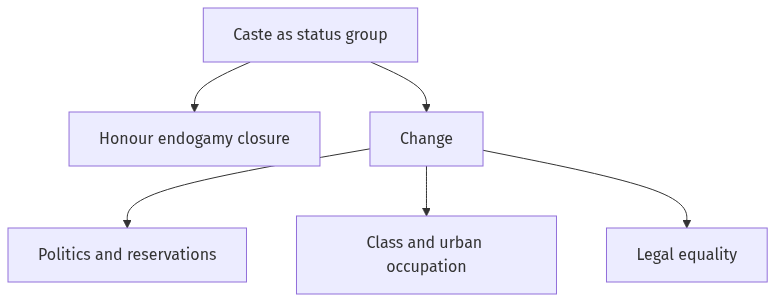
Weber’s status group is a community of honour, lifestyle and closure. Caste fits this through hierarchy, endogamy and ritual ranking described by Ghurye, Dumont and Ambedkar. Sanskritisation and the dominant caste show older strategies of status mobility and local power. Law, reservations and democratic politics have recast caste as a public identity. Urban class and occupation have loosened hereditary work more than they have loosened marriage. Change is real, but caste has not ceased to be a status group.
Model answer
Copper italics in this answer — like this — are the key facts. Each one is unpacked in the Facts & figures rail.
Introduction
Max Weber defined a status group as a community of honour, lifestyle and social closure. Caste in India has long been such a group. It ranked people by birth, regulated marriage and occupation, and claimed ritual purity or pollution. That picture has not vanished. It has changed in important ways. The task is to analyse how caste still works as status, and how politics, law, markets and cities have altered its form.
Body
Caste as a status group
Louis Dumont described caste as a system of hierarchy based on the opposition of pure and impure. G. S. Ghurye listed features such as segmental division, hierarchy, restrictions on feeding and marriage, and hereditary occupation. B. R. Ambedkar treated caste as a system of graded inequality that also divided the oppressed. As a status group, a caste claims honour, polices endogamy, and closes ranks against outsiders. Weber’s idea of social closure fits this well. Economic class can cut across caste, as Andre Beteille showed in Tanjore, but honour and marriage still follow status more stubbornly than income does.
Changing nature
- M. N. Srinivas described Sanskritisation as a status strategy: a lower group copies the ritual style of a higher group. He also described the dominant caste, which holds land, numbers and local power even without the highest ritual rank. After Independence, the Constitution banned untouchability, and reservations created a new political career for caste as a vote bank and as a claim on the state. Rajni Kothari and later scholars of caste politics showed that caste became an instrument of democratic mobilisation. Urban jobs, education and migration weakened hereditary occupation. Yet matrimonial advertisements, honour violence and residential clustering show that status honour continues.
Dipankar Gupta argued that we now see competing hierarchies rather than one Dumontian ladder. Yogendra Singh spoke of modernisation of tradition. The change is therefore double. Caste is less a complete ritual cosmos in the city and the factory. It remains a status group in marriage, social honour and political identity. Class and party have entered the field, but they have not simply replaced status.
Flow diagram
Conclusion
Caste remains a Weberian status group of honour and closure, even as occupation and law have shifted. Politics, education and the market have changed its public face. Analysis must hold both the persistence of status and the new uses of caste in democracy and class.
Quick related
Students also ask
-
Marriage as an institution has undergone a radical transformation from 'ritual' to 'commercial' in its outlook. Explain the factors behind this change.
Next question on this syllabus topic (2024 · Q1(c)). View answer →
-
Has caste become only a class matter?
No. Income and jobs have mixed with caste, but honour and endogamy still mark status in ways class alone cannot explain.
-
Did the Constitution end caste as status?
It ended legal support for untouchability and opened public office. Everyday honour, marriage and local power still carry caste status.
Same topic · past papers
UPSC has asked this before
These previous-year questions sit on the same topic. Open one to practise the earlier ask.
-
2026 · Q7(b) · Sociology GS 1 · 20 marks
According to Weber how do class, status and power interact to produce and sustain social inequality? -
2025 · Q5(b) · Sociology GS 1 · 10 marks
Does the structural-functionalist perspective on social stratification promote a status quo? Give reasons for your answer. -
2016 · Q6(c) · Sociology GS 1 · 15 marks
Examine the role of protest movements in changing the status of Dalits in India. -
2021 · Q8(a) · Sociology GS 1 · 20 marks
Discuss the changing nature of kinship relations in the contemporary world. -
2017 · Q6(a) · Sociology GS 1 · 20 marks
Trace the changing nature of organisation of work in capitalist society over the years
More from this topic
Q8(c) · UPSC Mains 2026 · Sociology GS 1 · 10 marks · Solution
Discuss the significance and limitations of 'intersectionality' in social research
Sociology
Intersectionality, coined by Kimberlé Crenshaw, examines how overlapping identities like race, class, and gender shape systemic oppression. Its significance in social research lies in capturing lived realities beyond single-axis frameworks and preventing reductive generalisations. However, limitations include methodological complexity, risks of infinite regress, and difficulties in operationalising fluid categories. Effective application requires balancing structural macro-analysis with micro-level lived experiences.
Q6(b) · UPSC Mains 2026 · Sociology GS 1 · 20 marks · Solution
Critically analyse the nature-nurture debate from different perspectives
Sociology
1. The nature-nurture debate explores whether biology or society primarily shapes human behavior
Q6(a) · UPSC Mains 2026 · Sociology GS 1 · 20 marks · Solution
Discuss the intellectual origins of sociology and its evolution as a distinct field of study
Sociology
Sociology arose in 19th-century Western Europe to make sense of massive upheavals caused by the Industrial and French Revolutions. Enlightenment thinkers laid the groundwork by championing reason, empirical observation, and human agency over traditional dogma. Auguste Comte gave the discipline its name, pushing for a positivist "physics of society" based on scientific laws. Émile Durkheim secured its academic legitimacy by defining "social facts" and using empirical methods to study human behavior. Max Weber introduced interpretive sociology, while Karl Marx focused on material conditions and class struggle. In the 20th century, Talcott Parsons advanced structural-functionalism to study systemic equilibrium. Later, conflict theories, the Frankfurt School, and postmodern critiques broadened the field to address power and marginalisation. Today, sociology continues to evolve by analyzing globalisation, digital shifts, and modern identity politics.