
Revision summary
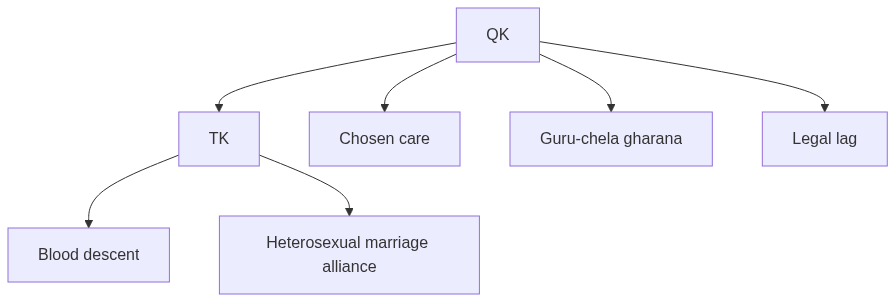
Traditional kinship canonically runs on descent, marriage alliance and binary gendered terms. Queer kinship organises care, parenthood and belonging beyond that monopoly. Weston’s chosen families and Schneider’s critique of blood as symbol are theoretical anchors. Indian hijra gharanas illustrate initiation-based relatedness outside the patriline. Law often still privileges conjugal heterosexual kinship, which is part of the challenge. The point is that kinship is done through practice, not only inherited as blood.
Model answer
Copper italics in this answer — like this — are the key facts. Each one is unpacked in the Facts & figures rail.
Introduction
Traditional kinship systems, in the anthropological and sociological canon, organise relatedness through descent and through marriage alliance. Blood, lawful marriage and the gendered household have been treated as the natural grid. Queer kinship names the ways lesbian, gay, bisexual, trans and other non-normative people actually make lasting care, parenthood and belonging. Those practices challenge the monopoly of blood-and-marriage as the only real family.
Body
What is being challenged
David Schneider already argued that American kinship’s “blood” is a cultural symbol, not a raw fact. Kath Weston, in Families We Choose, showed gay and lesbian networks in which friends, ex-lovers and co-parents do the work of kin. Judith Butler and later queer theory stressed that the heterosexual family is a regulatory ideal, not a description of all intimacy. Traditional systems assume binary gender for terms such as mother, father, uncle, and they assume that legitimate children follow a recognised marriage. Queer kinship interrupts all three: who counts as a parent, which body can be a mother or a father in law and in daily care, and whether a household must be conjugal.
Illustrations
In India, hijra and kinnar gharanas organise guru–chela relatedness, ritual work and care in old age outside the patrilineal house. That is kinship by initiation, not by descent from a father. Urban chosen families appear after natal rejection: shared rents, hospital signatures, funerals. Adoption and marriage equality remain legally constrained, which shows how tightly traditional kinship is wired into law. Friendship as kin during illness is an everyday challenge.
The challenge is not that biology disappears. It is that care and name can be organised otherwise, exposing kinship as a political arrangement of gender and legitimacy.
Flow diagram
Conclusion
Queer kinship challenges traditional systems by relocating relatedness from compulsory heterosexual marriage and blood to chosen and practiced ties. Illustrations from hijra gharanas and urban chosen families show that the challenge is already social, even where law still lags. Kinship is revealed as made, not merely given.
Quick related
Students also ask
-
Discuss the nature of Sociology. Highlight its relationship with Social Anthropology.
Next question on this syllabus topic (2024 · Q1(a)). View answer →
-
Does queer kinship deny all biological ties?
No. It denies that blood and heterosexual marriage are the only legitimate ties, not that biology ever exists.
-
Is a hijra gharana “queer” in the Western theory sense?
It is a historically Indian gender-kin form that challenges the same natal, conjugal grid; use it as illustration, not as a copy of a US case.
Same topic · past papers
UPSC has asked this before
These previous-year questions sit on the same topic. Open one to practise the earlier ask.
-
2026 · Q5(a) · Sociology GS 1 · 10 marks
The major challenge for sociology researchers is to analyze social reality objectively. Critically analyze.
More from this topic
Q8(c) · UPSC Mains 2026 · Sociology GS 1 · 10 marks · Solution
Discuss the significance and limitations of 'intersectionality' in social research
Sociology
Intersectionality, coined by Kimberlé Crenshaw, examines how overlapping identities like race, class, and gender shape systemic oppression. Its significance in social research lies in capturing lived realities beyond single-axis frameworks and preventing reductive generalisations. However, limitations include methodological complexity, risks of infinite regress, and difficulties in operationalising fluid categories. Effective application requires balancing structural macro-analysis with micro-level lived experiences.
Q6(b) · UPSC Mains 2026 · Sociology GS 1 · 20 marks · Solution
Critically analyse the nature-nurture debate from different perspectives
Sociology
1. The nature-nurture debate explores whether biology or society primarily shapes human behavior
Q6(a) · UPSC Mains 2026 · Sociology GS 1 · 20 marks · Solution
Discuss the intellectual origins of sociology and its evolution as a distinct field of study
Sociology
Sociology arose in 19th-century Western Europe to make sense of massive upheavals caused by the Industrial and French Revolutions. Enlightenment thinkers laid the groundwork by championing reason, empirical observation, and human agency over traditional dogma. Auguste Comte gave the discipline its name, pushing for a positivist "physics of society" based on scientific laws. Émile Durkheim secured its academic legitimacy by defining "social facts" and using empirical methods to study human behavior. Max Weber introduced interpretive sociology, while Karl Marx focused on material conditions and class struggle. In the 20th century, Talcott Parsons advanced structural-functionalism to study systemic equilibrium. Later, conflict theories, the Frankfurt School, and postmodern critiques broadened the field to address power and marginalisation. Today, sociology continues to evolve by analyzing globalisation, digital shifts, and modern identity politics.