
Revision summary
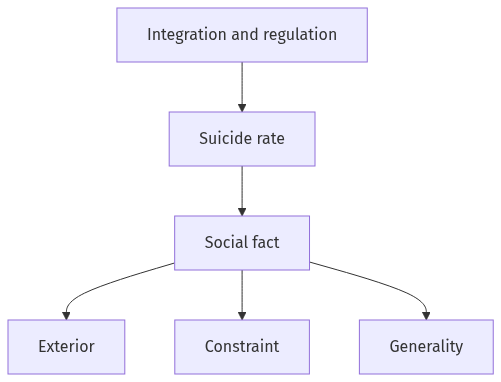
Social facts are ways of acting that are external, constraining and general. Durkheim asked that they be treated as things, not as inner opinions. A single suicide is a personal event; the suicide rate is a group property. Rates vary with religion, family and crisis through integration and regulation. Egoistic, altruistic, anomic and fatalistic types classify those social conditions. The method explains rates by other social facts, not by biography alone.
Model answer
Copper italics in this answer — like this — are the key facts. Each one is unpacked in the Facts & figures rail.
Introduction
Emile Durkheim defined a social fact as a way of acting, thinking or feeling that exists outside the individual and that can exert constraint. In The Rules of Sociological Method he asked students to treat social facts as things. In Suicide he used the suicide rate as a clear example. The rate is a property of a group, not a private mood.
Body
Characteristics of a social fact
A social fact is external. Language, law, currency and religious rites are already there when a person is born. The individual finds them, and does not invent them alone. A social fact is constraining. It can be felt as duty, shame, punishment or simple inability to do otherwise. One cannot drive on the wrong side of the road by private wish. A social fact is general in a group, yet it is not the same as a mere average of individual psychologies. It has a collective reality. Durkheim distinguished social facts from organic facts and from individual representations. Later readers such as Steven Lukes have noted that constraint can be moral as well as legal.
The suicide rate as a social fact
A particular suicide looks like the most private of acts. Durkheim did not deny grief or illness in the person. He showed that the rate of suicide varies in a stable way with religion, family status, war and economic crisis. Protestant communities, in his data, showed higher rates than Catholic ones. Married people with children showed lower rates than the unmarried. Rates rose in some crises and fell in others according to the degree of integration and regulation. These regularities cannot be read off one biography. The rate is therefore a social fact: it is exterior to any one victim, it constrains the group’s chances, and it is general as a collective tendency.
- He named types: egoistic suicide when integration is weak, altruistic when the self is absorbed in the group, anomic when regulation fails, and fatalistic when regulation is excessive. The classification is debated. The methodological point of the question stands. Psychology may explain a case. Sociology explains a rate by other social facts, such as integration and regulation, not by weather or insanity as sufficient causes.
The Indian official suicide data of NCRB, used carefully, still invite the same Durkheimian question: which groups, regions and crises show stable differences that point beyond private despair.
Flow diagram
Conclusion
A social fact is external, constraining and general. The suicide rate is such a fact because it belongs to the group and varies with social organisation. Durkheim’s study of suicide is the classic demonstration of this rule.
Quick related
Students also ask
-
How is 'power' different from 'authority'? Discuss various types of authorities as theorized by Max Weber.
Next question on this syllabus topic (2024 · Q5(d)). View answer →
-
Did Durkheim ignore individual motives?
He set them aside as insufficient for explaining a rate. The sociologist’s object was the collective tendency.
-
Is a fashion a social fact?
Yes, if it is a general, constraining way of acting that the individual finds already in the group.
Same topic · past papers
UPSC has asked this before
These previous-year questions sit on the same topic. Open one to practise the earlier ask.
-
2023 · Q3(a) · Sociology GS 1 · 20 marks
What are the characteristics of scientific method? Do you think that scientific method in conducting sociological research is foolproof? Elaborate -
2018 · Q7(c) · Sociology GS 1 · 15 marks
What, according to Pareto, are the basic characteristics of elites? Discuss. -
2026 · Q3(c) · Sociology GS 1 · 10 marks
How does Emile Durkheim conceptualize religion as a 'social fact'? Explain -
2020 · Q5(c) · Sociology GS 1 · 10 marks
What are the problems in observing social facts in Durkheim's views?
More from this topic
Q7(c) · UPSC Mains 2026 · Sociology GS 1 · 10 marks · Solution
Compare the social organisation of work in industrial capitalism and platform capitalism
Sociological Thinkers: Karl Marx
• **Setting:** Industrial capitalism centres work in physical factories; platform capitalism disperses it via digital apps. • **Control:** Factories use direct managerial supervision and time-discipline; platforms use invisible algorithms and automated ratings. • **Contracts:** Industrial work relies on standard, secure employment with welfare benefits; platform work relies on gig contracts and independent contractors. • **Risk:** Factories shoulder capital costs; platform capitalism shifts risks and equipment costs onto individual workers. • **Solidarity:** Shared factory spaces foster collective class consciousness; digital isolation creates an atomised "precariat." • **Surplus Value:** Both systems extract surplus value, but platforms obscure exploitation behind the illusion of entrepreneurial freedom.
Q5(d) · UPSC Mains 2026 · Sociology GS 1 · 10 marks · Solution
How does Max Weber's 'theory of authority' shape bureaucracy? Analyse.
Sociological Thinkers: Karl Marx
Max Weber's sociological framework links different forms of legitimate domination directly to the rise of modern rational-legal bureaucracy. Traditional and charismatic authority provide historical context, but rational-legal authority creates the impersonal rules, hierarchy, and technical expertise defining bureaucratic structures. While ensuring efficiency, this iron cage of rationalisation also poses risks of alienation and goal displacement, which later thinkers critiqued.
Q3(c) · UPSC Mains 2026 · Sociology GS 1 · 10 marks · Solution
How does Emile Durkheim conceptualize religion as a 'social fact'? Explain
Sociological Thinkers: Karl Marx
Emile Durkheim treats religion as a quintessential social fact in 'The Elementary Forms of the Religious Life' (1912). Moving away from supernatural or animistic definitions, he argues that religion is fundamentally a collective product. Society objectifies its own moral authority and solidarity through sacred symbols and rituals. By separating the sacred from the profane, religious practices reinforce social integration and collective consciousness. Thus, religion is society worshipping itself, operating as an external and coercive constraint upon individual thought and action.