
Revision summary
The gig economy pays for short tasks, often through digital platforms. Firms often classify workers as independent partners rather than employees. Labour-market effects include easy entry, risk transfer, wage pressure and algorithmic control. Social security designed for regular employment does not automatically cover gig workers. India’s Social Security Code named gig and platform workers, but benefits remain limited. Worker protests show that collective action is still possible outside the old factory union.
Model answer
Copper italics in this answer — like this — are the key facts. Each one is unpacked in the Facts & figures rail.
Introduction
The gig economy is a labour market in which people are paid for short tasks or gigs rather than for a stable job with one employer. Digital platforms now organise much of this work in transport, delivery, domestic service and click-work. Firms present the arrangement as flexibility and entrepreneurship. Sociology treats it as a form of labour control. The impact falls on the structure of the labour market and on the social security net that once assumed a long-term employer.
Body
Defining the gig economy
- A gig is a discrete task: a ride, a delivery, a design job, a micro-task online. Platforms such as ride-hailing and food-delivery apps match supply and demand, set rules, and often set prices through algorithms. Guy Standing’s idea of the precariat, and earlier work on informalisation by Jan Breman and the ILO, help place gig work in a longer history. In India most workers were already informal. The new element is platform mediation, rating systems, and the legal claim that the worker is an independent partner, not an employee. The Code on Social Security, 2020, named gig and platform workers as a category, which shows that the state now sees the form, even if protection is still thin.
Impact on the labour market
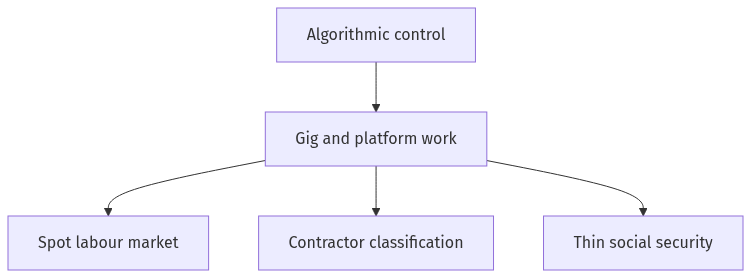
Gig platforms expand a flexible workforce that can be switched on and off. They compete with regular service jobs and can push wages and hours in those sectors. They create easy entry for migrants and students, which looks like opportunity. They also transfer risk to the worker: idle time, fuel, vehicle repair, accident and demand slumps. Classification struggles are central. If the worker is not an employee, labour law on minimum wage, union recognition and unfair dismissal is hard to apply. Algorithmic management replaces the visible supervisor. Ratings become a private court. Women in gig domestic work and beauty work face both platform control and household stigma. The labour market becomes more like a spot market and less like an internal labour market with careers.
Impact on the social security net
The standard net of Employees’ Provident Fund, ESI, gratuity, paid leave and employer-backed accident cover was built for recognised employment. Gig workers typically stand outside it. Health shocks, old age and downtime are privatised. Some platforms offer commercial insurance as a product, which is not the same as a right. Trade unions and new worker associations have tried to organise anyway, as in strikes by app-based transport workers in Indian cities. The NCEUS had already mapped a huge unorganised sector. Gig work adds a digitally visible layer to that old insecurity. Without portable benefits tied to the person rather than to a single employer, the security net will not catch this labour.
The sociological impact is therefore a sharpening of precarity, a blurring of the employee category, and a challenge to welfare systems designed for the factory and the office.
Labour market and security together
A delivery worker may have more daily choice of hours than a factory hand, and still have less monthly security. Idle time is unpaid. Accident risk sits on the worker. The platform can change incentive slabs overnight. Trade unions built for a factory gate find it hard to meet a workforce that never shares one canteen. New associations still try, which shows that the gig form does not abolish collective action. For Indian policy the implication is portable social security, clearer employment tests, and data rights over ratings. Without those, the gig economy will keep expanding the informal sector in a digitally visible way rather than shrinking it.
Flow diagram
Conclusion
The gig economy is task-based, often platform-mediated work sold as flexibility. It informalises and fragments the labour market and leaves workers outside the old employer-based security net. Law has begun to name the category. Protection and bargaining have not yet caught up.
Quick related
Students also ask
-
Describe various characteristics of a 'social fact'. How is the rate of suicide a social fact according to Durkheim?
Next question on this syllabus topic (2024 · Q5(a)). View answer →
-
Is every freelancer in the gig economy?
Freelance professional work overlaps, but the syllabus focus is platform-mediated, short-term service labour under algorithmic rules.
-
Does flexibility always help workers?
Some workers value time choice. Many pay for that choice with unpaid waiting, costs and no security. The balance is empirical, not a slogan.
Same topic · past papers
UPSC has asked this before
These previous-year questions sit on the same topic. Open one to practise the earlier ask.
-
2026 · Q1(b) · Sociology GS 1 · 10 marks
Critically examine the position of women in the informal economy. -
2025 · Q4(c) · Sociology GS 1 · 10 marks
Critically analyze the sociological significance of informal sector in the economy of developing societies
More from this topic
Q7(c) · UPSC Mains 2026 · Sociology GS 1 · 10 marks · Solution
Compare the social organisation of work in industrial capitalism and platform capitalism
Sociological Thinkers: Karl Marx
• **Setting:** Industrial capitalism centres work in physical factories; platform capitalism disperses it via digital apps. • **Control:** Factories use direct managerial supervision and time-discipline; platforms use invisible algorithms and automated ratings. • **Contracts:** Industrial work relies on standard, secure employment with welfare benefits; platform work relies on gig contracts and independent contractors. • **Risk:** Factories shoulder capital costs; platform capitalism shifts risks and equipment costs onto individual workers. • **Solidarity:** Shared factory spaces foster collective class consciousness; digital isolation creates an atomised "precariat." • **Surplus Value:** Both systems extract surplus value, but platforms obscure exploitation behind the illusion of entrepreneurial freedom.
Q5(d) · UPSC Mains 2026 · Sociology GS 1 · 10 marks · Solution
How does Max Weber's 'theory of authority' shape bureaucracy? Analyse.
Sociological Thinkers: Karl Marx
Max Weber's sociological framework links different forms of legitimate domination directly to the rise of modern rational-legal bureaucracy. Traditional and charismatic authority provide historical context, but rational-legal authority creates the impersonal rules, hierarchy, and technical expertise defining bureaucratic structures. While ensuring efficiency, this iron cage of rationalisation also poses risks of alienation and goal displacement, which later thinkers critiqued.
Q3(c) · UPSC Mains 2026 · Sociology GS 1 · 10 marks · Solution
How does Emile Durkheim conceptualize religion as a 'social fact'? Explain
Sociological Thinkers: Karl Marx
Emile Durkheim treats religion as a quintessential social fact in 'The Elementary Forms of the Religious Life' (1912). Moving away from supernatural or animistic definitions, he argues that religion is fundamentally a collective product. Society objectifies its own moral authority and solidarity through sacred symbols and rituals. By separating the sacred from the profane, religious practices reinforce social integration and collective consciousness. Thus, religion is society worshipping itself, operating as an external and coercive constraint upon individual thought and action.