
Revision summary
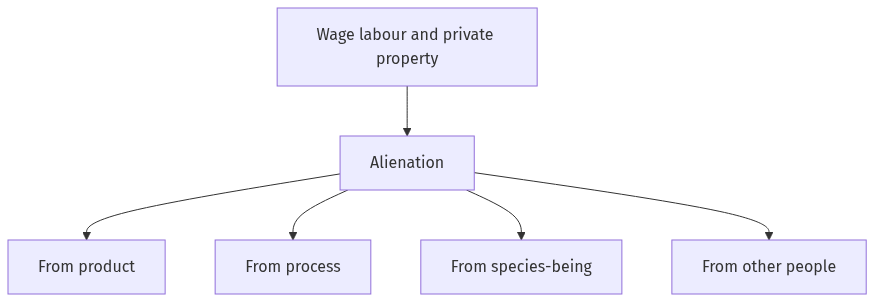
Marx’s 1844 manuscripts describe alienation as a social relation of wage labour. The worker is estranged from the product that capital owns. The process of work is external, forced and controlled. Species-being as creative production is reduced to survival. People are divided from one another by class and competition. Critique should not dilute the concept into mood, but may add gender, caste and informal labour.
Model answer
Copper italics in this answer — like this — are the key facts. Each one is unpacked in the Facts & figures rail.
Introduction
Karl Marx’s idea of alienation, set out most clearly in the Economic and Philosophic Manuscripts of 1844, describes what happens to the worker under private property and wage labour. The worker becomes a stranger to the product, to the act of work, to human species powers, and to other people. Alienation is a social relation, not a passing sadness. A critical explanation must state these features and then note what later debate has added or questioned.
Body
Salient features
First, the worker is alienated from the product. The object that labour creates belongs to the capitalist. The more the worker produces, the richer the alien world of commodities becomes. Second, the worker is alienated from the process of work. Labour is external, forced and controlled. It is not a free expression of skill. The working day is sold, and the method of work is dictated. Third, the worker is alienated from species-being. Marx, drawing on Ludwig Feuerbach and then turning him around, held that human beings are distinguished by conscious, creative production. Under capitalism this becomes a means of mere survival. Fourth, people are alienated from one another. Class antagonism and competition replace cooperative production. The capitalist is also caught in the logic of capital, though the worker bears the heavier loss.
- These features rest on a definite structure: labour power is a commodity, surplus value is extracted, and the means of production are privately owned. Alienation is therefore not a complaint about machines as such. A craft worker under a master could be unfree, but Marx’s type is the wage worker in a system of commodity production. In later writings the language of exploitation, surplus value and commodity fetishism carries much of the same insight in a more economic form. Commodity fetishism says that relations between people appear as relations between things.
Critical explanation
Critics say the 1844 texts are philosophical and that the later Marx dropped the word. Louis Althusser drew a sharp line between early and late Marx. Others, including Istvan Meszaros and many labour sociologists, see continuity. Harry Braverman’s deskilling thesis extended alienation into twentieth-century scientific management. Feminist writers argued that unpaid domestic labour is also alienated and that Marx’s worker is silently male. In India, bonded labour, caste-based occupation and informal work complicate a factory-only picture. A. R. Desai and later Marxist studies of Indian capitalism still find the core: people do not control the conditions of their labour.
The idea can be stretched into a vague cultural mood. That stretch is a weakness. The strength of the concept is its link to property and wage labour. Automation and gig contracts change the form. They do not automatically restore the worker’s control over product and process.
Flow diagram
Conclusion
- Marx’s alienation has four salient features: estrangement from product, from work, from species powers and from other people. They follow from wage labour and private property. A critical view keeps that structure, notes later debates on gender and informal work, and refuses to reduce the idea to a private feeling.
Quick related
Students also ask
-
Define the concept of 'gig' economy and discuss its impact on the labour market and workers' social security net
Next question on this syllabus topic (2024 · Q4(b)). View answer →
-
Is alienation the same as unhappiness at work?
No. A well-paid worker can still lack control over product and process. The term names a structure, not a mood.
-
Did Marx keep the word in Capital?
He used exploitation and fetishism more. Many readers still find the 1844 features inside that later analysis.
Same topic · past papers
UPSC has asked this before
These previous-year questions sit on the same topic. Open one to practise the earlier ask.
-
2020 · Q7(c) · Sociology GS 1 · 15 marks
Critically assess the Marxian theory of 'Alienation'."
More from this topic
Q7(c) · UPSC Mains 2026 · Sociology GS 1 · 10 marks · Solution
Compare the social organisation of work in industrial capitalism and platform capitalism
Sociological Thinkers: Karl Marx
• **Setting:** Industrial capitalism centres work in physical factories; platform capitalism disperses it via digital apps. • **Control:** Factories use direct managerial supervision and time-discipline; platforms use invisible algorithms and automated ratings. • **Contracts:** Industrial work relies on standard, secure employment with welfare benefits; platform work relies on gig contracts and independent contractors. • **Risk:** Factories shoulder capital costs; platform capitalism shifts risks and equipment costs onto individual workers. • **Solidarity:** Shared factory spaces foster collective class consciousness; digital isolation creates an atomised "precariat." • **Surplus Value:** Both systems extract surplus value, but platforms obscure exploitation behind the illusion of entrepreneurial freedom.
Q5(d) · UPSC Mains 2026 · Sociology GS 1 · 10 marks · Solution
How does Max Weber's 'theory of authority' shape bureaucracy? Analyse.
Sociological Thinkers: Karl Marx
Max Weber's sociological framework links different forms of legitimate domination directly to the rise of modern rational-legal bureaucracy. Traditional and charismatic authority provide historical context, but rational-legal authority creates the impersonal rules, hierarchy, and technical expertise defining bureaucratic structures. While ensuring efficiency, this iron cage of rationalisation also poses risks of alienation and goal displacement, which later thinkers critiqued.
Q3(c) · UPSC Mains 2026 · Sociology GS 1 · 10 marks · Solution
How does Emile Durkheim conceptualize religion as a 'social fact'? Explain
Sociological Thinkers: Karl Marx
Emile Durkheim treats religion as a quintessential social fact in 'The Elementary Forms of the Religious Life' (1912). Moving away from supernatural or animistic definitions, he argues that religion is fundamentally a collective product. Society objectifies its own moral authority and solidarity through sacred symbols and rituals. By separating the sacred from the profane, religious practices reinforce social integration and collective consciousness. Thus, religion is society worshipping itself, operating as an external and coercive constraint upon individual thought and action.