
Revision summary
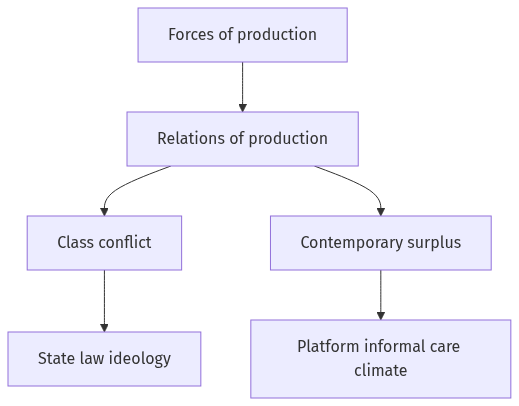
Historical materialism reads law, state, and ideas with the forces and relations of production. Class is a relation to surplus. Contradiction between forces and relations drives change. It remains relevant to global chains, informal and platform work, unpaid care, and climate. Caste, nation, and religion are not exhausted by class and must be added. Use it as a method of questions about ownership and surplus, not as a calendar of revolution.
Model answer
Copper italics in this answer — like this — are the key facts. Each one is unpacked in the Facts & figures rail.
Introduction
Historical materialism is Karl Marx’s method for explaining social order and change from the way people produce their means of life. It is not a denial of ideas. It is a claim that ideas, law, and the state must be read with the forces and relations of production of a given epoch.
Body
What the method is
- Marx and Engels, in The German Ideology and later in the 1859 Preface, argued that the economic structure is the real foundation on which a legal and political superstructure rises.
- Forces of production are tools, skills, science, and labour power. Relations of production are property and control over surplus.
- When forces grow inside old relations, class conflict intensifies and a new mode of production becomes possible.
- Modes such as ancient, feudal, and capitalist are historical types, not moral labels.
- Class is a relation to surplus, not a lifestyle. Ideology is the form in which people become conscious of this conflict.
What it is not
- It is not a claim that every event is caused by a wage rate. Engels warned against reducing the superstructure to a simple reflex.
- It is not identical with Hegel’s dialectic of Spirit. Marx inverted that dialectic onto labour and property.
- It is not a prediction timetable. Relevance is a test of explanation, not of calendar.
Relevance today
- Global value chains, platform work, and the informalisation of labour in India are readable as new forms of surplus extraction, which Guy Standing later named as a precariat without using Marx’s full system.
- Andre Gunder Frank’s development of underdevelopment used a materialist geography of core and periphery, which still frames export-processing and raw-material dependence.
- Gendered unpaid care, which Marxist feminists recovered, shows that reproduction of labour power is part of the base, not a private extra.
- Climate crisis is a contradiction between endless accumulation and finite nature, which ecological Marxists now write as a second contradiction of capitalism.
- Digital surveillance at work is still control of labour time, which Harry Braverman had already analysed as the degradation of work.
Limits
- Weber’s status and party, and caste in India, are not exhausted by class, though class organises a large part of their effects.
- Nationalism, religion, and caste blocs can mobilise against the grain of economic interest, which Marx under-specified.
- State welfare, public sector, and caste reservation modify pure market coercion without ending class.
How to use it now
- Use it to ask who owns, who works, and who takes surplus in a factory, a farm, a platform, or a household.
- Combine it with Weber and feminist standpoint when status and gender organise the same surplus.
Flow diagram
Conclusion
Historical materialism explains epochs from production, class, and contradiction. It remains relevant to global chains, informal labour, care, and climate as forms of surplus and crisis. It is not a complete map of caste, nation, and faith. Used as a method of questions, not as a closed script, it still organises the study of contemporary societies.
Quick related
Students also ask
-
Is Weber's idea of bureaucracy a product of the historical experiences of Europe? Comment
Next question on this syllabus topic (2023 · Q3(c)). View answer →
-
Does historical materialism deny ideas any force?
No. It claims that the force of ideas is understood with production and class, not that speeches never matter.
-
Is it obsolete after the Soviet collapse?
The Soviet state failed as a political project. Wage labour, property, and crisis did not disappear.
Same topic · past papers
UPSC has asked this before
These previous-year questions sit on the same topic. Open one to practise the earlier ask.
-
2025 · Q2(b) · Sociology GS 1 · 20 marks
Highlight the main features of historical materialism as propounded by Marx. How far is this theory relevant in understanding contemporary societies? Explain -
2017 · Q3(b) · Sociology GS 1 · 20 marks
Analyse Marxian conception of historical materialism as a critique of Hegelian dialectics -
2026 · Q8(b) · Sociology GS 1 · 20 marks
Critically evaluate the relevance of the cyclical theory of social change in understanding contemporary societies -
2016 · Q2(a) · Sociology GS 1 · 20 marks
Elucidate the basic premises of Davis' structural-functional theory of social stratification. How far is it relevant in understanding contemporary Indian society.
More from this topic
Q7(c) · UPSC Mains 2026 · Sociology GS 1 · 10 marks · Solution
Compare the social organisation of work in industrial capitalism and platform capitalism
Sociological Thinkers: Karl Marx
• **Setting:** Industrial capitalism centres work in physical factories; platform capitalism disperses it via digital apps. • **Control:** Factories use direct managerial supervision and time-discipline; platforms use invisible algorithms and automated ratings. • **Contracts:** Industrial work relies on standard, secure employment with welfare benefits; platform work relies on gig contracts and independent contractors. • **Risk:** Factories shoulder capital costs; platform capitalism shifts risks and equipment costs onto individual workers. • **Solidarity:** Shared factory spaces foster collective class consciousness; digital isolation creates an atomised "precariat." • **Surplus Value:** Both systems extract surplus value, but platforms obscure exploitation behind the illusion of entrepreneurial freedom.
Q5(d) · UPSC Mains 2026 · Sociology GS 1 · 10 marks · Solution
How does Max Weber's 'theory of authority' shape bureaucracy? Analyse.
Sociological Thinkers: Karl Marx
Max Weber's sociological framework links different forms of legitimate domination directly to the rise of modern rational-legal bureaucracy. Traditional and charismatic authority provide historical context, but rational-legal authority creates the impersonal rules, hierarchy, and technical expertise defining bureaucratic structures. While ensuring efficiency, this iron cage of rationalisation also poses risks of alienation and goal displacement, which later thinkers critiqued.
Q3(c) · UPSC Mains 2026 · Sociology GS 1 · 10 marks · Solution
How does Emile Durkheim conceptualize religion as a 'social fact'? Explain
Sociological Thinkers: Karl Marx
Emile Durkheim treats religion as a quintessential social fact in 'The Elementary Forms of the Religious Life' (1912). Moving away from supernatural or animistic definitions, he argues that religion is fundamentally a collective product. Society objectifies its own moral authority and solidarity through sacred symbols and rituals. By separating the sacred from the profane, religious practices reinforce social integration and collective consciousness. Thus, religion is society worshipping itself, operating as an external and coercive constraint upon individual thought and action.