
Revision summary
Weber’s bureaucracy is legal-rational office: rules, hierarchy, files, salary, impersonality. The type was drawn from European, especially Prussian, state and firm history. Weber compared China and India to show patrimonial contrast. Colonial file government carried the form beyond Europe. Indian services are Weberian in claim and mixed in practice.
Model answer
Copper italics in this answer — like this — are the key facts. Each one is unpacked in the Facts & figures rail.
Introduction
- Max Weber’s bureaucracy is an ideal type of legal-rational domination: written rules, office hierarchy, files, salaried career, and impersonality. It was written from European state-building, especially Prussian administration. The comment must say both that the type has a European history and that the form travelled.
Body
European historical source
- Weber watched the German Reich, the Prussian civil service, and the modern firm as they replaced patrimonial households of rule.
- Legal-rational authority was contrasted with traditional and charismatic authority, a triad drawn from European and biblical cases as well as from China and India in his comparative essays.
- The separation of office from person, the money salary, and the trained jurist were thick on the European ground he knew best.
- In that sense, yes: the ideal type is a product of European historical experience of the modern state and capitalist enterprise.
Why it is not only European
- Weber himself compared patrimonial administration in China and the Mughal and caste orders in India to show what legal-rational office was not.
- Colonial states exported file government to India. The Indian Civil Service and later the Union and State services are bureaucratic in Weber’s sense even though their history is imperial, not Prussian.
- Caste, faction, and political transfer postings show that the type is never pure. Merton later named trained incapacity and displacement of goals as dysfunctions of the same form.
- New public management and digital files change the furniture. They do not erase hierarchy and written competence as the claim of office.
Comment
- Treat bureaucracy as a European-born ideal type that became a world form through capitalism, empire, and the nation-state.
- Do not treat India as a failed Prussia. Treat it as a historically specific mix of Weberian office and patrimonial leakage.
Flow diagram
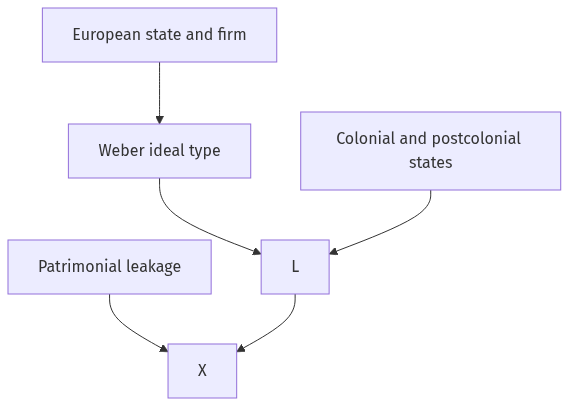
Conclusion
Weber’s bureaucracy is a product of European historical experience in its construction as an ideal type. It is not a product only of Europe in its later career, because colonial and postcolonial states installed the same claim of legal-rational office. The type is European in origin and comparative in use.
Quick related
Students also ask
-
What functions does religion perform in a pluralistic society?
Next question on this syllabus topic (2023 · Q5(c)). View answer →
-
Did Weber say only Europe can have bureaucracy?
No. He built the type from Europe and used it to compare other administrations.
-
Is a corrupt office not a bureaucracy?
It is a bureaucracy with patrimonial leakage. The ideal type is a measure, not a photograph.
Same topic · past papers
UPSC has asked this before
These previous-year questions sit on the same topic. Open one to practise the earlier ask.
-
2024 · Q2(a) · Sociology GS 1 · 20 marks
Sociology is the product of European enlightenment and renaissance. Critically examine this statement
More from this topic
Q7(c) · UPSC Mains 2026 · Sociology GS 1 · 10 marks · Solution
Compare the social organisation of work in industrial capitalism and platform capitalism
Sociological Thinkers: Karl Marx
• **Setting:** Industrial capitalism centres work in physical factories; platform capitalism disperses it via digital apps. • **Control:** Factories use direct managerial supervision and time-discipline; platforms use invisible algorithms and automated ratings. • **Contracts:** Industrial work relies on standard, secure employment with welfare benefits; platform work relies on gig contracts and independent contractors. • **Risk:** Factories shoulder capital costs; platform capitalism shifts risks and equipment costs onto individual workers. • **Solidarity:** Shared factory spaces foster collective class consciousness; digital isolation creates an atomised "precariat." • **Surplus Value:** Both systems extract surplus value, but platforms obscure exploitation behind the illusion of entrepreneurial freedom.
Q5(d) · UPSC Mains 2026 · Sociology GS 1 · 10 marks · Solution
How does Max Weber's 'theory of authority' shape bureaucracy? Analyse.
Sociological Thinkers: Karl Marx
Max Weber's sociological framework links different forms of legitimate domination directly to the rise of modern rational-legal bureaucracy. Traditional and charismatic authority provide historical context, but rational-legal authority creates the impersonal rules, hierarchy, and technical expertise defining bureaucratic structures. While ensuring efficiency, this iron cage of rationalisation also poses risks of alienation and goal displacement, which later thinkers critiqued.
Q3(c) · UPSC Mains 2026 · Sociology GS 1 · 10 marks · Solution
How does Emile Durkheim conceptualize religion as a 'social fact'? Explain
Sociological Thinkers: Karl Marx
Emile Durkheim treats religion as a quintessential social fact in 'The Elementary Forms of the Religious Life' (1912). Moving away from supernatural or animistic definitions, he argues that religion is fundamentally a collective product. Society objectifies its own moral authority and solidarity through sacred symbols and rituals. By separating the sacred from the profane, religious practices reinforce social integration and collective consciousness. Thus, religion is society worshipping itself, operating as an external and coercive constraint upon individual thought and action.