
Revision summary
Religion in pluralism still binds groups, supplies meaning, and stores values. Durkheim, Weber, and Parsons remain usable at community scale, not always at national scale. Welfare, identity, and bargaining with the state are added functions. The same sacred honour can organise peace forums or riots. Indian secular constitutionalism tries to keep practice without a state church.
Model answer
Copper italics in this answer — like this — are the key facts. Each one is unpacked in the Facts & figures rail.
Introduction
A pluralistic society contains several religious communities and a secular legal frame that claims to treat them as citizens. Religion still functions as meaning, belonging, and mobilisation. The same functions can integrate a group and divide the polity.
Body
Classical functions, still at work
- Emile Durkheim treated religion as the rite that makes the sacred and binds the group. In a plural society this binding is often at the community scale, not at the scale of the whole nation.
- Max Weber treated religion as a source of theodicy and of economic ethic, which still shapes work, charity, and status honour among communities.
- Talcott Parsons placed religion as a cultural subsystem that supplies values. Pluralism means several value stores, not one church.
Functions specific to pluralism
- Identity: festivals, law-like custom, and places of worship mark groups in public space.
- Welfare: trusts, langar, and community schools provide services the state does not fully supply.
- Voice: religious associations bargain with the state on personal law, holidays, and security.
- Peace: shared civic rituals and interfaith forums can lower everyday conflict.
- Conflict: sacred honour can be used to organise riots and electoral blocs.
Indian illustration
- Constitutional secularism, Articles 25 to 28, tries to keep the state from a single church while protecting practice.
- Lived pluralism includes procession routes, waqf and temple boards, and caste inside each religion.
- Peter Berger’s sacred canopy is thinner in a city of many canopies. Meaning does not vanish. It multiplies.
Judgement
- Functions are integration within, and both bridge and barrier between, communities.
- A plural democracy needs the welfare and meaning functions without allowing the conflict function to capture the state.
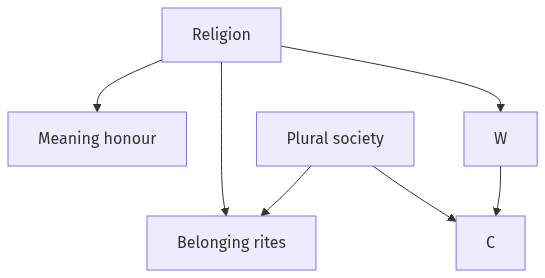
Flow diagram
Conclusion
In a pluralistic society religion still performs Durkheim’s binding, Weber’s meaning and honour, and Parsons’s value supply, mainly at community scale. It also performs welfare, bargaining, and, at times, conflict. The democratic task is to keep those functions inside citizenship rather than as a substitute for it.
Quick related
Students also ask
-
Explain Max Weber's theory of social stratification. How does Weber's idea of class differ from that of Marx?
Next question on this syllabus topic (2023 · Q6(b)). View answer →
-
Does pluralism mean religion loses function?
No. Functions move to communities and to competition in public space.
-
Is civil religion the same as church?
Civil religion is a shared political sacred, such as the Constitution as emblem. It is not one denomination’s creed.
Same topic · past papers
UPSC has asked this before
These previous-year questions sit on the same topic. Open one to practise the earlier ask.
-
2026 · Q3(c) · Sociology GS 1 · 10 marks
How does Emile Durkheim conceptualize religion as a 'social fact'? Explain -
2025 · Q7(b) · Sociology GS 1 · 20 marks
How do theories of Marx, Weber and Durkheim differ in understanding religion? Explain -
2022 · Q5(a) · Sociology GS 1 · 10 marks
Critically examine the relevance of Durkheim's views on religion in contemporary society. -
2018 · Q8(c) · Sociology GS 1 · 15 marks
In what way did Durkheim perceive religion as functional to society? -
2017 · Q5(c) · Sociology GS 1 · 10 marks
Give an assessment of Durkheimian notion of 'sacred' and 'profane' in sociology of religion
More from this topic
Q7(c) · UPSC Mains 2026 · Sociology GS 1 · 10 marks · Solution
Compare the social organisation of work in industrial capitalism and platform capitalism
Sociological Thinkers: Karl Marx
• **Setting:** Industrial capitalism centres work in physical factories; platform capitalism disperses it via digital apps. • **Control:** Factories use direct managerial supervision and time-discipline; platforms use invisible algorithms and automated ratings. • **Contracts:** Industrial work relies on standard, secure employment with welfare benefits; platform work relies on gig contracts and independent contractors. • **Risk:** Factories shoulder capital costs; platform capitalism shifts risks and equipment costs onto individual workers. • **Solidarity:** Shared factory spaces foster collective class consciousness; digital isolation creates an atomised "precariat." • **Surplus Value:** Both systems extract surplus value, but platforms obscure exploitation behind the illusion of entrepreneurial freedom.
Q5(d) · UPSC Mains 2026 · Sociology GS 1 · 10 marks · Solution
How does Max Weber's 'theory of authority' shape bureaucracy? Analyse.
Sociological Thinkers: Karl Marx
Max Weber's sociological framework links different forms of legitimate domination directly to the rise of modern rational-legal bureaucracy. Traditional and charismatic authority provide historical context, but rational-legal authority creates the impersonal rules, hierarchy, and technical expertise defining bureaucratic structures. While ensuring efficiency, this iron cage of rationalisation also poses risks of alienation and goal displacement, which later thinkers critiqued.
Q3(c) · UPSC Mains 2026 · Sociology GS 1 · 10 marks · Solution
How does Emile Durkheim conceptualize religion as a 'social fact'? Explain
Sociological Thinkers: Karl Marx
Emile Durkheim treats religion as a quintessential social fact in 'The Elementary Forms of the Religious Life' (1912). Moving away from supernatural or animistic definitions, he argues that religion is fundamentally a collective product. Society objectifies its own moral authority and solidarity through sacred symbols and rituals. By separating the sacred from the profane, religious practices reinforce social integration and collective consciousness. Thus, religion is society worshipping itself, operating as an external and coercive constraint upon individual thought and action.