
Revision summary
Nuclear families centre on the couple and dependent children. Neo-local residence means a home apart from both parental households. Filiocentric means the child becomes the emotional and economic centre. Parsons linked the isolated nuclear family to industrial mobility. Fertility decline, schooling and middle-class child projects deepen filiocentrism. Indian households often mix nuclear dwellings with continuing wider kinship.
Model answer
Copper italics in this answer — like this — are the key facts. Each one is unpacked in the Facts & figures rail.
Introduction
The modern family is often described as nuclear, neo-local and, increasingly, filiocentric. Nuclear means a couple and their dependent children as the everyday household core. Neo-local means the couple set up a home apart from both sets of parents. Filiocentric means that the child, rather than the lineage elder or even the conjugal pair as a rank order, becomes the emotional and economic centre. The trend needs a sociological explanation, not a complaint about spoiling.
Body
Nuclear and neo-local change
Talcott Parsons linked the isolated nuclear family to industrial society. Occupational mobility, he argued, is easier when the household is small and not bound to a joint estate. William Goode expected a world movement toward the conjugal family. Indian evidence is more mixed. A. M. Shah distinguished family and household. Joint living continues in many property-holding groups, while urban rental housing and migration produce neo-local nuclear units. I. P. Desai and later NFHS-style data show a rise of smaller households without a simple death of kinship. Remittances, care of the elderly and festival membership keep the wider family alive even when the dwelling is nuclear.
Neo-locality follows jobs, education and the housing market. It also follows the wish of young couples for privacy. Patriarchy does not automatically fall when the house is nuclear. The husband’s parents may still govern from another flat.
Why families become filiocentric
Philippe Ariès argued that the modern idea of childhood as a protected, precious stage is historically produced. Falling fertility, which demographic transition theory describes, concentrates parental investment on fewer children. Schooling lengthens dependence. The child becomes a project of the middle class: marks, coaching, health and display. Ulrich Beck and Elisabeth Beck-Gernsheim wrote of the negotiated family and of children as last remaining sources of meaning in an individualised world. Emotional democracy, in Anthony Giddens’s late-modern intimacy, raises the child’s voice inside the home compared with a strictly patriarchal joint family.
In India, the only-child or two-child urban household, the coaching industry, and public anxiety about the girl child’s education and safety all show filiocentrism. Advertising and social media amplify the child as consumer. This can improve child welfare. It can also produce pressure, sibling-less isolation, and neglect of the elderly, which is the other side of a child-centred budget.
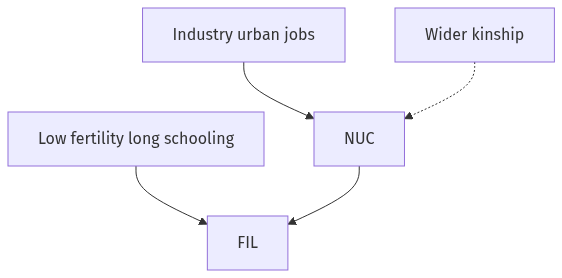
The three adjectives therefore hang together. Industrial and urban work pull households toward nuclear neo-local form. Low fertility and long schooling turn that household around the child.
How the three changes support one another
A joint household with many children can centre the eldest male and the lineage property. A neo-local flat with one or two children, both in school for many years, has a smaller stage. Parents spend time on homework, health and competitive exams. The child’s timetable organises the adults. This is filiocentrism as a practical order, not only as a feeling. It is strengthened by the state when childhood is legally protected, and by the market when toys, coaching and insurance are sold through the child. It is also class-specific. A landless household may still need children’s labour. A wealthy joint family may remain elder-centred. The trend named in the question is strongest where wage work, small dwellings and school competition coincide. Explanation should keep that social location in view.
Flow diagram
Conclusion
Modern families often live as nuclear neo-local units and place the child at the centre of emotion and spending. Industry, housing, fertility decline and schooling explain the trend. Kinship does not vanish, but authority inside the dwelling shifts toward the child’s future.
Quick related
Students also ask
-
How does the dramaturgical perspective enable our understanding of everyday life?
Next question on this syllabus topic (2023 · Q1(c)). View answer →
-
Is a nuclear family automatically child-centred?
Not automatically. A nuclear home can still be husband-centred. Filiocentrism is an added historical shift of investment and emotion.
-
Has the joint family disappeared in India?
No. Many groups still live jointly or function jointly. The modern trend is stronger in urban middle classes and among migrants.
Same topic · past papers
UPSC has asked this before
These previous-year questions sit on the same topic. Open one to practise the earlier ask.
-
2021 · Q3(c) · Sociology GS 1 · 10 marks
Do you agree with Max Weber's idea that bureaucracy has the potential to become an iron cage ? Justify your answer
More from this topic
Q8(c) · UPSC Mains 2026 · Sociology GS 1 · 10 marks · Solution
Discuss the significance and limitations of 'intersectionality' in social research
Sociology
Intersectionality, coined by Kimberlé Crenshaw, examines how overlapping identities like race, class, and gender shape systemic oppression. Its significance in social research lies in capturing lived realities beyond single-axis frameworks and preventing reductive generalisations. However, limitations include methodological complexity, risks of infinite regress, and difficulties in operationalising fluid categories. Effective application requires balancing structural macro-analysis with micro-level lived experiences.
Q6(b) · UPSC Mains 2026 · Sociology GS 1 · 20 marks · Solution
Critically analyse the nature-nurture debate from different perspectives
Sociology
1. The nature-nurture debate explores whether biology or society primarily shapes human behavior
Q6(a) · UPSC Mains 2026 · Sociology GS 1 · 20 marks · Solution
Discuss the intellectual origins of sociology and its evolution as a distinct field of study
Sociology
Sociology arose in 19th-century Western Europe to make sense of massive upheavals caused by the Industrial and French Revolutions. Enlightenment thinkers laid the groundwork by championing reason, empirical observation, and human agency over traditional dogma. Auguste Comte gave the discipline its name, pushing for a positivist "physics of society" based on scientific laws. Émile Durkheim secured its academic legitimacy by defining "social facts" and using empirical methods to study human behavior. Max Weber introduced interpretive sociology, while Karl Marx focused on material conditions and class struggle. In the 20th century, Talcott Parsons advanced structural-functionalism to study systemic equilibrium. Later, conflict theories, the Frankfurt School, and postmodern critiques broadened the field to address power and marginalisation. Today, sociology continues to evolve by analyzing globalisation, digital shifts, and modern identity politics.