
Revision summary
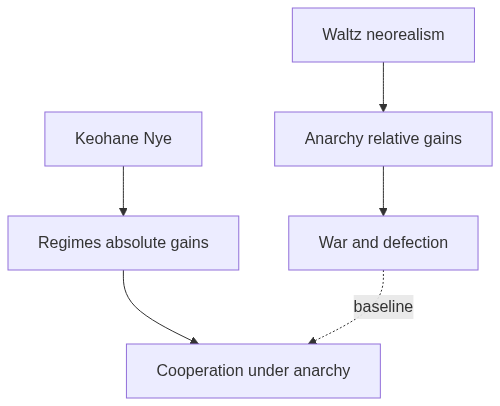
Waltzian neorealism pictures anarchy, self-help and relative gains as a dark constant. Keohane and Nye’s neoliberalism keeps anarchy but adds complex interdependence, regimes and absolute gains. Institutions reduce cheating and transaction costs; they do not create a world state. Ukraine, tariffs and health-governance shocks show both residual darkness and institutional repair. The ‘lightening’ is cooperation under anarchy, not the end of power politics.
Model answer
Copper italics in this answer — like this — are the key facts. Each one is unpacked in the Facts & figures rail.
Introduction
Neorealism, in Kenneth Waltz’s Theory of International Politics, is a dark science of anarchy: self-help, relative gains, and the constant possibility of war. Neoliberal institutionalism — Robert Keohane, Joseph Nye, regime theory — does not deny anarchy. It argues that information, iteration and institutions can make cooperation rational. That is the lightening.
Body
The dark view
Waltz stripped classical realism of human nature and kept structure. The international system is anarchic. Units are like units. Security is scarce. States watch relative gains because today’s partner can be tomorrow’s threat. John Mearsheimer later pushed this toward offensive realism: great powers maximise power. The 2022 full-scale war on Ukraine, Pahalgam 2025 and the return of tariff weapons in 2025 all feed the dark reading: force and fear still organise the board.
The neoliberal reply
Keohane’s After Hegemony and Keohane and Nye’s Power and Interdependence argued that under complex interdependence military force is not always the last word, multiple channels connect societies, and issue-areas have their own politics. Regimes — principles, norms, rules and decision procedures — reduce cheating and transaction costs. Absolute gains can suffice when defection is monitored. The WTO, the IAEA, ASEAN’s convening, and even a bruised WHO are illustrations that states lock themselves into rules they could, in theory, smash.
Neoliberalism is not Wilsonian idealism. It is rational-choice institutionalism. Hedley Bull’s anarchical society sits nearby: order without world government. Alexander Wendt later said anarchy is what states make of it; neoliberalism is more cautious, staying with interests and information.
Lightening, not abolition
- The lightening is this: anarchy remains, but it is not a jungle at every hour. Institutions do not replace power; they shape how power is used. When the United States threatens reciprocal tariffs in 2025, neorealists say “I told you so.” Neoliberals reply that the same shock sends India and the EU back to a free-trade agreement table, and that WHO reform talk after a U.S. withdrawal debate is still institutional politics, not a return to 1914. Both can be true. The dark view is the baseline risk. The light view is the daily work of diplomacy.
Flow diagram
Conclusion
Neoliberalism lightens neorealism by showing that iterated games, information and regimes make cooperation possible under anarchy. It does not abolish self-help. It makes self-help less lonely.
Quick related
Students also ask
-
Explain the non-traditional security threats in the context of food and environmental crises.
Next question on this syllabus topic (2025 · Q1(c)). View answer →
-
Is neoliberalism the same as economic neoliberalism?
No. In IR theory it means neoliberal institutionalism, not Thatcher–Reagan market ideology, though the words overlap in student essays.
-
Did neoliberalism refute Waltz?
It qualified him. Most syllabi treat the two as a debate inside rationalism, against constructivism and Marxism.
Same topic · past papers
UPSC has asked this before
These previous-year questions sit on the same topic. Open one to practise the earlier ask.
-
2021 · Q2(b) · PSIR GS 2 · 15 marks
Discuss the emergence of neo-realism and its basic tenets
More from this topic
Q7(a) · UPSC Mains 2026 · PSIR GS 2 · 20 marks · Solution
How does illegal cross border migration pose challenges to India's security? Discuss the steps taken by the government in this direction and their effectiveness
Comparative Politics
Illegal cross-border migration undermines India's national security by altering demographic balances, straining economic resources, and exacerbating internal security vulnerabilities. The government has responded through border fencing, technological integration like SMART fencing, institutional mechanisms, and bilateral agreements. However, porous terrain, regional political complexities, and local connivance limit the complete effectiveness of these measures. A holistic approach combining strict border management with socio-economic development and robust legal frameworks is essential for sustainable containment.
Q5(d) · UPSC Mains 2026 · PSIR GS 2 · 10 marks · Solution
Discuss the main features of the land-boundary agreement between India and Bangladesh.
Comparative Politics
• Operationalized via the 100th Constitutional Amendment Act of 2015 to resolve Radcliffe Line anomalies. • Rooted in the unratified 1974 bilateral agreement and the 2011 additional protocol. • Involved the peaceful exchange of 111 Indian enclaves in Bangladesh and 51 Bangladeshi enclaves in India. • Granted affected residents the sovereign right to choose their nationality and place of residence. • Demarcated roughly 6.1 km of previously un-demarcated land boundaries to end administrative confusion. • Secured human rights and welfare access for over 50,000 formerly stateless enclave residents. • Reduced bilateral trust deficits, paving the way for deeper cooperation in security and connectivity.
Q4(c) · UPSC Mains 2026 · PSIR GS 2 · 15 marks · Solution
What is UNCLOS? Explain its salient features
Comparative Politics
UNCLOS, established in 1982, serves as the constitution of the oceans, codifying customary international law regarding maritime jurisdictions. Its salient features include distinct maritime zones ranging from territorial waters to the high seas, balancing coastal state sovereignty with freedom of navigation. It establishes compulsory dispute settlement mechanisms through institutions like ITLOS. The convention also mandates environmental protection and sustainable management of marine resources. For India, UNCLOS provides a rules-based order in the Indo-Pacific while respecting navigational rights. It remains central to addressing contemporary maritime security and resource challenges.