
Revision summary
The psychological approach studies personality, attitudes, civic culture and cognition in comparative politics. Lasswell, Adorno, Almond and Verba, Easton and later political psychology are the main lineage. It explains voting, protest, obedience and leadership better than a constitution or a class map alone. Surveys, experiments and psychobiography are typical methods. It is a layer, not a substitute for institutions and political economy.
Model answer
Copper italics in this answer — like this — are the key facts. Each one is unpacked in the Facts & figures rail.
Introduction
- The psychological approach to comparative politics studies political man: personality, attitude, cognition and learning. It asks how inner life becomes public power. Constitutions and classes still matter, but they do not vote, fear, or follow a leader. Minds do.
Body
Core claims
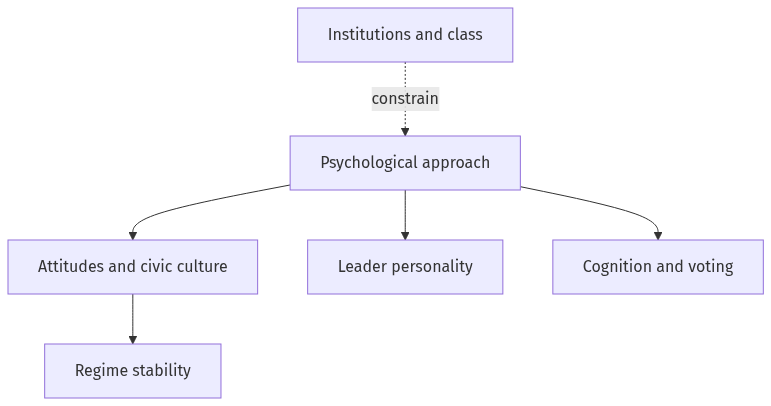
Harold Lasswell treated politics as the displacement of private motives onto public objects: who gets what, when, how. Theodor Adorno and colleagues, in The Authoritarian Personality, linked rigid child-rearing and prejudice to a potential for fascist followership. Gabriel Almond and Sidney Verba, in The Civic Culture, compared participant, subject and parochial orientations and argued that stable democracy needs a mix, not only a perfect constitution. David Easton placed those orientations inside a systems model: demands and supports are psychological inputs. Later Fred Greenstein, the Michigan voting school, and experimental political psychology added heuristics, motivated reasoning and leader images.
The approach is comparative because it treats civic culture, trust, efficacy and threat perception as variables that travel. Weimar’s subject culture, Britain’s allegiant mix, and high-threat polarisation in several democracies after 2016 are the same family of questions. Open societies socialise through plural media and parties; closed ones through fear and a single script — a point taken up in the short note on socialisation.
Method and payoff
Surveys, experiments, psychobiography (Alexander and Juliette George on Woodrow Wilson) and, now, digital trace data are the tools. The payoff is explanation of turnout, protest, obedience and charismatic followership that a legal text cannot supply. Robert Putnam’s later social-capital work and Ronald Inglehart’s post-materialism sit in the same neighbourhood: values and feelings, not only GDP, sort regimes.
Limits
Psychology can slide into reductionism. A “national character” story once excused empire. Samples are often WEIRD. Dependency and new institutionalism remind us that credit, oil, electoral rules and courts structure the menu of feelings. Kenneth Waltz would say that structure, not the leader’s childhood, is the first cut in international politics; the same caution applies when comparing states. The approach is a necessary layer, not a complete map.
Flow diagram
Conclusion
Comparative politics needs minds as well as machines of state. Personality, civic culture and cognition explain why similar rules produce unlike regimes. They do not replace political economy or institutions; they sit beside them.
Quick related
Students also ask
-
Discuss the interpretive approach to the study of comparative politics.
Next question on this syllabus topic (2024 · Q1(a)). View answer →
-
Is this the same as political psychology as a subfield?
Political psychology is the contemporary research programme. In a PSIR paper the ‘psychological approach’ is the older comparative claim that attitudes and personality are first-order variables.
-
Does it ignore the state?
Badly used, yes. Well used, it studies how people meet the state: trust, fear, efficacy and leader images.
Same topic · past papers
UPSC has asked this before
These previous-year questions sit on the same topic. Open one to practise the earlier ask.
-
2024 · Q1(a) · PSIR GS 2 · 10 marks
Discuss the interpretive approach to the study of comparative politics. -
2023 · Q1(a) · PSIR GS 2 · 10 marks
What are the crucial functions of empirical political theory in Comparative Politics? -
2026 · Q1(a) · PSIR GS 2 · 10 marks
Criticism of the institutional approach in comparative political analysis has come up in successive waves. Comment. -
2021 · Q1(a) · PSIR GS 2 · 10 marks
Discuss the political economy approach to the comparative analysis of politics. -
2025 · Q8(b) · PSIR GS 2 · 15 marks
Discuss some of the key drivers of India's new interests in Africa which might help in developing long-term comparative advantage over China
More from this topic
Q3(c) · UPSC Mains 2026 · PSIR GS 2 · 15 marks · Solution
Does power transition theory reflect the dynamics of US-China relations?
Approaches to the Study of International Relations
Power transition theory, formulated by A.F. Organski, posits that hegemonic wars occur when a dissatisfied challenger approaches parity with the dominant power. In the context of US-China relations, the theory explains the structural anxieties, trade wars, and technological decoupling observed today. China's rapid economic and military rise fits the challenger profile, while its contestation of the US-led liberal international order signals systemic dissatisfaction. However, the theory's deterministic focus on war overlooks complex economic interdependence, nuclear deterrence, and institutional absorption. While power transition highlights the security dilemma at play, contemporary Sino-US dynamics are shaped equally by deterrence and globalization, making conflict neither inevitable nor strictly linear.
Q1(d) · UPSC Mains 2024 · PSIR GS 2 · 10 marks · Solution
Explain the various facets of the idealist approach to the study of international relations. Comment on its contemporary relevance.
Approaches to the Study of International Relations
Idealism in IR treats law, morality, public opinion and organisations as real forces, not only military power. Kant’s perpetual peace and Wilson’s League/UN lineage are the core facets, with collective security and disarmament as programmes. It is not naive pacifism; it seeks to change incentives through institutions. Morgenthau and Waltz remain the main critique: interest, anarchy and self-help. Contemporary relevance is institutional and normative — UN, NPT, courts — not a claim that power politics has ended.
Q1(b) · UPSC Mains 2024 · PSIR GS 2 · 10 marks · Solution
Explain the central tenets of the World-Systems Theory.
Approaches to the Study of International Relations
Wallerstein’s unit is the capitalist world-economy since the long sixteenth century, not the isolated nation-state. Core, semi-periphery and periphery form a durable three-tier division of labour. Unequal exchange and strong/weak states move surplus toward the core. The theory rejects modernisation’s national ladder and differs from Waltz’s interstate anarchy as first cause. Limits include economic determinism and underplaying state autonomy and culture; mobility exists but hierarchy persists.