
Revision summary
Wallerstein’s unit is the capitalist world-economy since the long sixteenth century, not the isolated nation-state. Core, semi-periphery and periphery form a durable three-tier division of labour. Unequal exchange and strong/weak states move surplus toward the core. The theory rejects modernisation’s national ladder and differs from Waltz’s interstate anarchy as first cause. Limits include economic determinism and underplaying state autonomy and culture; mobility exists but hierarchy persists.
Model answer
Copper italics in this answer — like this — are the key facts. Each one is unpacked in the Facts & figures rail.
Introduction
World-Systems Theory, associated above all with Immanuel Wallerstein, treats the modern world as a single capitalist world-economy that has existed since the long sixteenth century. States are units inside that economy. They are not a set of separate national developments that happen to trade. The central tenets are about hierarchy, surplus and time, not about a list of poor countries.
Body
The unit of analysis
Wallerstein rejected the idea that ‘society’ equals the nation-state. The meaningful whole is the world-system: a large zone with a single division of labour and multiple polities. The modern system is a world-economy, not a world-empire. No single political centre owns all surplus. Capitalists and states compete. That competition is what keeps the system capitalist rather than a universal empire.
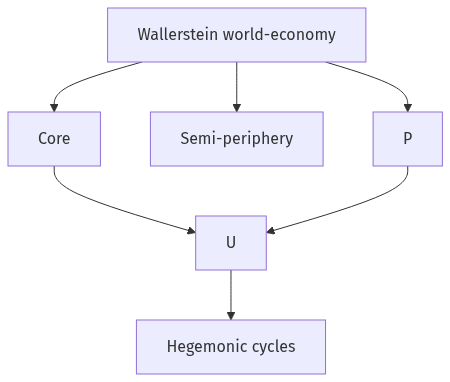
Core zones concentrate high-skill production, strong states and capital. Periphery zones specialise in low-wage extraction and weak or captured states. Semi-periphery zones sit between, mixing both roles and stabilising the hierarchy so that polarisation does not immediately smash the system. Movement is possible — the Netherlands, Britain and the United States have been hegemonic cores in sequence — but the three-tier structure persists.
Mechanism
The mechanism is unequal exchange and a world division of labour, drawing on dependency writers and on Fernand Braudel’s long duration. Wages, technology and state strength differ systematically. Surplus flows toward the core. Antonio Gramsci’s hegemony, later used by Robert Cox for world order, sits nearby: the core’s lead is not only guns. It is also consent around trade rules, money and culture. Wallerstein himself stressed cycles of hegemony and Kondratieff-type economic waves.
This is a direct attack on modernisation theory, which pictured each country climbing the same ladder from tradition to modernity. In world-systems thinking, the periphery is not late. It is produced as periphery by the same historical process that produced the core.
What it is not, and limits
It is not Kenneth Waltz’s neorealism. Waltz starts from anarchic states and relative military power. Wallerstein starts from a capitalist division of labour that states help to police. Great-power war still happens, but it is read as a fight over who organises the world-economy.
Limits are real. Critics say the theory is too economic, too deterministic about the periphery’s fate, and weak on culture, gender and domestic politics that the interpretive approach studies. Theda Skocpol and others argued that states have more autonomy than a pure world-market story allows. China’s rise, East Asian industrial policy and India’s partial climb complicate a frozen core–periphery map, even if they do not abolish hierarchy. The tenets remain useful as a structural picture of global inequality, not as a prophecy that no country can change position.
Flow diagram
Conclusion
World-Systems Theory says the modern world is one capitalist economy with core, semi-periphery and periphery, held by unequal exchange and hegemonic cycles. It explains global hierarchy better than a ladder of national modernisation. It does not replace every other theory of the state or of war.
Quick related
Students also ask
-
Explain the various facets of the idealist approach to the study of international relations. Comment on its contemporary relevance.
Next question on this syllabus topic (2024 · Q1(d)). View answer →
-
Is this the same as dependency theory?
It shares unequal exchange and a critique of modernisation. World-systems is more historical and systemic, and it includes a semi-periphery as a structural tier.
-
Does it deny interstate war?
No. War is read as part of hegemonic rivalry and systemic crisis, not as the whole of international politics.
Same topic · past papers
UPSC has asked this before
These previous-year questions sit on the same topic. Open one to practise the earlier ask.
-
2021 · Q2(b) · PSIR GS 2 · 15 marks
Discuss the emergence of neo-realism and its basic tenets
More from this topic
Q3(c) · UPSC Mains 2026 · PSIR GS 2 · 15 marks · Solution
Does power transition theory reflect the dynamics of US-China relations?
Approaches to the Study of International Relations
Power transition theory, formulated by A.F. Organski, posits that hegemonic wars occur when a dissatisfied challenger approaches parity with the dominant power. In the context of US-China relations, the theory explains the structural anxieties, trade wars, and technological decoupling observed today. China's rapid economic and military rise fits the challenger profile, while its contestation of the US-led liberal international order signals systemic dissatisfaction. However, the theory's deterministic focus on war overlooks complex economic interdependence, nuclear deterrence, and institutional absorption. While power transition highlights the security dilemma at play, contemporary Sino-US dynamics are shaped equally by deterrence and globalization, making conflict neither inevitable nor strictly linear.
Q1(a) · UPSC Mains 2025 · PSIR GS 2 · 10 marks · Solution
Discuss the psychological approach to the study of comparative politics.
Approaches to the Study of International Relations
The psychological approach studies personality, attitudes, civic culture and cognition in comparative politics. Lasswell, Adorno, Almond and Verba, Easton and later political psychology are the main lineage. It explains voting, protest, obedience and leadership better than a constitution or a class map alone. Surveys, experiments and psychobiography are typical methods. It is a layer, not a substitute for institutions and political economy.
Q1(d) · UPSC Mains 2024 · PSIR GS 2 · 10 marks · Solution
Explain the various facets of the idealist approach to the study of international relations. Comment on its contemporary relevance.
Approaches to the Study of International Relations
Idealism in IR treats law, morality, public opinion and organisations as real forces, not only military power. Kant’s perpetual peace and Wilson’s League/UN lineage are the core facets, with collective security and disarmament as programmes. It is not naive pacifism; it seeks to change incentives through institutions. Morgenthau and Waltz remain the main critique: interest, anarchy and self-help. Contemporary relevance is institutional and normative — UN, NPT, courts — not a claim that power politics has ended.