
Revision summary
Empirical political theory studies observable political facts with concepts that evidence can test. Its functions are description, classification, explanation, middle-range theory, and checking claims against practice. It shifted Comparative Politics from legal texts alone toward behaviour and institutions. Sartori’s warning against conceptual stretching is part of that discipline. It does not cancel culture or critical theory; it supplies the evidence those approaches still need.
Model answer
Copper italics in this answer — like this — are the key facts. Each one is unpacked in the Facts & figures rail.
Introduction
Empirical political theory in Comparative Politics studies observable political behaviour, institutions, and outcomes with concepts that can be checked against evidence. It does not replace philosophy. It tests what states and citizens actually do.
Body
What empirical political theory is
- It grew with the behavioural movement associated with David Easton, Gabriel Almond, and later quantitative and case-work that asked for statements that data can support or refute.
- It treats votes, cabinets, parties, courts, and public spending as facts that can be classified and compared, not only as legal texts.
- Giovanni Sartori insisted that concepts must travel without stretching, so empirical work needs clear definitions before counting.
Crucial functions
- Description: it records how governments, parties, and citizens behave across countries.
- Classification: it groups regimes, party systems, and federal designs so that like cases sit together.
- Explanation: it links causes such as class, institutions, or political culture to outcomes such as stability or turnout.
- Middle-range theory: it builds limited generalisations, for example about coalition cabinets or consociational bargains, rather than one law for all politics.
- Evaluation of claims: it checks whether a constitution or a slogan matches practice.
Role in Comparative Politics
- It moved the field from formal-legal catalogues of constitutions toward comparison of real processes.
- It supplies the evidence base on which later interpretive and critical work, including Robert Cox’s distinction between problem-solving and critical theory, can still argue.
- It remains limited when culture, meaning, and history are ignored, yet without it comparison becomes opinion.
Flow diagram
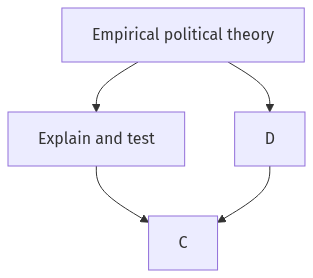
Conclusion
Empirical political theory describes, classifies, and tests political life across states. In Comparative Politics its role is to keep concepts tied to evidence so that comparison is more than a list of unique stories.
Quick related
Students also ask
-
What are the difficulties faced by a political theorist in comparing the States?
Next question on this syllabus topic (2023 · Q1(b)). View answer →
-
Is empirical theory the same as statistics?
No. Statistics are one tool. Case studies, process tracing, and clear concepts are also empirical if they answer to evidence.
-
Does it ignore values?
It tries to separate value claims from testable statements. The choice of what to study is still a value choice.
Same topic · past papers
UPSC has asked this before
These previous-year questions sit on the same topic. Open one to practise the earlier ask.
-
2026 · Q3(c) · PSIR GS 2 · 15 marks
Does power transition theory reflect the dynamics of US-China relations? -
2024 · Q1(b) · PSIR GS 2 · 10 marks
Explain the central tenets of the World-Systems Theory. -
2024 · Q4(a) · PSIR GS 2 · 20 marks
"The Gramscian theory of hegemony provides many valuable insights into the nature of global power." Comment.
More from this topic
Q7(a) · UPSC Mains 2026 · PSIR GS 2 · 20 marks · Solution
How does illegal cross border migration pose challenges to India's security? Discuss the steps taken by the government in this direction and their effectiveness
Comparative Politics
Illegal cross-border migration undermines India's national security by altering demographic balances, straining economic resources, and exacerbating internal security vulnerabilities. The government has responded through border fencing, technological integration like SMART fencing, institutional mechanisms, and bilateral agreements. However, porous terrain, regional political complexities, and local connivance limit the complete effectiveness of these measures. A holistic approach combining strict border management with socio-economic development and robust legal frameworks is essential for sustainable containment.
Q5(d) · UPSC Mains 2026 · PSIR GS 2 · 10 marks · Solution
Discuss the main features of the land-boundary agreement between India and Bangladesh.
Comparative Politics
• Operationalized via the 100th Constitutional Amendment Act of 2015 to resolve Radcliffe Line anomalies. • Rooted in the unratified 1974 bilateral agreement and the 2011 additional protocol. • Involved the peaceful exchange of 111 Indian enclaves in Bangladesh and 51 Bangladeshi enclaves in India. • Granted affected residents the sovereign right to choose their nationality and place of residence. • Demarcated roughly 6.1 km of previously un-demarcated land boundaries to end administrative confusion. • Secured human rights and welfare access for over 50,000 formerly stateless enclave residents. • Reduced bilateral trust deficits, paving the way for deeper cooperation in security and connectivity.
Q4(c) · UPSC Mains 2026 · PSIR GS 2 · 15 marks · Solution
What is UNCLOS? Explain its salient features
Comparative Politics
UNCLOS, established in 1982, serves as the constitution of the oceans, codifying customary international law regarding maritime jurisdictions. Its salient features include distinct maritime zones ranging from territorial waters to the high seas, balancing coastal state sovereignty with freedom of navigation. It establishes compulsory dispute settlement mechanisms through institutions like ITLOS. The convention also mandates environmental protection and sustainable management of marine resources. For India, UNCLOS provides a rules-based order in the Indo-Pacific while respecting navigational rights. It remains central to addressing contemporary maritime security and resource challenges.