
Revision summary
The interpretive approach studies political action as meaning in context, following Weber’s verstehen and later cultural and linguistic turns. It replies to behaviouralism’s search for covering laws by asking how votes, nations and authority are understood locally. Thick description, ethnography and discourse analysis are typical tools. It explains legitimacy, nationalism and everyday state practice that a constitution or a class map alone cannot supply. Limits are relativism, weak generalisation, and neglect of material and institutional constraint if used alone.
Model answer
Copper italics in this answer — like this — are the key facts. Each one is unpacked in the Facts & figures rail.
Introduction
The interpretive approach to comparative politics studies political life as meaning in context. It asks how people understand authority, nation, caste, party and protest, rather than treating those words as empty boxes to be filled with numbers. Institutions still matter. They matter as they are lived and named.
Body
What the approach claims
Max Weber’s verstehen asked the analyst to grasp the subjective meaning of action. Clifford Geertz’s thick description treated a ritual, a courtroom or a vote as a text that must be read in a local language of symbols. Charles Taylor argued that social science cannot copy physics because humans are self-interpreting. In comparative politics this becomes a method: constitutions, elections and revolutions are compared through the stories, categories and practices that make them intelligible to participants.
The approach grew as a reply to mid-century behaviouralism, which privileged surveys, covering laws and a search for universal regularities. Interpretivists do not deny that turnout can be counted. They deny that the count is the whole of politics. A vote in a consociational bargain, a vote in a clientelist village, and a vote in a polarised presidential republic may share a ballot paper and not share a meaning.
What it explains
It explains legitimacy, nationalism, religious politics and everyday the state. Why do similar federal texts produce unlike centre–state fights. Why does a coup in one country look like liberation and in another like crime. Benedict Anderson’s imagined community, James Scott’s hidden transcripts of resistance, and ethnographic work on Indian elections sit in this family even when the authors are not labelled ‘interpretivists’ on a syllabus list. Comparative politics needs this layer because culture is not a residual. It is how power is recognised.
The method uses ethnography, discourse analysis, history and close reading of law as practised, not only as printed. Cases are often few and deep. The payoff is a map of political languages: civic republicanism in one setting, divine kingship in another, developmental nationalism in a third.
Limits
Interpretation can slide into relativism, where every practice is only ‘true for them’ and comparison dies. It can become impressionistic if the scholar’s reading is not checked against archives, votes and budgets. Theda Skocpol and historical institutionalists remind us that organisations, armies and tax systems constrain what meanings can do. Immanuel Wallerstein’s world-system and class analysis remind us that meaning sits inside a material hierarchy of core and periphery. The interpretive approach is strongest as a necessary reading of politics, not as a claim that structures do not exist.
Flow diagram
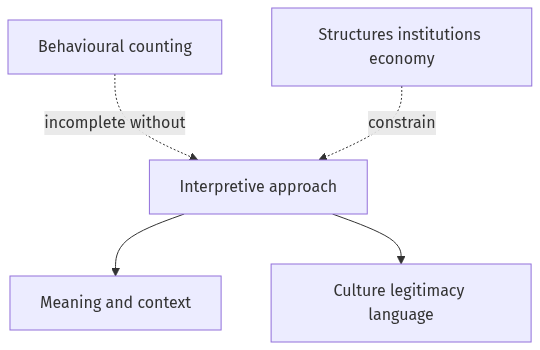
Conclusion
Comparative politics needs interpretation because people act on meanings, not only on incentives printed in a model. The approach recovers culture, legitimacy and everyday power. It must still sit beside institutions and political economy, or comparison becomes a collection of local stories.
Quick related
Students also ask
-
Explain the central tenets of the World-Systems Theory.
Next question on this syllabus topic (2024 · Q1(b)). View answer →
-
Is interpretive work unscientific?
It is a different standard of science: systematic interpretation, triangulation and public argument, not a laboratory covering law. It is still evidence-based.
-
Can two countries still be compared?
Yes, by comparing political languages and practices, not by pretending every variable travels unchanged. Comparison is harder, not forbidden.
Same topic · past papers
UPSC has asked this before
These previous-year questions sit on the same topic. Open one to practise the earlier ask.
-
2025 · Q1(a) · PSIR GS 2 · 10 marks
Discuss the psychological approach to the study of comparative politics. -
2023 · Q1(a) · PSIR GS 2 · 10 marks
What are the crucial functions of empirical political theory in Comparative Politics? -
2026 · Q1(a) · PSIR GS 2 · 10 marks
Criticism of the institutional approach in comparative political analysis has come up in successive waves. Comment. -
2021 · Q1(a) · PSIR GS 2 · 10 marks
Discuss the political economy approach to the comparative analysis of politics. -
2025 · Q8(b) · PSIR GS 2 · 15 marks
Discuss some of the key drivers of India's new interests in Africa which might help in developing long-term comparative advantage over China
More from this topic
Q3(c) · UPSC Mains 2026 · PSIR GS 2 · 15 marks · Solution
Does power transition theory reflect the dynamics of US-China relations?
Approaches to the Study of International Relations
Power transition theory, formulated by A.F. Organski, posits that hegemonic wars occur when a dissatisfied challenger approaches parity with the dominant power. In the context of US-China relations, the theory explains the structural anxieties, trade wars, and technological decoupling observed today. China's rapid economic and military rise fits the challenger profile, while its contestation of the US-led liberal international order signals systemic dissatisfaction. However, the theory's deterministic focus on war overlooks complex economic interdependence, nuclear deterrence, and institutional absorption. While power transition highlights the security dilemma at play, contemporary Sino-US dynamics are shaped equally by deterrence and globalization, making conflict neither inevitable nor strictly linear.
Q1(a) · UPSC Mains 2025 · PSIR GS 2 · 10 marks · Solution
Discuss the psychological approach to the study of comparative politics.
Approaches to the Study of International Relations
The psychological approach studies personality, attitudes, civic culture and cognition in comparative politics. Lasswell, Adorno, Almond and Verba, Easton and later political psychology are the main lineage. It explains voting, protest, obedience and leadership better than a constitution or a class map alone. Surveys, experiments and psychobiography are typical methods. It is a layer, not a substitute for institutions and political economy.
Q1(d) · UPSC Mains 2024 · PSIR GS 2 · 10 marks · Solution
Explain the various facets of the idealist approach to the study of international relations. Comment on its contemporary relevance.
Approaches to the Study of International Relations
Idealism in IR treats law, morality, public opinion and organisations as real forces, not only military power. Kant’s perpetual peace and Wilson’s League/UN lineage are the core facets, with collective security and disarmament as programmes. It is not naive pacifism; it seeks to change incentives through institutions. Morgenthau and Waltz remain the main critique: interest, anarchy and self-help. Contemporary relevance is institutional and normative — UN, NPT, courts — not a claim that power politics has ended.