
Revision summary
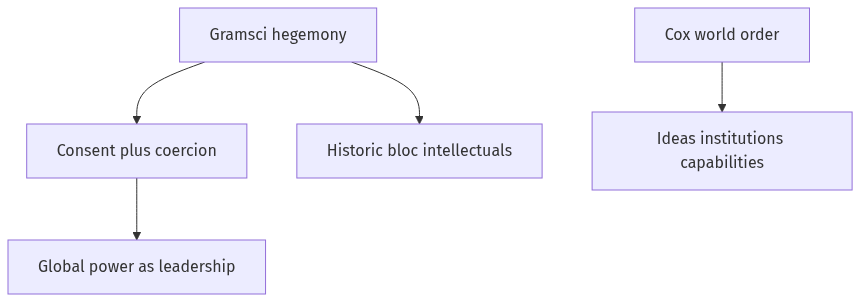
Gramsci’s hegemony is leadership through consent in civil society, backed by coercion, organised in a historic bloc. Cox applied this to world order: Pax Americana as material power plus institutions and ideas. Insights: global power includes WTO rules, culture and elite consent, not only armies; resistance includes counter-hegemonic ideas. NATO and liberal order are hegemonic tools in this sense. Limits: still need Waltz on anarchy and Wallerstein on the world-economy; the term must not mean every cultural flow.
Model answer
Copper italics in this answer — like this — are the key facts. Each one is unpacked in the Facts & figures rail.
Introduction
Antonio Gramsci wrote hegemony as a form of class power in which coercion is wrapped in consent. The ruling group leads in culture, education, church and everyday common sense, not only in the barracks. The claim that this theory gives valuable insights into the nature of global power is right. The comment should show how the insight travels from Italy to world order, and where it stops.
Body
Gramsci’s core
- Hegemony is not mere domination. It is a historic bloc: material force plus ideas that make the existing order look natural. Organic intellectuals produce that common sense. Civil society is a trench system where battles of position are fought before a war of manoeuvre. A state that must rule only by force has not achieved hegemony; it is in crisis.
Scaling to global power
Robert Cox took Gramsci into international political economy: world order as a configuration of material capabilities, ideas and institutions. Pax Britannica and Pax Americana were hegemonic orders when other states and elites consented to rules on trade, money and security. The United States after 1945 did not only occupy. It offered the dollar, reconstruction, NATO, and a liberal vocabulary that many allied elites made their own. That is why question 3(c) and this question belong together. Wallerstein’s hegemonic cycles in the world-economy name a similar peak of organising power, in a more economic idiom.
Insights follow. Global power is not only tanks. It is standard-setting in the WTO, rating agencies, university rankings, Hollywood and digital platforms. Resistance is not only anti-colonial armies; it is counter-hegemonic common sense — Bandung, NIEO, and today’s Global South claims on climate finance. Passive revolution and trasformismo help explain how elites absorb dissent without redistributing power.
Limits
Gramsci does not replace Waltz. Anarchy and nuclear balances still structure war, as Russia’s campaign and U.S. extended deterrence show. He does not replace a map of unequal exchange. Insights are richest on why the strong are obeyed when they are not present, and why they fail when consent collapses — Vietnam, Iraq, or the present contest over who writes digital and green rules. The theory can become vague if every cultural export is called hegemony. Used tightly, it remains one of the best accounts of power as leadership plus force.
Flow diagram
Conclusion
Gramscian hegemony shows global power as consent organised through institutions and common sense, backed by force. That insight explains American-led order, NATO, and fights over trade and culture better than a purely military count. It does not abolish structure or capitalist hierarchy. It makes them politically intelligible.
Quick related
Students also ask
-
Bhutan has historically been an ally of India, but the China-Bhutan border-related issues have become a security issue for India. Discuss.
Next question on this syllabus topic (2024 · Q5(b)). View answer →
-
Is hegemony the same as unipolarity?
Unipolarity is a distribution of capabilities. Hegemony is a relationship of leadership and consent. A unipolar state can lack hegemony.
-
Can there be a Chinese global hegemony in Gramsci’s sense?
Only if other elites consent to Chinese-led rules and ideas, not only if China has ships. That consent is still incomplete.
Same topic · past papers
UPSC has asked this before
These previous-year questions sit on the same topic. Open one to practise the earlier ask.
More from this topic
Q5(e) · UPSC Mains 2025 · PSIR GS 2 · 10 marks · Solution
Historical ties between India and Japan grew into a 'special strategic and global partnership'. Comment.
India and the Global Centres of Power
India–Japan moved from post-war distance and aid to a Special Strategic and Global Partnership (2014 upgrade). Drivers are China’s rise, FOIP, quality infrastructure and technology. Pillars include the Quad, 2+2, a civil nuclear deal, the bullet-train project and semiconductor talk. Japan finances and manufactures without a U.S.-style treaty bill; India gives FOIP continental scale. Limits: trade deficit, Russia residue, and still-thin military integration.
Q5(b) · UPSC Mains 2024 · PSIR GS 2 · 10 marks · Solution
Bhutan has historically been an ally of India, but the China-Bhutan border-related issues have become a security issue for India. Discuss.
India and the Global Centres of Power
Bhutan is India’s closest Himalayan partner through treaty history, hydropower and military training. China–Bhutan boundary talks and Chinese construction at Doklam in 2017 made the trijunction an Indian military crisis. The Siliguri corridor and the LAC context turn Bhutan’s western sector into Indian strategic depth. Sakteng and possible China–Bhutan diplomatic normalisation add political pressure. India must back Bhutanese sovereignty without treating the trijunction as a purely bilateral China–Bhutan file.
Q7(a) · UPSC Mains 2022 · PSIR GS 2 · 20 marks · Solution
What are the main drivers of India-Japan Strategic and Global Partnership?
India and the Global Centres of Power
China’s rise is the structural driver of India–Japan closeness. Abe’s FOIP and India’s Act East locked the Indo-Pacific frame. Japanese ODA, corridors, and the 2016 nuclear deal are economic drivers. The Quad and 2+2 are the security method, not NATO. Trade still lags the political headline, which is the partnership’s unfinished piece.