
Revision summary
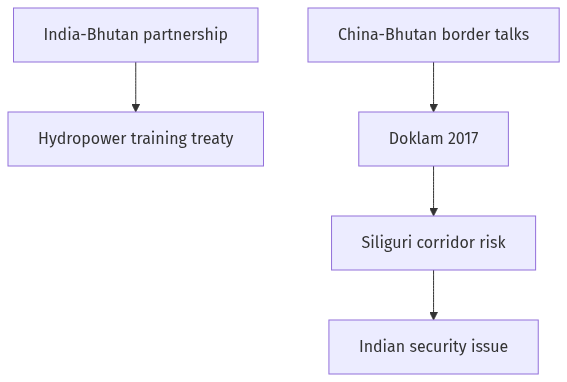
Bhutan is India’s closest Himalayan partner through treaty history, hydropower and military training. China–Bhutan boundary talks and Chinese construction at Doklam in 2017 made the trijunction an Indian military crisis. The Siliguri corridor and the LAC context turn Bhutan’s western sector into Indian strategic depth. Sakteng and possible China–Bhutan diplomatic normalisation add political pressure. India must back Bhutanese sovereignty without treating the trijunction as a purely bilateral China–Bhutan file.
Model answer
Copper italics in this answer — like this — are the key facts. Each one is unpacked in the Facts & figures rail.
Introduction
Bhutan has been India’s closest Himalayan partner: a friendship treaty, coordinated diplomacy, Indian military training, and hydropower as the economic spine. China–Bhutan border talks, and Chinese pressure on that boundary, have become a security issue for India because Bhutan’s northern and western frontiers sit on India’s strategic depth. The relationship remains an alliance in practice. The border file is no longer only Thimphu’s.
Body
Historical ally
The 1949 treaty, updated in 2007, ended the requirement that Bhutan be guided by India on external affairs, but the security partnership continued. India is the primary market for Bhutanese hydropower. The Indian Military Training Team still sits in Bhutan. For a small state between two giants, that bet on India has been the structure of survival.
Why the China border is India’s problem
China and Bhutan do not have formal diplomatic relations, yet they have held many rounds of boundary talks. Beijing’s claims in the western sector, near the trijunction with India, and occasional pressure in the east (including statements around Sakteng), matter because they rearrange the map above the Siliguri corridor — the narrow link between India’s northeast and the rest of the country. In 2017, Chinese road-building at Doklam on Bhutanese territory produced a 73-day stand-off with the Indian Army. Delhi treated an alteration of the trijunction as a direct threat, not as a bilateral China–Bhutan technicality.
A boundary ‘package’ that traded northern pastures for western territory could, in a worst case, bring Chinese presence closer to the ridge that overlooks the corridor. Even without a settlement, Chinese villages, roads and patrols along the disputed line create facts on ground that India must read as LAC-adjacent. Bhutan’s wish to settle with China and perhaps open diplomatic relations is rational for Thimphu. It is a two-front cartographic risk for Delhi already facing China on the Line of Actual Control.
Discuss, do not panic
India cannot veto Bhutanese diplomacy without looking like a patron and thereby pushing Thimphu to balance. The workable line is: support Bhutan’s sovereignty, keep hydropower and people-to-people density, and insist that trijunctions are trilateral in effect. Doklam showed that India will physically contest a change. The security issue is real. It is managed by partnership, not by treating Bhutan as a district.
Flow diagram
Conclusion
Bhutan remains India’s ally in the Himalaya. China–Bhutan border moves, especially at Doklam and toward the Siliguri approaches, are Indian security business because geography ties the three states. Delhi’s task is to keep the alliance by respecting Bhutanese agency while refusing unilateral change at the trijunction.
Quick related
Students also ask
-
What are the main drivers of India-Japan Strategic and Global Partnership?
Next question on this syllabus topic (2022 · Q7(a)). View answer →
-
Does Bhutan want to play China against India?
Thimphu wants a settled border and room to breathe. That is small-state rationality, not a camp switch. Indian delivery on hydropower and respect still decides the tilt.
-
Is this the same as the LAC?
It is adjacent, not identical. The LAC is India–China. Doklam is Bhutanese territory with Indian security externalities.
Same topic · past papers
UPSC has asked this before
These previous-year questions sit on the same topic. Open one to practise the earlier ask.
-
2026 · Q7(b) · PSIR GS 2 · 15 marks
The island of Kachchatheevu remains an intractable issue in India-Sri Lanka relations. Comment -
2025 · Q7(a) · PSIR GS 2 · 20 marks
India continues to invoke its time-tested policy of strategic autonomy vis-à-vis both the United States of America and Russia by rejecting US' offer of mediation on Kashmir issue and by refusing to criticize Russia in its ongoing war against Ukraine. Comment
More from this topic
Q5(e) · UPSC Mains 2025 · PSIR GS 2 · 10 marks · Solution
Historical ties between India and Japan grew into a 'special strategic and global partnership'. Comment.
India and the Global Centres of Power
India–Japan moved from post-war distance and aid to a Special Strategic and Global Partnership (2014 upgrade). Drivers are China’s rise, FOIP, quality infrastructure and technology. Pillars include the Quad, 2+2, a civil nuclear deal, the bullet-train project and semiconductor talk. Japan finances and manufactures without a U.S.-style treaty bill; India gives FOIP continental scale. Limits: trade deficit, Russia residue, and still-thin military integration.
Q4(a) · UPSC Mains 2024 · PSIR GS 2 · 20 marks · Solution
"The Gramscian theory of hegemony provides many valuable insights into the nature of global power." Comment.
India and the Global Centres of Power
Gramsci’s hegemony is leadership through consent in civil society, backed by coercion, organised in a historic bloc. Cox applied this to world order: Pax Americana as material power plus institutions and ideas. Insights: global power includes WTO rules, culture and elite consent, not only armies; resistance includes counter-hegemonic ideas. NATO and liberal order are hegemonic tools in this sense. Limits: still need Waltz on anarchy and Wallerstein on the world-economy; the term must not mean every cultural flow.
Q7(a) · UPSC Mains 2022 · PSIR GS 2 · 20 marks · Solution
What are the main drivers of India-Japan Strategic and Global Partnership?
India and the Global Centres of Power
China’s rise is the structural driver of India–Japan closeness. Abe’s FOIP and India’s Act East locked the Indo-Pacific frame. Japanese ODA, corridors, and the 2016 nuclear deal are economic drivers. The Quad and 2+2 are the security method, not NATO. Trade still lags the political headline, which is the partnership’s unfinished piece.