
Revision summary
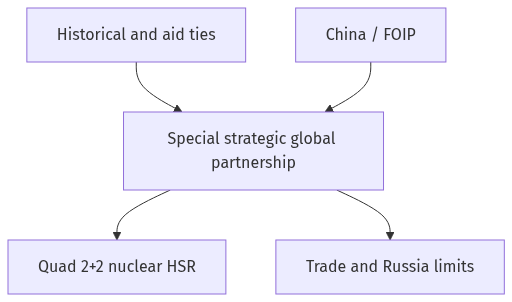
India–Japan moved from post-war distance and aid to a Special Strategic and Global Partnership (2014 upgrade). Drivers are China’s rise, FOIP, quality infrastructure and technology. Pillars include the Quad, 2+2, a civil nuclear deal, the bullet-train project and semiconductor talk. Japan finances and manufactures without a U.S.-style treaty bill; India gives FOIP continental scale. Limits: trade deficit, Russia residue, and still-thin military integration.
Model answer
Copper italics in this answer — like this — are the key facts. Each one is unpacked in the Facts & figures rail.
Introduction
India and Japan did not begin as brothers-in-arms. Post-1945 Japan was a U.S. ally with a peace constitution; India was a NAM republic that recognised the PRC early and tested nuclear weapons Japan hated. The climb to a Special Strategic and Global Partnership is therefore a historical achievement, not a cliché. It grew because China’s rise and a free and open Indo-Pacific gave both capitals the same map.
Body
Historical ties, then a turn
Buddhist and civilisational memory, the IJN’s wartime Indian links, and post-war Japanese aid (steel, autos, Metro) were the soft base. The political turn is twenty-first century: 2006 strategic partnership language, 2014 upgrade to special strategic and global partnership under Abe and Modi, a civil nuclear understanding, and annual summits. Shinzo Abe’s confluence of the two seas and later FOIP gave India a maritime vocabulary Japan already lived.
Why ‘special’
- Japan is India’s most serious quality infrastructure partner: Mumbai–Ahmedabad high-speed rail, metro systems, northeast roads. Defence has moved from taboo to 2+2, exercises, and talks on engines and electronics. Both sit in the Quad. Both want semiconductor and supply-chain hedges. Both distrust a Sino-centric Asia (Q5(c)). For India, Japan is the partner that can finance and manufacture without the political bill of a U.S. treaty. For Japan, India is the scale that makes FOIP more than a Japanese–American lake.
Limits
A large trade deficit, slow FTA ambition, India’s Russia oil and defence residue, and Japan’s still-tight export controls on some dual-use items keep the partnership below its press. Domestic politics in Tokyo can return to a China-market first instinct. The partnership is special in strategy and trust, not yet in the density of U.S.–Japan or even Australia–Japan military integration. That honesty keeps the 10-mark note from becoming a brochure.
Flow diagram
Conclusion
Historical regard became a special strategic and global partnership when China and the Indo-Pacific forced both states to need each other. The title is earned in infrastructure, Quad and nuclear trust. It is still being earned in trade and hard defence.
Quick related
Students also ask
-
"The Gramscian theory of hegemony provides many valuable insights into the nature of global power." Comment.
Next question on this syllabus topic (2024 · Q4(a)). View answer →
-
Is this an alliance?
No. It is a partnership with growing defence content. Neither side wants a NATO-like Article 5.
-
Why did nuclear Japan accept a deal with India?
Because China and energy business overrode the old NPT sermon, after India’s NSG waiver politics and Japan’s own strategic rethink.
Same topic · past papers
UPSC has asked this before
These previous-year questions sit on the same topic. Open one to practise the earlier ask.
-
2022 · Q7(a) · PSIR GS 2 · 20 marks
What are the main drivers of India-Japan Strategic and Global Partnership? -
2026 · Q6(c) · PSIR GS 2 · 15 marks
"The mother of all deals" is a transformative milestone in Indo-EU trade relations. Elaborate on the new Security and Defence partnership -
2025 · Q6(c) · PSIR GS 2 · 15 marks
The tariff threats have pushed India and the European Union closer. Evaluate the India-EU partnership
More from this topic
Q5(b) · UPSC Mains 2024 · PSIR GS 2 · 10 marks · Solution
Bhutan has historically been an ally of India, but the China-Bhutan border-related issues have become a security issue for India. Discuss.
India and the Global Centres of Power
Bhutan is India’s closest Himalayan partner through treaty history, hydropower and military training. China–Bhutan boundary talks and Chinese construction at Doklam in 2017 made the trijunction an Indian military crisis. The Siliguri corridor and the LAC context turn Bhutan’s western sector into Indian strategic depth. Sakteng and possible China–Bhutan diplomatic normalisation add political pressure. India must back Bhutanese sovereignty without treating the trijunction as a purely bilateral China–Bhutan file.
Q4(a) · UPSC Mains 2024 · PSIR GS 2 · 20 marks · Solution
"The Gramscian theory of hegemony provides many valuable insights into the nature of global power." Comment.
India and the Global Centres of Power
Gramsci’s hegemony is leadership through consent in civil society, backed by coercion, organised in a historic bloc. Cox applied this to world order: Pax Americana as material power plus institutions and ideas. Insights: global power includes WTO rules, culture and elite consent, not only armies; resistance includes counter-hegemonic ideas. NATO and liberal order are hegemonic tools in this sense. Limits: still need Waltz on anarchy and Wallerstein on the world-economy; the term must not mean every cultural flow.
Q7(a) · UPSC Mains 2022 · PSIR GS 2 · 20 marks · Solution
What are the main drivers of India-Japan Strategic and Global Partnership?
India and the Global Centres of Power
China’s rise is the structural driver of India–Japan closeness. Abe’s FOIP and India’s Act East locked the Indo-Pacific frame. Japanese ODA, corridors, and the 2016 nuclear deal are economic drivers. The Quad and 2+2 are the security method, not NATO. Trade still lags the political headline, which is the partnership’s unfinished piece.