
Revision summary
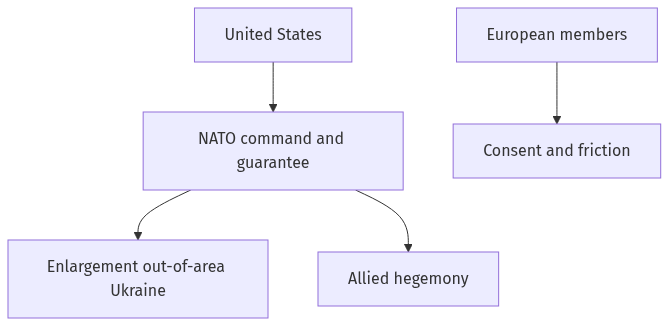
NATO has been U.S.-led since 1949 in guarantee, command and expeditionary capacity. Post-Cold War enlargement and out-of-area wars used the Alliance as a strategy tool beyond territorial defence of 1949. Ukraine policy and Nordic accession again centred Washington in European security. Gramscian consent and Ikenberry’s liberal hegemony explain why many Europeans want this hierarchy. Agree with the hegemony thesis; qualify it with allied demand and occasional European refusal.
Model answer
Copper italics in this answer — like this — are the key facts. Each one is unpacked in the Facts & figures rail.
Introduction
NATO was founded in 1949 as a transatlantic collective defence pact. From the start the United States supplied the nuclear guarantee, the command spine and much of the expeditionary capacity. The view that Washington still uses NATO as a traditional tool of strategy to perpetuate hegemony is largely convincing. The comment should add that hegemony here is allied hegemony, not rule without Europeans.
Body
Traditional tool
John Ikenberry described the U.S. order as a liberal hegemony that binds others through institutions. NATO is the security core of that order in Europe. Gramscian readings of hegemony, taken up in 4(a), would add that consent matters: European elites have wanted the U.S. presence as much as they have resented it. Morgenthau and Waltz would strip the moral language: an alliance is an instrument for aggregating power. For the United States, NATO multiplies bases, standardises militaries, and gives legal-political cover for operations far from the North Atlantic.
How it perpetuates primacy
After 1990 NATO did not dissolve. It enlarged into Central and Eastern Europe, which extended a U.S.-centred security system to Russia’s doorstep — the grievance Moscow names, and the choice many of those states made. Out-of-area war in Kosovo, Afghanistan, and the Libya campaign showed NATO as a toolbox for U.S. and allied strategy beyond Article 5 defence of Europe. The 2022–24 response to Russia’s war on Ukraine — intelligence, weapons standards, and a larger NATO that Finland and Sweden joined — again placed the United States at the centre of European security. Burden-sharing debates, including under President Trump, confirm the hierarchy: Europeans are asked to pay more inside an American-led structure, not to replace it.
Hegemony is visible in command (SACEUR as a U.S. officer), in nuclear sharing, and in the fact that a European ‘strategic autonomy’ remains a speech more than a substitute army.
Limits of the claim
- The United States does not always get its way: France’s early withdrawal from the integrated command, the Iraq 2003 split, German energy choices, and Turkish veto politics show allied friction. NATO is also a demand from the weak: Baltic and Central European states want U.S. hegemony as protection, not as a chain they secretly wish to break. Calling NATO only an American imposition misses that consent.
Still, as a traditional tool of U.S. strategy, the description holds. It is the durable military arm of Atlantic primacy. It is how Washington remains a European power. A unipolar moment without NATO would have been more expensive and less legitimate. That is hegemony in the ordinary IR sense.
Flow diagram
Conclusion
NATO remains the principal institutional tool through which the United States organises European security and projects power with allied cover. That is hegemony by consent of many members, not only by command. The view in the question is right as strategy. It is too simple if it erases European choice and intra-alliance bargaining.
Quick related
Students also ask
-
Discuss the implications of the scrapping of the Free Movement Regime with Myanmar by the Indian Government on the complex ethno-political dynamics of the north-eastern region.
Next question on this syllabus topic (2024 · Q8(b)). View answer →
-
Is NATO the same as U.S. hegemony everywhere?
No. It is the European-Atlantic tool. Asia uses hubs-and-spokes alliances and minilaterals such as the Quad.
-
Could Europe replace NATO?
Not on present budgets and nuclear facts. Strategic autonomy is a project, not a substitute Alliance.
Same topic · past papers
UPSC has asked this before
These previous-year questions sit on the same topic. Open one to practise the earlier ask.
-
2023 · Q4(c) · PSIR GS 2 · 15 marks
Discuss the various constraints on American hegemony today. Which of these are likely to become more prominent in the future? -
2024 · Q4(a) · PSIR GS 2 · 20 marks
"The Gramscian theory of hegemony provides many valuable insights into the nature of global power." Comment.
More from this topic
Q7(c) · UPSC Mains 2026 · PSIR GS 2 · 15 marks · Solution
India has adopted multi-alignment to fulfill its core values and interests in international relations. Discuss
Changing International Political Order
• Shifted from passive non-alignment to active multi-alignment to navigate a multipolar world. • Preserves strategic autonomy by building overlapping partnerships without joining exclusive blocs. • Drives economic security through diversified energy, trade corridors, and critical technologies. • Promotes a pluralistic, reformed global order rooted in civilizational independence. • Engages simultaneously in diverse platforms like the Quad, BRICS, SCO, and I2U2. • Balances major-power rivalries (US-China, Russia-West) while championing the Global South.
Q4(b) · UPSC Mains 2026 · PSIR GS 2 · 15 marks · Solution
How did the Council of Mutual Economic Assistance (CMEA) reflect geo-political division of the world during the cold war?
Changing International Political Order
The Council of Mutual Economic Assistance (CMEA), established in 1949, served as the Soviet bloc's institutional counterpart to the US-led Marshall Plan, institutionalizing the geo-political division of the global economy during the Cold War. It reflected bipolarity by binding Eastern European satellite states and extra-European socialist economies like Cuba and Vietnam into a centralized, Moscow-directed trade network. While intended to foster socialist internationalism and economic cooperation, it cemented the Eastern Bloc's separation from capitalist markets and reflected asymmetrical Soviet dominance. The organization ultimately highlighted the structural limitations of command economies and disintegrated alongside the Soviet collapse in 1991.
Q8(a) · UPSC Mains 2025 · PSIR GS 2 · 20 marks · Solution
India's reluctance to perceive any 'existential threat' inevitably made the multilateral path to nuclear security a 'default option' until it decided to cross nuclear Rubicon in 1998. Identify and analyze some of the major reasons behind this shift in India's position on the nuclear question
Changing International Political Order
India’s early nuclear path mixed scientific capacity with moral multilateralism and a recessed 1974 PNE. NPT hierarchy, NSG sanctions and CTBT’s closing window turned the default into a cage. China’s arsenal and Pakistan’s weapons-plus-proxy mix supplied the security case for 1998. Vajpayee’s government supplied the political will; status mixed with deterrence. 1998 was admission that survival could no longer be outsourced to a disarming great-power club.