
Revision summary
The FMR let border highland communities cross a short distance because Naga, Chin, Kuki and Mizo kin were split by the India–Myanmar line. Delhi’s restriction is driven by insurgent sanctuaries, narcotics, post-2021 refugees and Manipur’s 2023 conflict. Security gains are possible in counting and fencing. Ethno-political costs fall on hill kinship, humanitarian Chin-Kuki links and Naga cross-border society. A harder border can also empower illegal brokers if political settlement on both sides is absent.
Model answer
Copper italics in this answer — like this — are the key facts. Each one is unpacked in the Facts & figures rail.
Introduction
The Free Movement Regime (FMR) with Myanmar allowed hill communities to cross the border for a short distance without a full visa, because the boundary cuts Naga, Chin, Kuki, Mizo and related kin. The Indian government’s move to scrap or severely restrict that regime is a security decision with ethno-political costs in the northeast. Both sides of that ledger belong in the discussion.
Body
What the FMR was
Colonial and post-colonial borders split highland societies. The FMR, in its operational form, recognised that livelihood, marriage and markets do not stop at a pillar. It was a rare official admission that the northeast is a transnational ethnic space, not only a map of Indian districts.
Why Delhi moved against it
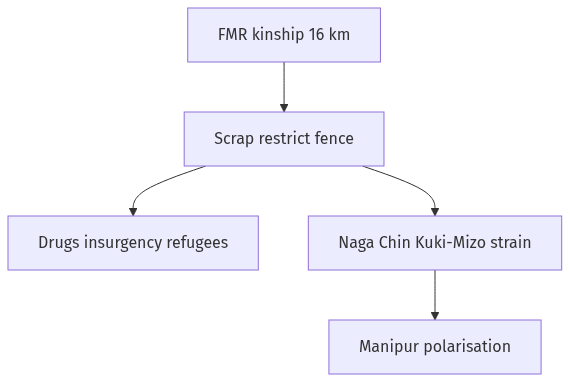
After the 2021 Myanmar coup, refugee inflows, arms, and narcotics routes thickened. Indian insurgent groups have long used Myanmar’s side as a rest area. The Manipur conflict from 2023, with its Kuki–Meitei polarisation and charges about illegal immigration and poppy, made an open 16-kilometre belt look, in New Delhi and in Imphal’s valley politics, like a security hole. The government paired FMR restriction with talk of fencing. From a classical state view, this is ordinary border modernisation: one regime, one document, one count.
Implications for ethno-political dynamics
For Mizo and Chin kinship, and for Kuki-Zo communities, the FMR was a humanitarian and cultural right, not a loophole. Closing it during a Myanmar civil war can be read as abandoning kin and as taking a side in Manipur’s demographic argument. That hardens ethnic mistrust toward Delhi and toward valley majorities. For Naga politics, cross-border Naga identity is already the sensitive core of ceasefire and integration talks; a harder border can cut insurgent logistics and also cut the social world that any political settlement must live in.
A fenced, visa-heavy border may reduce some armed and drug movement. It will not dissolve ethnic maps. It may push movement into illegal brokers, raising the power of those who sell crossings. It may worsen refugee suffering without ending insurgency, if the Myanmar junta and rival armed groups still hold the other side.
The northeast’s stability has always required both a hard state against guns and a political recognition of kinship. FMR scrap tilts toward the hard state. The ethno-political risk is that Delhi wins a map and loses consent in the hills.
Flow diagram
Conclusion
Restricting the FMR answers real problems of drugs, insurgency and post-coup inflows. It also cuts a recognised kinship belt and feeds Manipur’s demographic conflict. Implications are mixed: more border control, more hill alienation, and a test of whether northeast peace can survive a fully modern frontier.
Quick related
Students also ask
-
"During the Cold War, the Non-Aligned Movement tried to become a Third force in World Politics, but failed because it was too large and unwieldy." Discuss
Next question on this syllabus topic (2023 · Q3(a)). View answer →
-
Is fencing the northeast like fencing the west?
The west is a different ethnic and military story. In the east, fencing cuts societies that the Indian state itself has recognised as split nations.
-
Does ending FMR end insurgency?
It can raise the cost of casual crossing. It does not replace politics inside Naga talks or a policy toward Myanmar’s war.
Same topic · past papers
UPSC has asked this before
These previous-year questions sit on the same topic. Open one to practise the earlier ask.
-
2021 · Q2(c) · PSIR GS 2 · 15 marks
What is complex interdependence? Discuss the role of transnational actors in the international system
More from this topic
Q7(c) · UPSC Mains 2026 · PSIR GS 2 · 15 marks · Solution
India has adopted multi-alignment to fulfill its core values and interests in international relations. Discuss
Changing International Political Order
• Shifted from passive non-alignment to active multi-alignment to navigate a multipolar world. • Preserves strategic autonomy by building overlapping partnerships without joining exclusive blocs. • Drives economic security through diversified energy, trade corridors, and critical technologies. • Promotes a pluralistic, reformed global order rooted in civilizational independence. • Engages simultaneously in diverse platforms like the Quad, BRICS, SCO, and I2U2. • Balances major-power rivalries (US-China, Russia-West) while championing the Global South.
Q4(b) · UPSC Mains 2026 · PSIR GS 2 · 15 marks · Solution
How did the Council of Mutual Economic Assistance (CMEA) reflect geo-political division of the world during the cold war?
Changing International Political Order
The Council of Mutual Economic Assistance (CMEA), established in 1949, served as the Soviet bloc's institutional counterpart to the US-led Marshall Plan, institutionalizing the geo-political division of the global economy during the Cold War. It reflected bipolarity by binding Eastern European satellite states and extra-European socialist economies like Cuba and Vietnam into a centralized, Moscow-directed trade network. While intended to foster socialist internationalism and economic cooperation, it cemented the Eastern Bloc's separation from capitalist markets and reflected asymmetrical Soviet dominance. The organization ultimately highlighted the structural limitations of command economies and disintegrated alongside the Soviet collapse in 1991.
Q8(a) · UPSC Mains 2025 · PSIR GS 2 · 20 marks · Solution
India's reluctance to perceive any 'existential threat' inevitably made the multilateral path to nuclear security a 'default option' until it decided to cross nuclear Rubicon in 1998. Identify and analyze some of the major reasons behind this shift in India's position on the nuclear question
Changing International Political Order
India’s early nuclear path mixed scientific capacity with moral multilateralism and a recessed 1974 PNE. NPT hierarchy, NSG sanctions and CTBT’s closing window turned the default into a cage. China’s arsenal and Pakistan’s weapons-plus-proxy mix supplied the security case for 1998. Vajpayee’s government supplied the political will; status mixed with deterrence. 1998 was admission that survival could no longer be outsourced to a disarming great-power club.