
Revision summary
Post-1968 progress included the NPT bargain, INF and START/New START cuts, and chemical and biological bans. Russia’s war, INF collapse, frozen New START practice and China’s expansion reopen nuclear politics. Great powers taking sides in regional conflicts raise the value of nuclear hedges and missiles. Idealism’s institutions remain; Waltzian anarchy is again the loud fact. Jeopardised is accurate; total erasure of the non-proliferation majority is not yet true.
Model answer
Copper italics in this answer — like this — are the key facts. Each one is unpacked in the Facts & figures rail.
Introduction
- The decades after 1968 built a thin but real disarmament and arms-control architecture: the Nuclear Non-Proliferation Treaty, bilateral United States–Soviet and then United States–Russian cuts, and bans on chemical and biological weapons. The statement that a changing global order and regional wars with great powers taking sides have jeopardised that progress is largely right. The comment should say how, and how far.
Body
What progress existed
- The NPT created a bargain: non-nuclear-weapon states abstain; recognised weapon states pursue disarmament in good faith; civilian nuclear cooperation is allowed. The Intermediate-Range Nuclear Forces Treaty, START and New START cut and capped deployed strategic arms. The Chemical Weapons Convention and Biological Weapons Convention set legal floors. Nuclear-weapon-free zones and IAEA safeguards were the daily machinery. None of this abolished nuclear weapons. It slowed spread and reduced some inventories.
How the present jeopardises it
Great-power rivalry has returned as the organising fact. Russia’s war on Ukraine, discussed in 1(c), came with nuclear threats and a breakdown of cooperative verification. The INF Treaty collapsed earlier amid United States–Russia accusations. New START’s implementation has been frozen in political terms even when paper remains. China’s arsenal expansion sits outside the old bilateral frame. The United States, NATO allies and Russia treat nuclear weapons again as usable political currency, not as a residual Cold War stockpile.
Regional wars pull patrons in. Ukraine is a NATO-supported defence against a nuclear-armed invader. In West Asia, great-power alignment around Israel, Iran and armed groups raises the value of missiles and, for some states, of a nuclear hedge. The Korean peninsula and AUKUS nuclear-powered submarines show that proliferation and naval nuclearisation remain live. Export controls and sanctions replace inspections when trust dies. Waltz would say anarchy was always there. The idealist machinery of 1(d) needed a minimum of great-power concert that no longer exists.
Conventional arms racing, hypersonic missiles, and dual-use space and cyber tools further blur the old counting rules of warheads and bombers.
Comment
‘Jeopardised’ is the correct verb. Treaties are unravelling or unused. Disarmament Article VI of the NPT looks empty when weapon states modernise. The progress is not fully erased: most states remain non-nuclear; chemical weapons still carry stigma; the IAEA still inspects. A comment that says ‘disarmament is over’ is too neat. A comment that says the architecture is healthy is false. The 2020s are a backsliding decade for arms control, driven by revisionist war and by a order in which the United States, China and Russia do not share one security regime.
Flow diagram
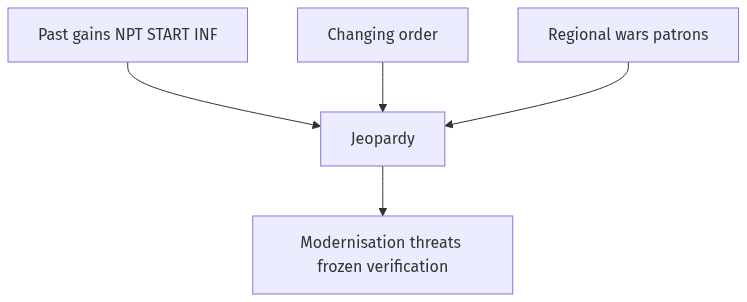
Conclusion
Past gains in non-proliferation and bilateral cuts depended on a workable great-power bargain. Sided regional wars and a contested order have broken that bargain. Disarmament is jeopardised. It is not yet a blank page, because the NPT membership and the stigma of some weapons still exist.
Quick related
Students also ask
-
Do you agree with the view that the USA uses NATO as a traditional tool of strategy to perpetuate its hegemony in the world?
Next question on this syllabus topic (2024 · Q3(c)). View answer →
-
Is AUKUS a proliferation problem?
It transfers naval nuclear propulsion to Australia under NPT interpretations that many non-nuclear states contest. It is part of the Indo-Pacific contest, not a new warhead state.
-
Did disarmament ever really happen?
Inventories fell from Cold War peaks, and testing norms held for a time. That is progress. It was never general and complete disarmament.
Same topic · past papers
UPSC has asked this before
These previous-year questions sit on the same topic. Open one to practise the earlier ask.
-
2025 · Q5(d) · PSIR GS 2 · 10 marks
Does the Non-Aligned Movement have any future in the wake of India's growing indifference towards it?
More from this topic
Q7(c) · UPSC Mains 2026 · PSIR GS 2 · 15 marks · Solution
India has adopted multi-alignment to fulfill its core values and interests in international relations. Discuss
Changing International Political Order
• Shifted from passive non-alignment to active multi-alignment to navigate a multipolar world. • Preserves strategic autonomy by building overlapping partnerships without joining exclusive blocs. • Drives economic security through diversified energy, trade corridors, and critical technologies. • Promotes a pluralistic, reformed global order rooted in civilizational independence. • Engages simultaneously in diverse platforms like the Quad, BRICS, SCO, and I2U2. • Balances major-power rivalries (US-China, Russia-West) while championing the Global South.
Q4(b) · UPSC Mains 2026 · PSIR GS 2 · 15 marks · Solution
How did the Council of Mutual Economic Assistance (CMEA) reflect geo-political division of the world during the cold war?
Changing International Political Order
The Council of Mutual Economic Assistance (CMEA), established in 1949, served as the Soviet bloc's institutional counterpart to the US-led Marshall Plan, institutionalizing the geo-political division of the global economy during the Cold War. It reflected bipolarity by binding Eastern European satellite states and extra-European socialist economies like Cuba and Vietnam into a centralized, Moscow-directed trade network. While intended to foster socialist internationalism and economic cooperation, it cemented the Eastern Bloc's separation from capitalist markets and reflected asymmetrical Soviet dominance. The organization ultimately highlighted the structural limitations of command economies and disintegrated alongside the Soviet collapse in 1991.
Q8(a) · UPSC Mains 2025 · PSIR GS 2 · 20 marks · Solution
India's reluctance to perceive any 'existential threat' inevitably made the multilateral path to nuclear security a 'default option' until it decided to cross nuclear Rubicon in 1998. Identify and analyze some of the major reasons behind this shift in India's position on the nuclear question
Changing International Political Order
India’s early nuclear path mixed scientific capacity with moral multilateralism and a recessed 1974 PNE. NPT hierarchy, NSG sanctions and CTBT’s closing window turned the default into a cage. China’s arsenal and Pakistan’s weapons-plus-proxy mix supplied the security case for 1998. Vajpayee’s government supplied the political will; status mixed with deterrence. 1998 was admission that survival could no longer be outsourced to a disarming great-power club.