
Revision summary
Parties can sustain developing democracies by aggregating conflict, training elites and making peaceful turnover possible. Huntington’s institutionalisation and India’s early Congress incorporation illustrate the positive case. Failures include family vehicles, ethnic census parties, clientelism and polarising attacks on referees. Existence of parties is not the same as a party system that can lose. Critical verdict: necessary organisations whose quality decides whether democracy thickens or hollows.
Model answer
Copper italics in this answer — like this — are the key facts. Each one is unpacked in the Facts & figures rail.
Introduction
In developing societies, political parties are often the main machine that turns a constitution into a living democracy. They recruit leaders, aggregate demands, fight elections and, in the best case, accept defeat. The question asks for a critical examination of that role in sustaining and stabilising democracy. The verdict is mixed: parties are necessary, and they are frequently the source of the instability they are asked to cure.
Body
How parties can stabilise
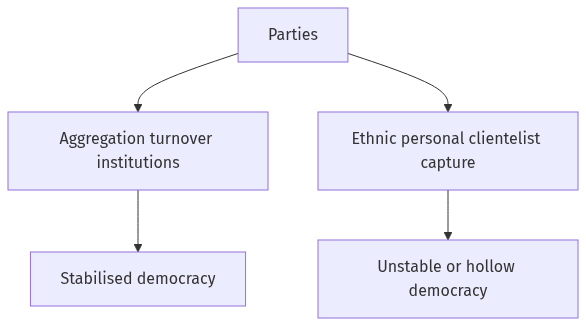
E. E. Schattschneider said democracy is unthinkable save in terms of parties. Samuel Huntington treated institutionalised parties as the difference between participation that strengthens order and participation that wrecks it. In a poor or post-colonial society, parties can: (1) aggregate language, caste, class and region into a bargain instead of a militia; (2) train a political class that knows how to run ministries; (3) offer peaceful turnover so that losers still have a future; (4) link the village to the capital through patronage that, at its least bad, is a form of incorporation. India’s Congress system in the early decades, whatever its later decay, did this incorporation. Later coalition years and a competitive national party system showed that democracy can survive without a single dominant party if parties still treat the Election Commission and the Constitution as binding.
Elsewhere, South Africa’s ANC after apartheid, Chile’s concertación years, and parts of Ghana and Senegal show parties as roofs over social conflict. Internationally, party internationals and election observation try to socialise that role.
Critical failures
Many developing democracies have parties that are not organisations. They are vehicles for a family, a business house or an ethnic census. Mainwaring and Scully’s work on institutionalisation is the standard warning: where labels change every election, voters cannot reward or punish a programme, and presidents rule through deals. Ethnic parties can mobilise turnout and also lock minorities out, turning democracy into a rotating capture of the state. Clientelism buys the poor at the cost of public goods. One-party dominance can freeze opposition until the street explodes. Military-tutelary systems keep parties as decoration.
Parties also polarise. When they treat opponents as enemies of the nation, they eat the referees — courts, election bodies, the press — which is the backsliding path known from Levitsky and Ziblatt. Developing societies with young institutions are more exposed to that path because alternative organisations (unions, professional bodies) are thinner.
Verdict
Parties sustain democracy when they are programmatic enough to be accountable and restrained enough to lose. They destabilise democracy when they are militias in party clothing or when they become the private property of a leader. The critical examination therefore refuses two cartoons: that parties are a Western luxury poor countries cannot afford, and that any party system is automatically a democratic good. Stabilisation is a quality of party institutionalisation, not of the mere existence of party names on a ballot.
Flow diagram
Conclusion
Political parties remain the ordinary instrument of democratic stability in developing societies: they aggregate, incorporate and allow defeat. They also organise ethnic capture, clientelism and executive assault on referees. The role is indispensable and double-edged. Institutionalised, bounded parties sustain democracy. Personal and ethnic machines consume it.
Quick related
Students also ask
-
Discuss the role of social movements in strengthening the democratic processes in developing societies
Next question on this syllabus topic (2022 · Q2(b)). View answer →
-
Do independent candidates make parties unnecessary?
Not at national scale. Legislatures and ministries need durable labels. Independents are a local supplement, not a system.
-
Are ethnic parties always anti-democratic?
They can represent excluded groups. They become a threat when they deny the opposition a permanent place in the state.
Same topic · past papers
UPSC has asked this before
These previous-year questions sit on the same topic. Open one to practise the earlier ask.
-
2025 · Q3(a) · PSIR GS 2 · 20 marks
Of late, centrist and centre-left political parties have been facing setbacks while centre-right parties have been in ascendency the world over. Comment -
2022 · Q2(b) · PSIR GS 2 · 15 marks
Discuss the role of social movements in strengthening the democratic processes in developing societies -
2021 · Q1(b) · PSIR GS 2 · 10 marks
"Political parties and pressure groups are sine qua non of democracy." Comment.
More from this topic
Q3(a) · UPSC Mains 2025 · PSIR GS 2 · 20 marks · Solution
Of late, centrist and centre-left political parties have been facing setbacks while centre-right parties have been in ascendency the world over. Comment
Politics of Representation and Participation
Many democracies since the late 2010s show centre-left and centrist losses and centre-right or radical-right gains. Drivers include migration, post-COVID inflation, culture war, housing and the split of the old working-class vote. Inglehart’s counter-revolution and Piketty’s Brahmin-left sketch help; they do not travel unchanged to India or Latin America. UK Labour 2024 and other cases are exceptions; not every right victory is fascism. The wave still shapes IR: tariffs, NATO, WHO and China policy.
Q1(d) · UPSC Mains 2025 · PSIR GS 2 · 10 marks · Solution
Discuss the political socialization of open and closed societies.
Politics of Representation and Participation
Political socialisation is the learning of political attitudes, skills and identities. Open societies use competing agents — family, school, parties, plural media — and allow doubt. Closed societies monopolise the story through party, clergy or police and punish dissent. Almond, Verba, Easton, Hyman and Popper supply the vocabulary; Iran, China and backsliding democracies are living cases. No regime is perfectly open or closed; smartphones and migration leak closed systems.
Q3(a) · UPSC Mains 2024 · PSIR GS 2 · 20 marks · Solution
Discuss the major recent social movements related to the physical rights of women in various countries of the world.
Politics of Representation and Participation
Physical rights of women concern safety, reproduction and control of the body in public. #MeToo, Ni Una Menos, India’s post-Nirbhaya protests, Argentina’s Green Tide, Poland’s abortion strikes and Iran’s Woman, Life, Freedom are major recent cases. Gains include legal reform and public naming of violence; losses include U.S. abortion rollback and repression in Iran. The wave is transnational in method and local in outcome. Counter-movements are part of the same comparative story.