
Revision summary
Many democracies since the late 2010s show centre-left and centrist losses and centre-right or radical-right gains. Drivers include migration, post-COVID inflation, culture war, housing and the split of the old working-class vote. Inglehart’s counter-revolution and Piketty’s Brahmin-left sketch help; they do not travel unchanged to India or Latin America. UK Labour 2024 and other cases are exceptions; not every right victory is fascism. The wave still shapes IR: tariffs, NATO, WHO and China policy.
Model answer
Copper italics in this answer — like this — are the key facts. Each one is unpacked in the Facts & figures rail.
Introduction
- Since the late 2010s, a comparative pattern has been hard to miss: centrist and centre-left parties have lost vote share or office in many industrial and some developing democracies, while centre-right and radical-right lists have risen. The pattern is not a law of history. It is a cluster of elections that asks for political-economy and cultural explanation together.
Body
The map
Italy’s Giorgia Meloni, the French right’s strength around Marine Le Pen even when the Élysée is held by a centrist, Germany’s AfD surge in the east, the Netherlands’ anti-migration turns, Javier Milei in Argentina, and Donald Trump’s return to the White House in 2025 are the headline cases. Social democrats who once owned the industrial working class now split that class with nativist lists. Third Way centrism after Clinton–Blair looks exhausted: it is blamed both for austerity and for cultural liberalism.
Drivers
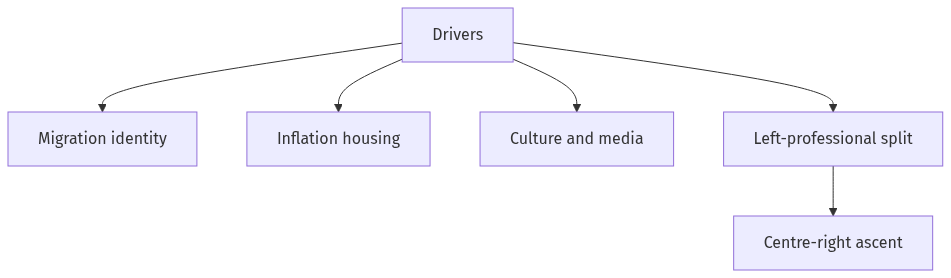
Migration and identity became first-order after 2015 in Europe and remain so. Inflation after COVID and the Ukraine war punished incumbents, many of them centre-left or technocratic. Housing and energy costs hurt median voters more than GDP charts. Culture-war issues — gender, religion, universities — let the right speak a moral language the professional left often concedes. Social media rewards anger. Democratic backsliding literature warns that some right victories then attack referees; not all do on day one.
Political science should not flatten this into “the masses failed the Enlightenment.” Ronald Inglehart’s silent revolution produced a silent counter-revolution. Thomas Piketty’s Brahmin-left versus merchant-right split in Western electorates is a useful sketch: educated professionals stayed left-liberal; many non-graduates moved right. In the Global South the same words map poorly: India’s BJP is a civilisational right with welfare delivery; Latin America’s pendulum still swings (Chile, Brazil, Mexico) rather than locking.
Exceptions and caution
The United Kingdom’s 2024 Labour landslide, periodic Nordic social-democratic holds, and urban-liberal majorities in several U.S. states are exceptions. Centre-left can still win when it owns competence on wages and public services and does not treat voters as a seminar. Centre-right ascent is also not identical to fascism: Christian democrats, Gaullists and India’s broad right are unlike interwar blackshirts. The danger is coalition gravity — mainstream right adopting radical-right frames on migration and press freedom.
For IR, the trend matters because it produces tariff nationalism, NATO burden-shifting, WHO scepticism and a harder line on China — the Trump shock to the EU in Q4(c). Comparative politics and international politics here are one story.
Flow diagram
Conclusion
Centre-left setbacks and centre-right ascent are a real, incomplete wave driven by migration, prices, culture and distrust of elites. Exceptions exist. The task is to explain the wave without baptising every conservative win as the end of democracy, and without ignoring the referees some of those wins then threaten.
Quick related
Students also ask
-
Discuss the major recent social movements related to the physical rights of women in various countries of the world.
Next question on this syllabus topic (2024 · Q3(a)). View answer →
-
Is this only a Western story?
The densest data are European and American. Latin America still pendulums. Several Asian democracies have their own conservative-national turns that are not copies of AfD.
-
Did the centre-left lose because of ‘woke’ politics?
Culture is one driver, not the only. Inflation, housing and migration management explain at least as much. A monocausal culture story is campaign rhetoric, not comparative politics.
Same topic · past papers
UPSC has asked this before
These previous-year questions sit on the same topic. Open one to practise the earlier ask.
More from this topic
Q1(d) · UPSC Mains 2025 · PSIR GS 2 · 10 marks · Solution
Discuss the political socialization of open and closed societies.
Politics of Representation and Participation
Political socialisation is the learning of political attitudes, skills and identities. Open societies use competing agents — family, school, parties, plural media — and allow doubt. Closed societies monopolise the story through party, clergy or police and punish dissent. Almond, Verba, Easton, Hyman and Popper supply the vocabulary; Iran, China and backsliding democracies are living cases. No regime is perfectly open or closed; smartphones and migration leak closed systems.
Q3(b) · UPSC Mains 2024 · PSIR GS 2 · 15 marks · Solution
Critically examine the role of political parties in sustaining and stabilising democracies in the developing societies.
Politics of Representation and Participation
Parties can sustain developing democracies by aggregating conflict, training elites and making peaceful turnover possible. Huntington’s institutionalisation and India’s early Congress incorporation illustrate the positive case. Failures include family vehicles, ethnic census parties, clientelism and polarising attacks on referees. Existence of parties is not the same as a party system that can lose. Critical verdict: necessary organisations whose quality decides whether democracy thickens or hollows.
Q3(a) · UPSC Mains 2024 · PSIR GS 2 · 20 marks · Solution
Discuss the major recent social movements related to the physical rights of women in various countries of the world.
Politics of Representation and Participation
Physical rights of women concern safety, reproduction and control of the body in public. #MeToo, Ni Una Menos, India’s post-Nirbhaya protests, Argentina’s Green Tide, Poland’s abortion strikes and Iran’s Woman, Life, Freedom are major recent cases. Gains include legal reform and public naming of violence; losses include U.S. abortion rollback and repression in Iran. The wave is transnational in method and local in outcome. Counter-movements are part of the same comparative story.