
Revision summary
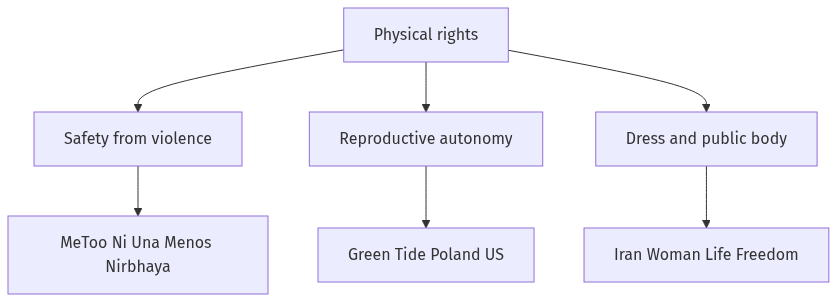
Physical rights of women concern safety, reproduction and control of the body in public. #MeToo, Ni Una Menos, India’s post-Nirbhaya protests, Argentina’s Green Tide, Poland’s abortion strikes and Iran’s Woman, Life, Freedom are major recent cases. Gains include legal reform and public naming of violence; losses include U.S. abortion rollback and repression in Iran. The wave is transnational in method and local in outcome. Counter-movements are part of the same comparative story.
Model answer
Copper italics in this answer — like this — are the key facts. Each one is unpacked in the Facts & figures rail.
Introduction
Physical rights of women are rights in the body: safety from sexual and domestic violence, control over reproduction, freedom from forced dress and genital harm, and the right to be in public without assault. Recent years have seen large social movements on these claims in several countries. They are not one organisation. They are a comparable wave.
Body
Violence and public safety
After the 2012 Nirbhaya case, Indian streets, campuses and later the legal debate on rape law showed a mass demand for bodily safety, still unfinished on marital rape and on conviction rates. #MeToo from 2017, beginning in the United States and travelling through media and workplaces in many countries, named sexual harassment as a public fact rather than a private shame. Ni Una Menos in Argentina and across Latin America made femicide a political crime, not a private tragedy. In South Africa and elsewhere, campus and township protests against rape repeated the same demand in a different social structure.
Reproductive body
The Green Tide in Argentina won a legal right to abortion in 2020 after years of street mobilisation, then influenced debate in parts of Latin America. Poland’s near-total abortion restriction produced mass women’s strikes. In the United States, the end of federal constitutional abortion protection in 2022 sent the fight back to states and to electoral politics, a reminder that movements can lose as well as win. These are physical-rights movements because they concern medical control of the female body.
Dress, morality police and theocratic control
In Iran, the death of Mahsa (Jina) Amini in 2022 and the Woman, Life, Freedom rising made hair, face and public presence a human-rights claim against compulsory hijab and the morality police. Related dissent over dress codes and guardianship appears in other West Asian settings. This is physical rights as the state’s hand on the body in the street.
What ‘major’ and ‘recent’ means for PSIR
- The comparative point is that bodily autonomy has become a transnational repertoire: hashtags, strikes, green or violet colours, and legal reform campaigns. Cynthia Enloe’s question ‘where are the women?’ is answered in the square, not only in the ministry. Success is uneven. Argentina’s legislative win, India’s partial criminal-law response, Iran’s unfinished revolt, and the U.S. judicial reversal are four endings, not one.
- Movements also meet counter-movements: religious conservatism, party polarisation, and online harassment. Physical rights are therefore not a completed global norm. They are a live comparative conflict inside both democracies and autocracies.
Flow diagram
Conclusion
Recent women’s movements on rape, femicide, abortion and compulsory modesty are movements about the body in public and in law. They have changed statutes and speech in some countries and have been reversed or crushed in others. Comparative politics should treat them as a wave of physical-rights claims, not as a single happy ending.
Quick related
Students also ask
-
Critically examine the role of political parties in sustaining and stabilising democracies in the developing societies.
Next question on this syllabus topic (2024 · Q3(b)). View answer →
-
Are these only Western movements?
No. Latin America, India and Iran are central. The methods travel; the legal targets differ.
-
Is reservation in legislatures a physical right?
It is a political right. This question is about the body. The two fights often support each other but are not the same demand.
Same topic · past papers
UPSC has asked this before
These previous-year questions sit on the same topic. Open one to practise the earlier ask.
-
2022 · Q2(b) · PSIR GS 2 · 15 marks
Discuss the role of social movements in strengthening the democratic processes in developing societies
More from this topic
Q3(a) · UPSC Mains 2025 · PSIR GS 2 · 20 marks · Solution
Of late, centrist and centre-left political parties have been facing setbacks while centre-right parties have been in ascendency the world over. Comment
Politics of Representation and Participation
Many democracies since the late 2010s show centre-left and centrist losses and centre-right or radical-right gains. Drivers include migration, post-COVID inflation, culture war, housing and the split of the old working-class vote. Inglehart’s counter-revolution and Piketty’s Brahmin-left sketch help; they do not travel unchanged to India or Latin America. UK Labour 2024 and other cases are exceptions; not every right victory is fascism. The wave still shapes IR: tariffs, NATO, WHO and China policy.
Q1(d) · UPSC Mains 2025 · PSIR GS 2 · 10 marks · Solution
Discuss the political socialization of open and closed societies.
Politics of Representation and Participation
Political socialisation is the learning of political attitudes, skills and identities. Open societies use competing agents — family, school, parties, plural media — and allow doubt. Closed societies monopolise the story through party, clergy or police and punish dissent. Almond, Verba, Easton, Hyman and Popper supply the vocabulary; Iran, China and backsliding democracies are living cases. No regime is perfectly open or closed; smartphones and migration leak closed systems.
Q3(b) · UPSC Mains 2024 · PSIR GS 2 · 15 marks · Solution
Critically examine the role of political parties in sustaining and stabilising democracies in the developing societies.
Politics of Representation and Participation
Parties can sustain developing democracies by aggregating conflict, training elites and making peaceful turnover possible. Huntington’s institutionalisation and India’s early Congress incorporation illustrate the positive case. Failures include family vehicles, ethnic census parties, clientelism and polarising attacks on referees. Existence of parties is not the same as a party system that can lose. Critical verdict: necessary organisations whose quality decides whether democracy thickens or hollows.