
Revision summary
India and South Africa asked for a wide TRIPS waiver on COVID health products. The 2022 Ministerial Decision was a limited, conditional easing for vaccines. Tests and treatments were not given the same treatment. Technology transfer, not only law, remained the production bottleneck. The outcome was a compromise that preserved TRIPS more than it waived it.
Model answer
Copper italics in this answer — like this — are the key facts. Each one is unpacked in the Facts & figures rail.
Introduction
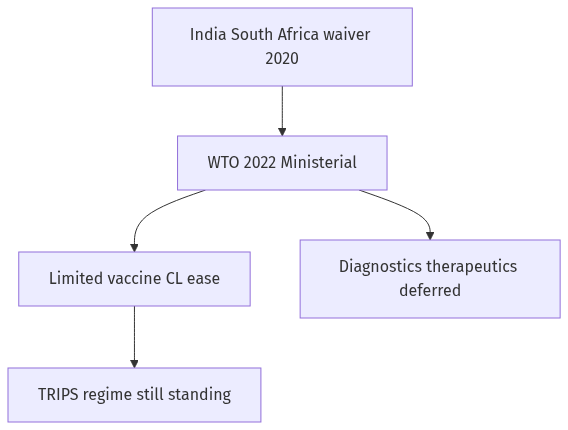
India and South Africa proposed a broad TRIPS waiver in 2020 so that patents would not block COVID-19 vaccines, diagnostics, and therapeutics. The June 2022 Ministerial Decision was a narrower, time-bound compromise. It was not the waiver as drafted.
Body
What a TRIPS waiver would have been
- A waiver would have suspended specified TRIPS obligations for a set of COVID products so that more producers could copy and export without each patent-holder’s permission.
- Developing-country demand was for speed, coverage of vaccines plus treatments and tests, and simple eligibility.
What the 2022 decision was
- Members authorised a limited easing of compulsory-licensing rules for COVID-19 vaccines, with conditions on eligible members, duration, and notification.
- Diagnostics and therapeutics were left for later discussion, not covered in the same way.
- Legal complexity remained. Many manufacturers still needed technology transfer, not only a legal permission.
- Export and eligibility clauses were tighter than the India–South Africa text.
Comment
- Keohane’s regime view fits: the WTO produced a bargain that kept the TRIPS regime standing rather than opening a hole in it.
- Cox’s view also fits: intellectual-property order serving research firms in the core was protected while a public-health emergency was met with a minimum deal.
- India could still use existing TRIPS flexibilities and its own vaccine production. The political point is that the club did not rewrite IP for the South.
- Calling the outcome a waiver in headlines was inaccurate. It was a compromise that left TRIPS largely intact.
Flow diagram
Conclusion
The COVID-19 vaccine decision at the WTO eased some compulsory-licensing steps for vaccines. It was not the broad TRIPS waiver India and South Africa sought. The regime survived the pandemic with a narrow carve-out.
Quick related
Students also ask
-
What are the challenges and limitations in India - Iran relations?
Next question on this syllabus topic (2023 · Q7(c)). View answer →
-
Did India stop making vaccines because there was no waiver?
No. Indian firms produced large volumes under other arrangements. The waiver fight was about global legal space and later products, not about a total stop in Pune or Hyderabad.
-
Why do writers still say waiver?
Political branding. The legal text is a limited decision on vaccine compulsory licensing, not a general TRIPS holiday.
Same topic · past papers
UPSC has asked this before
These previous-year questions sit on the same topic. Open one to practise the earlier ask.
-
2021 · Q5(c) · PSIR GS 2 · 10 marks
Explain India's position on the waiver of intellectual property rights on COVID-19 vaccines in WTO.
More from this topic
Q7(a) · UPSC Mains 2026 · PSIR GS 2 · 20 marks · Solution
How does illegal cross border migration pose challenges to India's security? Discuss the steps taken by the government in this direction and their effectiveness
Comparative Politics
Illegal cross-border migration undermines India's national security by altering demographic balances, straining economic resources, and exacerbating internal security vulnerabilities. The government has responded through border fencing, technological integration like SMART fencing, institutional mechanisms, and bilateral agreements. However, porous terrain, regional political complexities, and local connivance limit the complete effectiveness of these measures. A holistic approach combining strict border management with socio-economic development and robust legal frameworks is essential for sustainable containment.
Q5(d) · UPSC Mains 2026 · PSIR GS 2 · 10 marks · Solution
Discuss the main features of the land-boundary agreement between India and Bangladesh.
Comparative Politics
• Operationalized via the 100th Constitutional Amendment Act of 2015 to resolve Radcliffe Line anomalies. • Rooted in the unratified 1974 bilateral agreement and the 2011 additional protocol. • Involved the peaceful exchange of 111 Indian enclaves in Bangladesh and 51 Bangladeshi enclaves in India. • Granted affected residents the sovereign right to choose their nationality and place of residence. • Demarcated roughly 6.1 km of previously un-demarcated land boundaries to end administrative confusion. • Secured human rights and welfare access for over 50,000 formerly stateless enclave residents. • Reduced bilateral trust deficits, paving the way for deeper cooperation in security and connectivity.
Q4(c) · UPSC Mains 2026 · PSIR GS 2 · 15 marks · Solution
What is UNCLOS? Explain its salient features
Comparative Politics
UNCLOS, established in 1982, serves as the constitution of the oceans, codifying customary international law regarding maritime jurisdictions. Its salient features include distinct maritime zones ranging from territorial waters to the high seas, balancing coastal state sovereignty with freedom of navigation. It establishes compulsory dispute settlement mechanisms through institutions like ITLOS. The convention also mandates environmental protection and sustainable management of marine resources. For India, UNCLOS provides a rules-based order in the Indo-Pacific while respecting navigational rights. It remains central to addressing contemporary maritime security and resource challenges.