
Revision summary
Both theories are structural realisms under anarchy. Defensive realism, with Waltz, treats moderate power and balancing as rational. Offensive realism, with Mearsheimer, treats the search for regional hegemony as rational for great powers. The security dilemma is shared; the predicted amount of expansion is not. Institutions are secondary in both, unlike in Keohane.
Model answer
Copper italics in this answer — like this — are the key facts. Each one is unpacked in the Facts & figures rail.
Introduction
Offensive and defensive realism are both structural realist theories. They start from anarchy, self-help, and relative power. They disagree on how much power a State should seek and on whether expansion is the rational path to security.
Body
Shared ground
- Both follow Kenneth Waltz’s third-image start: the international system is anarchic. There is no world government.
- Survival is the first goal. Intentions of others are uncertain. Capabilities matter more than speeches.
- The security dilemma, developed by John Herz and Robert Jervis, is the shared mechanism: steps that one State takes to be safe can look like threats to another.
Defensive realism
- Waltz’s Theory of International Politics is the main defensive text. States seek enough power to be secure, not maximum power.
- Excess power triggers balancing. Conquest is often self-defeating because of nationalism, nuclear weapons, and the costs of occupation.
- Stephen Walt’s balance-of-threat and Jervis’s offence-defence balance sit in this family: moderation can be rational.
- Stability is more likely when defence is easy and when great powers accept a balance.
Offensive realism
- John Mearsheimer’s The Tragedy of Great Power Politics holds that great powers seek regional hegemony and as much power as they can get, because only hegemony ends the survival problem.
- The structure creates revisionist behaviour even among status-quo-minded leaders. Buck-passing and war are expected tools.
- Offshore balancers, in this view, try to stop a peer hegemon in another region, which is how Mearsheimer reads United States policy toward potential Asian hegemons.
Distinction that matters
- Defensive realism predicts more restraint and more balancing against expansion. Offensive realism predicts more expansion and more tragedy.
- Neither is Keohane’s institutionalism. Institutions, for both realisms, are thin. For Keohane they can still shape cheating and information.
- India’s nuclear and Quad choices can be read in both frames: minimum deterrence looks defensive; concern to prevent Chinese regional hegemony looks closer to Mearsheimer’s problem.
Flow diagram
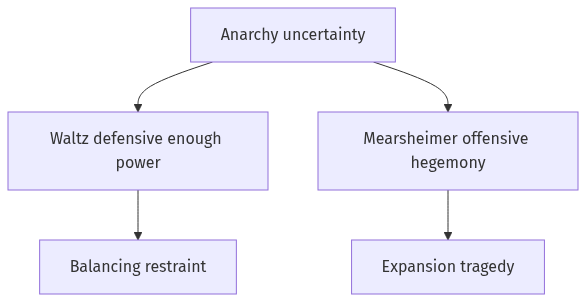
Conclusion
Defensive realism says States should seek security, not domination, because the system punishes greedy expansion. Offensive realism says the same system forces great powers to seek hegemony. The distinction is about rational strategy under anarchy, not about whether power politics exists.
Quick related
Students also ask
-
Why is the compromise reached at WTO regarding the Covid-19 vaccine manufacturing not a Trade Related Intellectual Property Rights (TRIPS) waiver?
Next question on this syllabus topic (2023 · Q5(c)). View answer →
-
Is offensive realism a moral claim that States should attack?
No. It is a predictive claim about what great powers tend to do under anarchy. It is not a moral instruction.
-
Does nuclear weapons decide the debate?
Defensive realists say nuclear weapons make conquest harder and restraint more rational. Offensive realists still expect competition below the nuclear threshold.
Same topic · past papers
UPSC has asked this before
These previous-year questions sit on the same topic. Open one to practise the earlier ask.
-
2026 · Q1(e) · PSIR GS 2 · 10 marks
What role does identity and technology play in the conceptualisation of Defensive realism?
More from this topic
Q7(a) · UPSC Mains 2026 · PSIR GS 2 · 20 marks · Solution
How does illegal cross border migration pose challenges to India's security? Discuss the steps taken by the government in this direction and their effectiveness
Comparative Politics
Illegal cross-border migration undermines India's national security by altering demographic balances, straining economic resources, and exacerbating internal security vulnerabilities. The government has responded through border fencing, technological integration like SMART fencing, institutional mechanisms, and bilateral agreements. However, porous terrain, regional political complexities, and local connivance limit the complete effectiveness of these measures. A holistic approach combining strict border management with socio-economic development and robust legal frameworks is essential for sustainable containment.
Q5(d) · UPSC Mains 2026 · PSIR GS 2 · 10 marks · Solution
Discuss the main features of the land-boundary agreement between India and Bangladesh.
Comparative Politics
• Operationalized via the 100th Constitutional Amendment Act of 2015 to resolve Radcliffe Line anomalies. • Rooted in the unratified 1974 bilateral agreement and the 2011 additional protocol. • Involved the peaceful exchange of 111 Indian enclaves in Bangladesh and 51 Bangladeshi enclaves in India. • Granted affected residents the sovereign right to choose their nationality and place of residence. • Demarcated roughly 6.1 km of previously un-demarcated land boundaries to end administrative confusion. • Secured human rights and welfare access for over 50,000 formerly stateless enclave residents. • Reduced bilateral trust deficits, paving the way for deeper cooperation in security and connectivity.
Q4(c) · UPSC Mains 2026 · PSIR GS 2 · 15 marks · Solution
What is UNCLOS? Explain its salient features
Comparative Politics
UNCLOS, established in 1982, serves as the constitution of the oceans, codifying customary international law regarding maritime jurisdictions. Its salient features include distinct maritime zones ranging from territorial waters to the high seas, balancing coastal state sovereignty with freedom of navigation. It establishes compulsory dispute settlement mechanisms through institutions like ITLOS. The convention also mandates environmental protection and sustainable management of marine resources. For India, UNCLOS provides a rules-based order in the Indo-Pacific while respecting navigational rights. It remains central to addressing contemporary maritime security and resource challenges.