
Revision summary
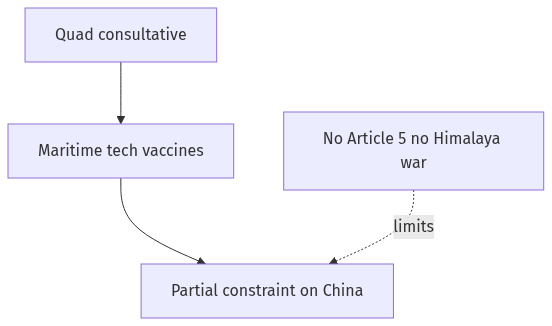
The Quad is Australia, India, Japan, and the United States in a non-treaty Indo-Pacific format. It can help at sea, in technology, and in public goods such as vaccines. It cannot run a land war on the India–China border or replace ASEAN. Members’ other ties, including India’s Russia file, cap militarisation. It is a balancing layer, not a complete counter to China in Asia.
Model answer
Copper italics in this answer — like this — are the key facts. Each one is unpacked in the Facts & figures rail.
Introduction
The Quad is a consultative grouping of Australia, India, Japan, and the United States. It aims at a free and open Indo-Pacific. It can constrain Chinese power in some maritime and technology fields. It is not a NATO for Asia and cannot “counter” China in every domain.
Body
What the Quad is
- It began in the 2004 tsunami core and 2007 security talk, lapsed, and returned in the late 2010s as China’s South China Sea, Belt and Road, and border behaviour hardened.
- Leaders’ summits, working groups on vaccines, climate, critical minerals, and maritime domain awareness are the method.
- Malabar exercises overlap in membership but are not identical to the Quad as a legal organ. There is no Article 5.
Where it can counter
- Naval presence, information sharing, and quality infrastructure offers can raise the cost of Chinese maritime coercion in the Indian Ocean and Western Pacific.
- Technology and supply-chain work can reduce exclusive dependence on Chinese manufacturing in some sectors.
- For Mearsheimer, this is balancing against a potential Asian hegemon. For Waltz, it is a loose coalition whose cohesion is not guaranteed.
- India’s participation signals that Asia’s balancing is not only a US–Japan–Australia line.
Where it cannot
- It does not fight a land war for India on the Himalaya. The 2020 Ladakh crisis was an India–China military problem first.
- ASEAN States reject a NATO copy. Several depend on China for trade.
- Members differ: India will not become a treaty ally; it still buys Russian energy and speaks NAM language.
- Keohane’s point applies: without a dense alliance contract, cooperation is issue-based and reversible.
How far
- The Quad is a partial maritime and techno-political counter, not a full-spectrum counter to China in Asia.
- It works best as one layer with bilateral US alliances, AUKUS, European presence, and each member’s national military.
Flow diagram
Conclusion
The Quad can complicate Chinese maritime and technology dominance and can reassure some partners. It cannot substitute for Indian land power, ASEAN consent, or a treaty army. Countering China in Asia remains a set of overlapping tools, of which the Quad is one.
Quick related
Students also ask
-
Discuss the role of public diplomacy in the enhancement of India's global standing.
Next question on this syllabus topic (2022 · Q5(e)). View answer →
-
Is the Quad an alliance against China?
Officials deny it is a NATO. China treats it as a containment tool. The accurate middle is a balancing coalition without a mutual-defence clause.
-
Does India lose autonomy in the Quad?
India sets red lines on treaties and on extra-regional wars. Autonomy is reduced only if New Delhi cannot say no on a given issue.
Same topic · past papers
UPSC has asked this before
These previous-year questions sit on the same topic. Open one to practise the earlier ask.
-
2024 · Q5(e) · PSIR GS 2 · 10 marks
Despite deep ties, India's relations with Sri Lanka have seen strains due to China's growing influence in Sri Lanka through investments and economic dominance. Analyse. -
2026 · Q4(a) · PSIR GS 2 · 20 marks
QUAD requires more robust architecture than the summit driven mode to tide over the current challenges. Elaborate -
2023 · Q8(b) · PSIR GS 2 · 15 marks
Discuss the significance of "West Asia Quad" in the light of India's 'Look West' policy -
2021 · Q5(d) · PSIR GS 2 · 10 marks
Write about the growing significance of QUAD.
More from this topic
Q5(a) · UPSC Mains 2026 · PSIR GS 2 · 10 marks · Solution
Describe India's objections to agricultural negotiations at the World Trade Organisation.
India’s Contribution to the Non-Alignment Movement
India's objections at WTO agricultural negotiations stem from protecting livelihood security for over 800 million rural citizens against subsidized Western agricultural exports. Key sticking points include the Peace Clause ambiguity regarding public stockholding for food security, lack of permanent solutions for domestic support limits, and safeguarding Special Safeguard Mechanisms against import surges. India balances defensive multilateral interests in plurilateral trade forums while championing Global South coalitions like the G-33. The strategy prioritizes food sovereignty over unfettered market access in developing country agriculture.
Q8(c) · UPSC Mains 2025 · PSIR GS 2 · 15 marks · Solution
Discuss the potential role India can play in initiating a possible phase of trilateral economic engagement among India, China and Nepal
India’s Contribution to the Non-Alignment Movement
Map-logic supports India–China–Nepal talks on hydropower, trade, tourism and Himalayan disasters. The trust deficit is structural: LAC after Galwan, BRI in Nepal, and Kalapani–Lipulekh map fights. Nepal will omni-enmesh; Delhi cannot veto that without pushing Kathmandu further toward Beijing. India’s realistic role is initiator of thin technical engagement, not chair of a Himalayan concert. Grade potential as moderate and politically capped — the same honesty used for Latin American regionalism.
Q6(a) · UPSC Mains 2025 · PSIR GS 2 · 20 marks · Solution
Critically analyze the different phases of India's foreign policy since independence. How justified, do you think, is S. Jaishankar's classification of the current phase as the phase of 'energetic diplomacy'? 15+5=
India’s Contribution to the Non-Alignment Movement
Phases: Nehruvian NAM, post-1962/1971 realism, 1991 economic opening, 1998 nuclear break, U.S. civil nuclear bargain, then Modi-era multi-alignment. The core across phases is strategic autonomy, not a simple Nehru-to-neoliberal conversion. Jaishankar’s energetic diplomacy fairly describes tempo: G20, minilaterals, argumentative Global South voice. It is weaker as a claim of structural success: LAC, Bangladesh and industrial depth still bind. Treat ‘energetic’ as method, not as a new telos.